A patio pond is a small water garden installed in a container on a patio or in a courtyard. A few plants, a reflective surface and a well-chosen location are enough to change the atmosphere of the place. Its appeal lies in this proximity: you can observe the leaves, flowers and insects from where you sit every day.
It does not necessarily require digging or adding fish. To start, a planted arrangement remains a simple option. The project should nevertheless be prepared: weight, exposure, volume and the needs of the plants determine its success much more than the number of accessories.

Finding its place on the patio
Start with existing uses. Where do you pull out the chairs? Which path do you use with a tray or a watering can? The pond must remain visible without occupying an essential walkway. An arrangement placed right next to a bench can be more pleasant than a large tub in the middle of the space.
Also observe the view from inside. In winter or on rainy days, the patio pond continues to be part of the decor through a window. Its container and the silhouettes of the plants then count as much as the summer flowers.
Keep an accessible work area on at least one side. You will need to reach the baskets, remove leaves and check the level. A corner completely filled with pots quickly becomes difficult to maintain, even if the arrangement looks attractive on the first day.
Choosing the container for its function and style
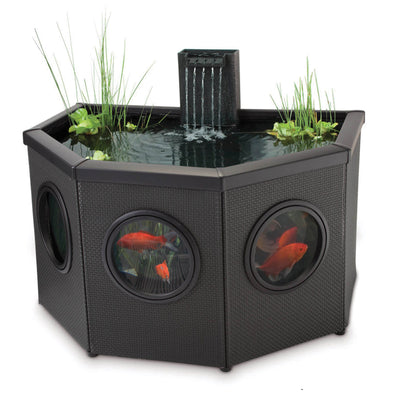
A round shape softens a very geometric patio. A rectangular tub can follow a low wall or delimit a space without multiplying curves. A container with windows highlights what is happening underwater more. First choose a shape compatible with the space, then look at the materials and equipment.
The container must durably support the water and outdoor conditions. An unsuitable terracotta pot can be porous or suffer from frost. A metal container requires compatibility with aquatic use. Old tanks that have contained chemicals should be ruled out.
A preformed pond to be buried is not necessarily self-supporting. Check this point before installing it freely on slabs. For a solution designed to stay above ground, the Half Moon Mocha is a reference in the catalog to examine, with its instructions and the exact contents of the version offered.
Check the weight before filling
The weight of water is easy to underestimate. One hundred liters represent about one hundred kilograms; you must also add the tub, the baskets, the supports and the stones. An abundant mineral decor can significantly increase the load while reducing the useful volume.
On a ground patio, prepare a stable and level support according to the container's specifications. On a raised patio, a roof or a balcony, have the structure checked by a competent person. The load is not limited to an average weight calculated over the entire patio: the supports and the location are important.
The pond must be installed in its final place before filling. Do not use casters or a mobile support without explicit validation for the load and this use. A filled water garden is treated as heavy equipment.
Composing with three visual elements
For a first patio pond, think of three elements: a plant that gives height, a lower plant near the surface and an open water area. The latter really counts. It welcomes reflections and prevents the container from quickly looking like a saturated planter.
Place the tall plants at the back if the pond is observed from one side. If you walk around it, offset the main clump instead to preserve several viewpoints. Draw the composition with the adult dimensions, not just with those of the pots.
Water lilies may suit certain containers, provided you choose a truly compact cultivar compatible with the depth. The word "water lily" alone is not enough: a vigorous variety can cover a mini-pond far too quickly.
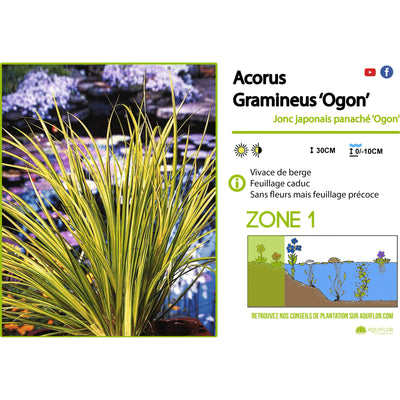
Luminous foliage: Acorus gramineus ‘Ogon’

The Acorus gramineus ‘Ogon’ is a lead to give structure without choosing a large marsh plant. Its place is in a damp area adapted to its needs, not at the bottom of the container under a significant height of water.
The marsh forget-me-not can complete the composition in a shallow depth. If you choose water mint instead, plan an accessible container to control its spread. These species are not automatically placed at the same level.
Use baskets and stable supports to achieve the correct immersion. A different basket height changes the depth at the base. Take the measurements once the water level is stabilized, then adjust without putting the plant under stress.
Calm water or small movement?
A planted patio pond can be designed with calm water. If you are mainly looking for the sound, a small fountain adapted to the volume can be considered. The effect must remain proportional: a jet that is too high splashes water on the slabs and forces frequent refilling.
The pump is chosen according to the effect, the drop and the accessories used. Its presence does not automatically constitute complete biological filtration. If the container welcomes fish, their treatment and oxygenation needs require a separate study.
Electricity must be planned before filling, with equipment intended for this environment. Follow the instructions for the pump, its power supply and the connections. Extension cords or power strips left near a damp area are not a durable installation solution.
Making room for small wildlife
Even a reduced water point can interest insects. For animals that reach the tub from the ground, a smooth and high wall is however an obstacle. Provide a stable exit from the water and an external access when the project also aims at terrestrial wildlife.
A rough ramp must remain functional when the level drops. Check that it does not tip over and that it does not create a drainage path out of the container. The stones serving as support must be stable and compatible with the tub.
Let the colonization happen naturally. Do not add animals or water taken from another pond to speed things up: this can transport unwanted organisms and diseases. A planted patio pond is already alive without buying fish.
Planning a light and regular routine
A short frequent observation allows you to see a drop in level, a plant that is coming loose or leaves that are accumulating. Remove accessible waste, check the circulation if a pump is running and clean the parts according to their instructions.
In summer, monitor overheating and evaporation. Partial shade can be useful depending on the plants and exposure. Top up with suitable water without causing a sudden change, especially if animals are present. Rain does not guarantee that the level and the quality of the water will always remain correct.
In autumn, avoid the accumulation of leaves. Before winter, check the instructions of the container and the equipment. A hardy plant installed in wet ground does not undergo exactly the same conditions in a small pot out of the ground exposed to frost.
The project to prepare before buying
Note the available dimensions, the type of support, the hours of sun and the desired plants. Decide if you simply want a water garden or a system with movement and equipment. This list reduces the risk of buying a container that is too small or a plant that is too vigorous.
Send a photo of your patio and these few measurements to support@aquiflor.com. You will be able to choose a patio pond that is pleasant to look at and accessible enough to remain simple to maintain over the seasons.
Our guides on this subject
- 15 patio pond ideas to find your style
- Patio pond in 30 minutes: is it realistic?
- Floating light balls for ponds: the guide
- How to create a mini natural pond without digging?
- Planted mini-pond in winter: protecting it from frost
- Small above-ground pond: choice and installation
- Can you install a pond on a balcony?
- Can you put fish in a mini-pond?
- Protecting a patio pond and its medakas in winter
- Which plants to choose for a patio pond?
On related topics: