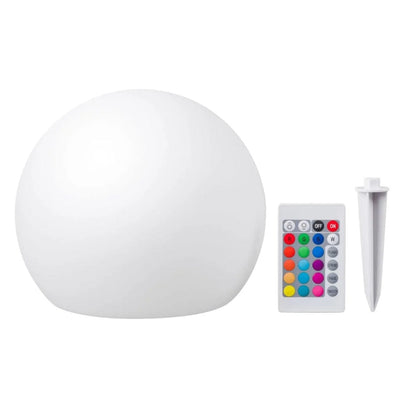
A floating light ball transforms a pond as soon as dusk falls: its reflection moves with the water and creates a soft point of light near the patio. For a good result, choose a model specifically designed to float, then decide from the outset on its power source (solar or transformer), its location, and how to turn it off.
Not all decorative spheres are lights, and not all outdoor lamps can be placed on the water. Between two real floating balls, the difference in use comes mainly from the power source, much more than from the shape.

Start with the place from where you will look at the pond
Look at the pond from the garden lounge and from the house. A superb ball in the center of the water can disappear behind a clump of plants seen from another angle: think about the line of sight and the free water surface.
Read also:
- Winter planted mini-pond: protect from frost
- Small above-ground garden pond: choice, installation and maintenance
Take into account the wind and the current. A floating object does not stay quietly where you put it: it drifts towards the bank, between the plants, or towards the suction of a skimmer. Use only the anchor points provided by the manufacturer and make sure that the lamp never interferes with a suction.
Solar or connected to a transformer?
| Version | Practical advantage | Check before purchase |
|---|---|---|
| Solar ball | No cable to the ball in normal use | Panel sunlight, control, variable autonomy |
| Transformer balls | Operation less dependent on the sun during the day | Cable routing, transformer location, connection |
| Set of several balls | Several points of light in the same system | Distances between the balls, exact contents of the set |
A solar version is appealing when you want to see few cables, but it must capture enough light to recharge. A ball that remains in the shade of a large leaf or a tree will not have the same autonomy as a ball in full sun. With a wired system, integrate the installation from the design of the layout and plan access to the connections for maintenance.
Two concrete examples
The MultiBright SolarFloat 20 by Ubbink measures 20 cm in diameter. It includes a solar panel and turns on automatically at dusk. Its autonomy depends on the charging conditions: season, clouds, shade, chosen setting and battery condition. Do not count on a full night of lighting in every season.
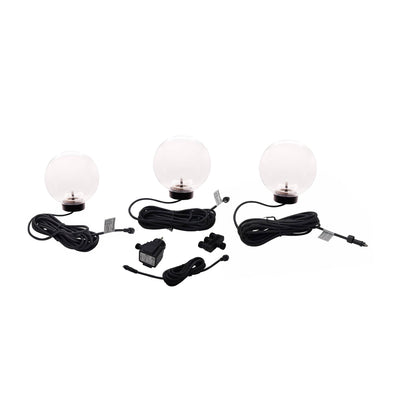
The MultiBright Float 3 LED brings together three spheres connected to each other on a 230/12 V transformer. It is a different installation from three independent solar balls: measure your distances and locate the transformer before fixing the final position.
Floating or submerged: two different uses
A lamp can be designed to float without being intended to rest on the bottom. Follow the use indicated by the manufacturer, even if the product is said to be "waterproof". Check the conditions separately for the ball, the connections, the cables and the power supply.
To highlight a stone, a waterfall or a detail underwater, a spotlight is more suitable. The LunAqua Power LED Set 3 by Oase is one example: it is fixed and responds to its own installation conditions. Find all the solutions in our pond lighting department.
Adapt the size and intensity to the pond
Before buying, do a simple visual test: place on dry land, in your line of sight, an object of the same diameter as the ball you are considering. You will judge the scale next to the plants and stones. More light is not necessarily more beautiful: from a dark patio, a discreet source is already seen very well. A fixed and warm light soothes more than colors that change constantly.
Keep a part of the night
A pond is a living environment. The Buglife association recommends limiting the quantity, duration and orientation of artificial light, especially near the water. Therefore, use the balls as an ambient light when you are outside, leave a part of the pond and the plantations in the darkness and turn them off when you go back inside. The possibility of cutting the light is a real purchase criterion, even for a solar model with automatic turn-on.
Maintenance without damaging the waterproofing
Clean the deposit according to the instructions, without abrasives. On a solar model, the panel must remain clean to capture the light. Only open a closed element if the instructions provide for it: a poorly resealed closure compromises the waterproofing. Before the frosts, check the storage conditions: "for outdoors" does not mean "can be taken in the ice". Take the ball out of the water in time.
To go further: Patio pond: setting up a small water garden on your patio.
Frequently asked questions
Does a decorative mirror ball illuminate the pond?
No. A reflective sphere reflects the ambient light without containing a light source. Check that the product sheet clearly mentions an LED, a battery or a power supply.
Can you float a ball near a fountain?
It depends on the conditions provided by the manufacturer and the movement of the water. Keep a sufficient distance from strong currents, suctions and hard elements against which the ball could hit.
Can I use another transformer?
Use the power supply and parts provided for the system. A plug that fits does not prove electrical compatibility. In case of doubt, have the exact reference checked.
How long does a solar ball illuminate?
Its autonomy varies according to the sunlight of the day, the season, the shade and the condition of the battery. Place the panel in full sun and consider the announced autonomy as a maximum.