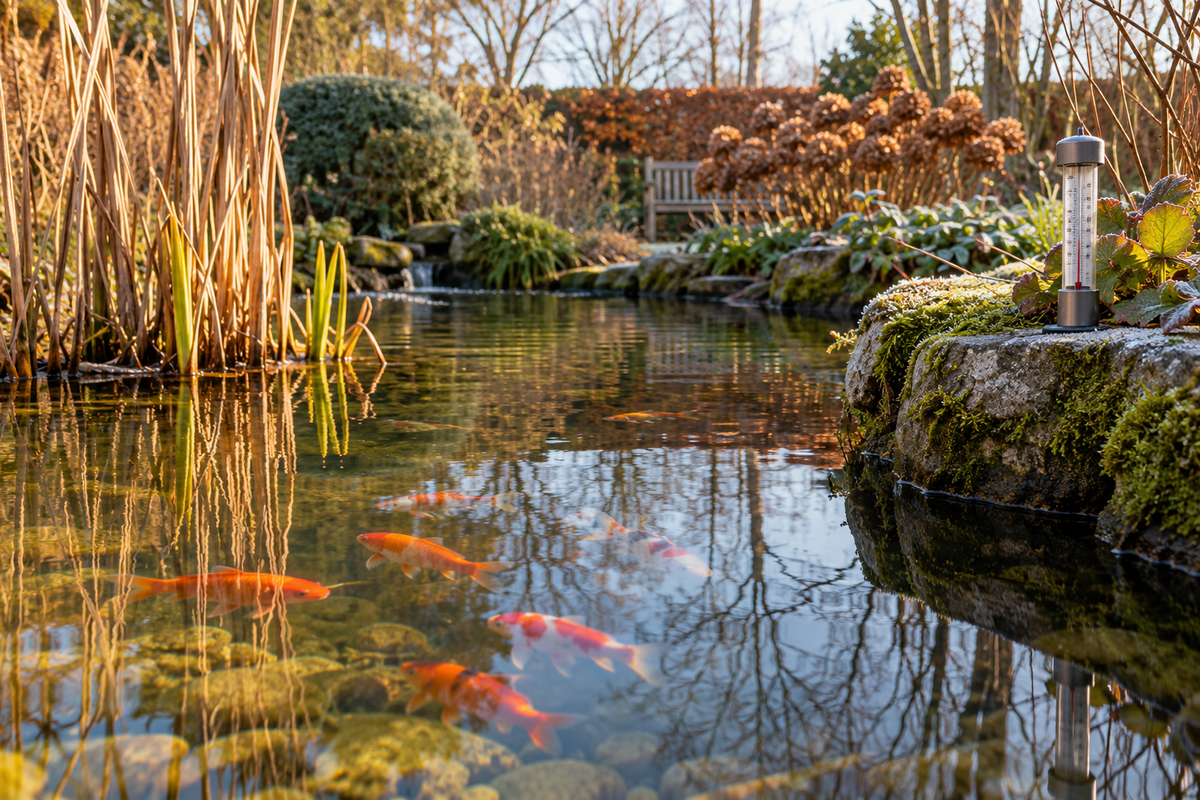
Patio ponds, also known as Patio Ponds, are becoming increasingly popular with garden enthusiasts. Stylish, easy to install, and perfect for housing a few Medakas, minnows, or Notropis. These micro-ponds allow you to enjoy a genuine little ecosystem, even on a patio or balcony.

Whether you want to house Medakas, minnows, Notropis chrosomus, a few freshwater shrimp, or simply create a little slice of nature, a 190-litre pond is an excellent solution.
But one question arises every winter:
Should you protect your Patio Pond from freezing?
The answer is yes, especially if your fish spend the winter outdoors. You must maintain continuous gas exchange to ensure your fish survive.
Read also:
- Patio pond: creating a small water garden on your patio
- Wintering a planted mini-pond: protecting it from frost

Can Medakas tolerate the cold?
Good news: Medakas (Oryzias latipes) are among the most cold-tolerant ornamental fish. They can easily overwinter outdoors, provided their environment remains healthy.
The real danger is not so much the cold...
👉 It is the surface freezing solid.
When the pond is completely covered in ice:
- gas exchange is blocked;
- carbon dioxide and gases from decomposing organic matter accumulate;
- oxygen can no longer enter the water.
Even though Medakas significantly reduce their activity during the winter, they still need oxygenated water.
The Medaka (Oryzias latipes) is one of the most cold-tolerant ornamental fish. Native to Japan, it easily withstands winters in Belgium and France.
The same is true for several species adapted to small ponds, such as:
- minnows;
- Notropis chrosomus;
- certain selected small goldfish;
- several species of freshwater shrimp.
Provided, of course, that their pond is properly maintained. Contrary to popular belief, the cold is not the greatest danger. The real problem is the lack of oxygen caused by the surface freezing solid.
Why does an above-ground pond freeze faster?
Unlike a buried pond, a Patio Pond is exposed to the cold on all sides.
Consequences:
- the water cools down much more quickly;
- a layer of ice can form from the first nights of frost;
- during prolonged cold spells, the ice can become very thick.
The 190-litre ponds remain perfectly suited to Medakas, but they require a little more vigilance during the winter.
Why can ice become dangerous?
When the entire surface is covered in ice:
- oxygen can no longer enter the water;
- carbon dioxide gradually accumulates;
- gases from decomposing dead leaves and sediment remain trapped in the pond.
Even though Medakas enter their winter rest period and significantly reduce their activity, they continue to breathe.
Without gas exchange, the environment can quickly become unfavorable to their survival.

Never break the ice
This is a very common mistake. Many owners think they are doing the right thing by breaking the ice with a hammer or a heavy object.
In reality, the vibrations travel through all the water and can cause significant stress in the fish, sometimes even internal injuries. If your pond is frozen, it is better to prevent the ice from forming than to try to break it.
A buried pond naturally benefits from the thermal inertia of the soil. In contrast, a Patio Pond is exposed to the cold on all sides.
Result:
- the water cools down much more quickly;
- a layer of ice appears from the first nights of frost;
- during long cold spells, the ice can become particularly thick.
The 190-litre models, such as the one offered by Aquishop, remain perfectly suited to Medakas, but simply require appropriate winter protection.
The solution: an intelligent floating heater
For small ponds and Patio Ponds, we recommend the OASE IceFree Thermo 330. Unlike a simple anti-freeze float, this model includes an automatically controlled 330 W heating element.
Its main advantages:
- maintains an opening in the ice down to around -20 °C;
- starts automatically only when a risk of frost is detected;
- maintains the gas exchange essential for fish;
- better oxygenation of the water;
- particularly suited for shallow ponds and small volumes such as Patio Ponds.
In other words, the device does not try to heat the entire pond.
It simply maintains an ice-free zone, exactly what your fish need to spend the winter in good conditions.

A few additional tips
To maximize the chances of success:
- regularly remove dead leaves before winter;
- limit feeding when the temperature drops below 10 °C;
- avoid moving the fish during the cold period;
- leave hardy aquatic plants in place;
- simply make sure the opening in the ice remains clear.
A small investment for great peace of mind
A Patio Pond is a genuine little ecosystem. A few Medakas, a few plants, and a little filtration are enough to create a living pond all year round.
By adding a suitable anti-freeze system such as the OASE IceFree Thermo 330, you easily secure the overwintering of your fish without having to intervene during every frost.
If you had to remember one piece of information:
Medakas are surprisingly robust fish, but they still need a minimum amount of gas exchange during the winter.
If you have a 190-litre Patio Pond, a floating heater such as the IceFree Thermo 330 is a simple, reliable, and economical solution to get through the winter with complete peace of mind. Your fish will thank you… from the first beautiful days, when they resume their activity on the surface.
Our Aquiflor tips for successfully wintering a Patio Pond
After more than 30 years of experience with garden ponds, we also recommend:
✅ removing dead leaves before winter to limit the production of fermentation gases;
✅ gradually stopping feeding when the water drops below 8 to 10 °C;
✅ leaving hardy aquatic plants in place, as they will naturally contribute to the pond's balance in spring;
✅ regularly checking that the filtration is suitable for winter temperatures;
✅ checking that the opening created by the anti-freeze system remains clear.
These few steps are generally enough to get through the winter without any unpleasant surprises.
What equipment do you need to protect a 190-litre Patio Pond?
If you have a 190-litre above-ground pond, we recommend the following combination:
- an OASE IceFree Thermo 330 anti-freeze system;
- a few hardy aquatic plants;
- light filtration adapted to the pond;
- a reasonable population of Medakas or small fish.
This combination provides an excellent biological balance throughout the year. Medakas, minnows, and Notropis are perfectly capable of spending the winter outdoors. What they fear above all else is not the cold, but the lack of gas exchange when the pond freezes solid.
By equipping your Patio Pond with a floating heater such as the OASE IceFree Thermo 330, you will protect your fish for the long term, preserve the biological balance of your pond, and enjoy a living body of water from the first beautiful days of spring.
To learn more: