A small above-ground pond allows you to create a water garden without digging a large excavation. It brings the plants closer to view and integrates easily into a patio at garden level. However, to ensure a pleasant result, you must choose a container specifically designed to hold water, check its support, and plan its maintenance.
The word “small” does not mean light: 200 liters of water already weigh around 200 kg, before the weight of the structure and décor. The first decision therefore concerns the location. The plants, equipment, and any fish come next.

Which type of above-ground pond to choose?
You can start with a kit designed for this purpose, a watertight container compatible with aquatic life, or a custom-made structure. A kit makes assembly easier and specifies the necessary parts. A custom build offers more freedom, but requires addressing wall strength, waterproofing, and finishing.
Also read:
A preformed shell intended to be buried is not automatically usable when placed freely on a patio. Some shells need the support of the ground on their walls. The fact that they hold water during a short test does not prove that they can withstand pressure over the long term in this configuration.
For a repurposed container, check its material, its previous use, and its frost resistance. Rule out containers that have held chemicals. An ordinary planter may also have holes, joints, or an interior finish that is not suitable for permanent immersion.
An example of a kit to consider

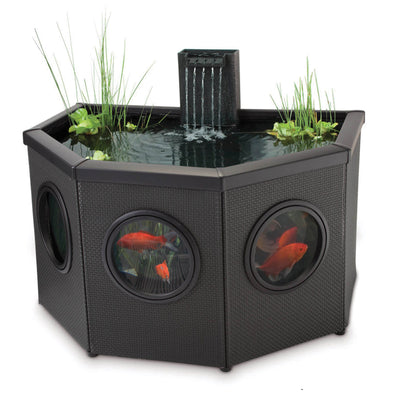
The Half Moon Mocha combines a pond with windows and circulation and filtration equipment. The Aquishop product page notably describes an Inpond set, a UV-C unit, and decorative accessories. Check the version delivered, its useful volume, its dimensions, and the exact contents of the package at the time of purchase.
The windows change the way you view the pond, but they require gentle cleaning with suitable tools. An abrasive accessory or a stone wedged in a sponge can leave a mark. Leave enough space in front of the walls to be able to work without moving the filled pond.
Prepare a stable and level support
The support must bear the total load according to the manufacturer's specifications. Loose lawn, a few isolated paving stones, or a warped patio are not necessarily suitable. The pond must not twist as it is filled.
On a ground slab, check the stability and irregularities. On a patio on blocks, a wooden structure, a roof, or a balcony, have the project validated by someone competent in structures. A board placed under the tub does not, on its own, prove that the whole can support the load.
Calculate the weight of the water, the tub, the stones, the baskets, and the substrate. Add the other loads present around it. The actual support point of the pond counts as much as its exterior surface. Also avoid placing a pond near a railing if it can serve as a step.
Choose the exposure without burning the plants
A pond benefits from light, but a small above-ground volume can experience marked temperature variations. Observe the location at several times of the day. A dark wall against a very exposed wall can accentuate heating during the summer.
Look for a compromise suitable for the chosen plants, with protection from the strongest hours if necessary. Also keep the pond away from heavy leaf fall and splashes of products used on the patio or in the garden.
Do not place the surrounding terrestrial plants in a way that completely hides access. You must be able to observe the level, remove debris, and reach the equipment without stepping over the tub.
Assemble and fill in the correct order
Read the entire manual before assembly. Sort the parts, check the joints, and prepare the recommended tools. The assemblies must be completed before filling, without forcing a part that seems misaligned.
Install the pond in its final place: a filled container is not moved like an empty planter. If the model has an inner liner, avoid stretching it and protect it during the installation of accessories. Check the connections as you gradually fill it.
Electrical connections must be suitable for the outdoors and aquatic use. A low-voltage pump also has a power supply that requires a location compliant with its manual. Do not leave the connections in a zone of stagnant water and have the installation validated if necessary.
Plant sparingly, but at the right depth
In a small pond, the adult size of the plants matters more than their appearance in a pot. A vigorous plant can quickly occupy the entire surface. Choose a few complementary species and keep a visible open water area.
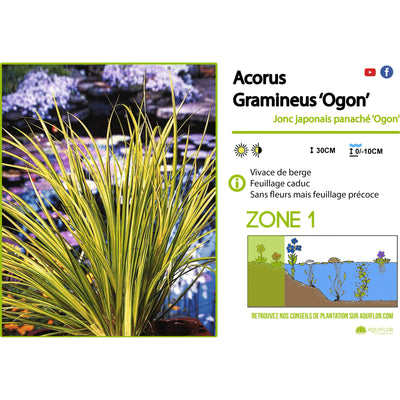
The Acorus gramineus ‘Ogon’ can provide low foliage along a damp edge. The marsh forget-me-not finds its place in a very shallow area. Check the immersion required at the crown, taking into account the height of the basket.
The planting baskets make it easier to move and divide clumps. Choose a size compatible with the pond and a stable support. Do not stack wobbly stones to gain a few centimeters.
Can you put fish in it?
The presence of a filter in a kit does not guarantee that all fish will live properly in it. You must examine the useful volume, the swimming dimensions, the adult species, the temperature, the oxygenation, and the overwintering possibilities. Koi become large fish and do not constitute a sustainable choice for a small patio pond.
A purely planted water garden is often simpler to start with. If you want fish, have the entire project validated before buying them. The small size of a young fish does not solve its future needs.
The biological system must establish itself and the parameters must be checked before introduction. Starter bacteria can accompany a suitable protocol, but do not instantly make the pond ready. Feeding and the population are then managed with caution.
Maintain without starting over
Regularly check the level, the condition of the plants, and the water circulation. Remove dead leaves and accessible debris before they accumulate. Clean the glass and walls with accessories compatible with their material.
A light deposit does not necessarily require a complete drain. Proceed with targeted interventions, with a tool proportionate to the volume. PondoVac pond vacuums are suitable for many larger ponds, but can remove too much water too quickly in a very small tub: have their relevance checked before purchase.
If a treatment becomes necessary, calculate the dose based on the actual volume. A small measurement error has a greater effect in a mini-pond. Avoid successively adding several products for water that is simply a little cloudy at the start; start by identifying the problem.
Prepare for winter and the arrival of wildlife
The exposed walls make an above-ground pond different from a buried pond. The frost resistance of the container, the windows, and the equipment must be checked. Follow the manufacturer's overwintering instructions and plan ahead the solution for the fish, if any.
For a pond accessible to small wildlife, install a stable exit from the water and, if necessary, access from the ground. An animal fallen into a container with smooth walls must be able to get out. The arrangement for wildlife does not replace the necessary protections for children.
Are you hesitating on a model? Send the dimensions of the location, the type of support, and your planting desires to support@aquiflor.com. This information will allow the pond and its accessories to be checked before installation.
To go further: Patio pond: create a small water garden on your patio.