For a patio pond, choose plants whose adult size and planting depth truly match the container. A small potted plant can become a large clump; a species sold among aquatic plants may need only damp soil. These two checks prevent a great deal of disappointment.
The easiest approach is to start with a few complementary plants: foliage that provides structure, flowers, and, if space allows, a submerged plant. Leave some open water for reflections and so you can see what is happening in the pond.

Measure before choosing plants
Note the available water depth and the container's internal dimensions. Add the height of the baskets and any supports. The useful depth for a marginal plant is generally measured at the crown, the junction between roots and aerial parts, according to its information sheet.
For example: in a container filled to a height of 35 cm, a 20 cm basket placed at the bottom may leave about 15 cm of water above its top. This is not a shallow immersion for all marginal plants. You may sometimes need to elevate the basket on a stable support or choose another species.
Also note the sunlight received in spring and summer. A patio shaded by a building, a south-facing terrace, and a container under a tree require different choices. Depth cannot compensate for unsuitable exposure.
Six options to consider for a small water garden
| Plant | Appeal | Caution in a container |
|---|---|---|
| Marsh forget-me-not | Small flowers and low border | Damp area with very little immersion; monitor its spread |
| Caltha palustris | Yellow flowers in spring | Leave enough room for the clump and respect its crown |
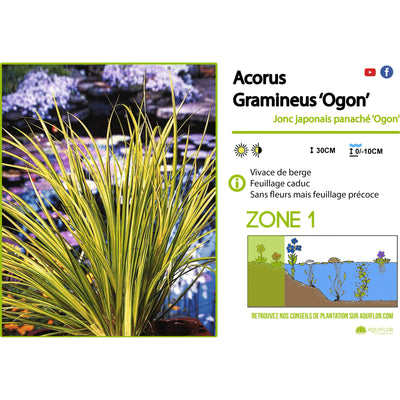
| Acorus gramineus ‘Ogon’ | Fine variegated foliage | Suitable damp soil, without improvised deep immersion |
| Mentha aquatica | Fragrant foliage and flowers | Vigorous species to contain in a small volume |
| Ceratophyllum demersum | Submerged vegetation | No true roots; thin out if the bed becomes too dense |
| Compact cultivar water lily | Floating leaves and flowers | Confirm the cultivar, its adult size, and its depth |
This selection offers possibilities, not a shopping list to buy entirely. The volume of open water, access to the baskets, and future growth matter more than the number of species present at the start.
Also read: Patio pond: creating a small water garden on your terrace.
Marsh forget-me-not for a light border
The marsh forget-me-not is offered in the catalog under the name Myosotis palustris, also associated with the botanical name Myosotis scorpioides. It provides low vegetation and small blue flowers. It should not be confused with an ordinary garden forget-me-not chosen without checking the species.
The Aquishop information sheet places it around the water level, with very little immersion possible. An accessible basket allows you to monitor its spread and divide it. It can accompany vertical foliage without obscuring the entire surface.
Marsh marigold for early flowers

The Caltha palustris has rounded leaves and yellow flowers. The Aquishop information sheet indicates a height of about 30 to 40 cm and a position ranging from a damp bank to slight immersion, up to about 10 cm at the crown.
It therefore deserves more room than a simple small pot placed in a corner. Pair it with interesting foliage after its flowering. In a very small container, a beautiful, properly established clump is better than an overly crowded arrangement.
Sweet flag ‘Ogon’ to structure the composition
The Acorus gramineus ‘Ogon’ is appreciated for its fine variegated leaves. The catalog describes it as a plant about 30 cm high at maturity, suited to damp soil and sun or partial shade.
Its role in this selection is mainly visual: it provides a low, bright silhouette. Do not attribute a filtration capacity in liters to it. Above all, do not plant it under a great height of water because the container is deep; prepare the damp area that suits it.
Water mint, to choose with plenty of room
The water mint gives a generous presence to the border. It is suitable for a project where you accept to control its growth. In a small pond, its spread can compete with other plants and quickly reduce the visible water.
Install it so you can intervene without dismantling the arrangement. A basket facilitates certain operations, but does not prevent all stem or root growth. Observe the plant and divide it when growth requires it.
Hornwort for the submerged part
The submerged hornwort brings fine branching under the surface. It has no true roots and does not require the same setup as a marginal plant rooted in a substrate. A small amount can already structure a small volume.
Its growth must be monitored to maintain open water and passages around the equipment. Remove excess carefully if animals frequent the pond. So-called oxygenating plants also breathe: they do not guarantee good oxygenation at all times on their own.
A water lily, only with the right name
To choose a patio water lily, ask for the cultivar name and its recommended depth. A color indication does not provide enough information about its vigor. The pot sold may be small while the adult plant will cover a large area.
Also check the sunlight required for flowering and the placement of the basket. A jet placed just above the leaves can disrupt the desired effect. Leave a calm area and adapt the choice to the container, rather than trying to constrain a large variety in too little water.
Three compositions to start with
For a spring scene: a marsh marigold and a forget-me-not, each at its depth, with open surface maintained. This combination emphasizes the flowers and remains easy to observe if the baskets are accessible.
For a foliage arrangement: an ‘Ogon’ sweet flag in a suitable damp area and a limited amount of hornwort in the water. Check that the container truly allows these two positions; it is not enough to place both plants at the same level.
For a pond centered on a flower: an identified compact water lily, complemented only if the remaining space allows. Simplicity makes it easier here to adjust the depth and control growth.
Planting neatly and maintaining gradually
The planting baskets help to organize a small pond and move the clumps. Use a growing medium suited to the species and the system. A rich and loose potting soil can cloud the water and provide too many nutrients.
Do not fertilize the entire container as a matter of principle. Needs differ depending on the plants and conditions. If a supplement is necessary for a specific plant, choose a product and method suited to it, taking into account the animals and the small volume.
Remove accessible dead leaves, check the level, and thin out gradually. Before winter, check the needs of the plants and the resistance of the container. A plant's hardiness does not automatically protect a small container exposed to frost on all sides.
Avoid purchases that complicate the mini-pond
Avoid plants whose identity is uncertain, species that are too vigorous for your area, and those whose sale or possession is restricted in your region. A photo found on a foreign website is not enough to validate a purchase.
Also read:
Keep removed plants and fragments out of natural environments. For a mini-pond focused on local biodiversity, ask for a selection of cultivated native species adapted to your space.
Send the water depth, the container's dimensions, and its exposure to support@aquiflor.com. With these guidelines, the choice of plants becomes precise and the composition can evolve without being entirely redone.