A pond planted solely for its beauty in June can look very empty in March and lose all appeal by the end of summer. To create an attractive composition for longer, combine staggered flowering times, foliage of different shapes, and plants whose needs match the available locations.
Outdoor pond plants are also chosen according to their annual cycle. Some start early, others take their place in summer, while marginal plants extend the colours in autumn. In winter, volumes, stems, and open water become more prominent. Here is how to prepare this succession without overloading the pond.

Start with depth and light
The flower calendar must not make you forget the location. A plant chosen for its autumn flowering will not grow properly if it is installed at a water depth incompatible with its needs.
Note the depths of the shelves and measure the water height above the future crown. Also note the sunlight in spring and summer: a tree still without leaves in March can heavily shade the pond a few weeks later.
Then, leave room for adult growth. The goal is to have interests succeed each other, not to install a plant every month in each basket. Some clumps will retain a visual role long after their flowering.
In spring: support the restart
Spring reveals new shoots and the first foliage. Before adding plants, identify those that are still dormant. A location that seems empty may belong to a perennial that starts later.
The Caltha palustris, or marsh marigold, can open the season with its yellow flowers. Its Aquishop sheet announces flowering from April to June, a height of 30 to 40 cm, and planting near the water level.
The water forget-me-not can then accompany the shallow edges. Its flowering is announced from May to September, with low growth. These dates give a direction for composing the pond; weather and growing conditions can shift them.
The period when the water warms up, from mid-spring to early summer depending on the plants, is generally favourable for new installations. Take advantage of this to check the baskets and divide the clumps that need it, without stirring up the whole pond in a single intervention.
In summer: compose the volumes and preserve open water
The plants then take their greatest place. Floating leaves, upright stems, and submerged plants create different atmospheres. A balanced composition also leaves the water visible and allows access to the equipment.
The Pontederia cordata brings mauve spikes, announced from June to September, above heart-shaped leaves. It is placed on a shelf compatible with its planting depth, 10 to 30 cm underwater according to the sheet.
A white water lily can complete the scene in another area. Check the variety received, its depth, and its spread: a vigorous water lily can occupy much more space than imagined at purchase.
Remove accessible faded leaves and gradually limit excess. During strong heat, pay particular attention to fish ponds. Plants produce oxygen in the light, but also breathe at night; their presence does not guarantee sufficient oxygenation.
In autumn: extend the flowering on the edge

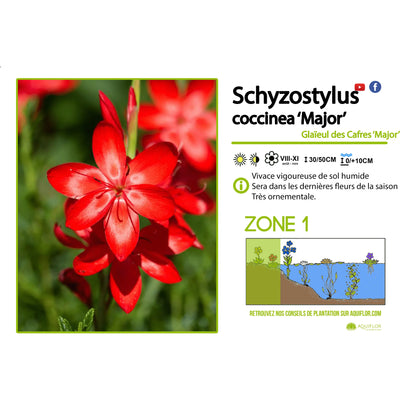
The Hesperantha coccinea ‘Major’, sold under the name Schizostylis, allows you to extend the colours with red flowers. The Aquishop sheet announces flowering from August to November. An early frost or unfavourable exposure can naturally shorten this period.
This plant is suitable for a damp border near the water level; it is not planted like a fully submerged plant. The RHS recommends a sunny location, moist but draining soil, and shelter from cold and drying winds.
At this season, remove the leaves that fall off and risk accumulating in the water. However, keep refuges and useful stems in areas where they do not interfere with the pond's operation. The maintenance of a border can be done in stages.
In winter: recognize dormancy and protect sensitive plants
The retreat of the foliage is not necessarily a sign of decline. Hardy water lilies enter dormancy and restart when conditions become favourable. Tropical plants, however, require different overwintering conditions.
Do not deduce hardiness from the colour of a flower alone or the word "aquatic". Keep the exact names and ask for the conditions suitable for each reference. In a small container out of the ground, the cold can reach the roots more easily than in a large buried pond.
A hardy plant still needs an installation compatible with local frost. Check in particular that the organs to be preserved do not risk freezing completely. For sensitive species, prepare their protection before the first cold period rather than improvising when they are already damaged.
The remaining stems and foliage can give relief to the garden, but must not prevent the monitoring of the water or the maintenance necessary for the fish.
A simple calendar to prepare your composition
| Period | Interest to look for | Example to study | Useful action |
|---|---|---|---|
| Spring | Restart and first flowers | Caltha palustris | Identify new shoots and check locations |
| Late spring and summer | Flowering edges and developed foliage | Myosotis, pontederia, adapted water lily | Keep open water and monitor oxygenation |
| Late summer and autumn | Late marginal flowering | Hesperantha coccinea ‘Major’ | Gradually remove leaves falling into the water |
| Winter | Silhouettes and vegetative dormancy | Hardy plants already adapted to the pond | Check protections and prepare for the next season |
This table serves to organize purchases. It does not guarantee flowers every week or an identical quantity of plants for all ponds.
Combine heights without hiding the pond
Place the tallest plants taking into account the main viewpoint and their shade. Low plants can underline a border near the terrace, while floating leaves occupy part of the surface.
The aquatic baskets of different sizes facilitate adjustments and divisions. They must, however, remain stable and large enough for the plant. Avoid multiplying small containers simply to add more varieties.
If you want a pond composed solely of native species, indicate it before choosing. Some ornamental plants mentioned, such as pontederia and Hesperantha, do not meet this criterion.
Observe for one year before changing everything
Take a few photos from the same place over the months. They show the periods that are too empty, the areas that have become dense, and the plants that hide their neighbours. You will be able to complete the composition with a precise goal.
A disappointing flowering also deserves a diagnosis: light, depth, crowding, and the condition of the plant. Adding fertilizer without checking these points can unnecessarily enrich the pond. When fertilization is justified, use a product intended for aquatic plants according to its instructions.
To compose a planting adapted to your pond and the seasons, contact the Aquiflor team with the depths, exposure, and a few photos. We can help you distribute the species and plan their maintenance throughout the year.
Our guides on this subject
- FlexiCut OASE: pruning pond plants
- Dwarf water lily: which variety for a small pond?
- Where to buy aquatic plants in Belgium?
- Floating basket: which plants to choose?
- Floating aquatic plants without rooting
- Invasive plants in the pond: limiting them
- Pond plants: where to find them and how to choose
- Plants for floating islands and planted rafts
- Which aquatic plants still flower in September?
- Which plants to choose for my natural pond?
- Which oxygenating plants to choose for your pond?
On related topics:
- Preparing your pond for winter: the guide
- Green water in the pond: what to do?
- Building a pond in your garden: where to start?
- Natural swimming pool in Belgium: preparing your project
- Patio pond: setting up a small water garden on your terrace
- Why install a water feature in your garden?
- Aquiflor Nodebais: the aquatic garden center
Useful sources and readings
- RHS — choice of pond plants and maintenance throughout the seasons.
- RHS — growth and overwintering of hardy and tropical water lilies.
- RHS — Hesperantha coccinea, exposure and growing conditions.
- Penn State Extension — dissolved oxygen variations.
- Aquishop sheets of the plants mentioned: indicative flowering periods, depths and announced dimensions.