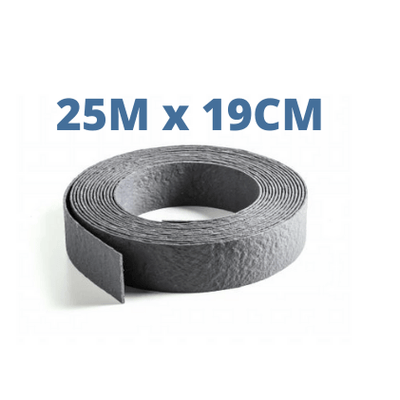
The short answer: the edge of the pond determines the water level. If it is not perfectly level, the liner will show on one side and the water will overflow on the other. The simplest solution is an Ecolat edging fixed on Ecopic stakes driven in every 50 cm and levelled with a spirit level all around the pond. The liner is pulled up against the edging, folded over the top and hidden on the garden side. The result: a consistent water level and an almost invisible liner.
Key points
- The edge determines the water level: it must be level all around.
- Ecolat: 100% recycled plastic edging, made in Belgium, rot-proof.
- Available in 25 m rolls for freeform ponds and straight slats for rectangular ponds.
- One Ecopic stake at least every 50 cm, with two stainless steel screws per stake.
- A protective felt layer between the edging and the liner.
Why is the edge of the pond so important?
When you fill a pond, the water stops at the lowest point of the edge. If there is a difference of a few centimetres around the perimeter, which is not visible to the naked eye on the ground, the water will overflow on one side while a strip of black liner remains exposed on the other. This strip will age in the sun, deteriorate more quickly and spoil the natural appearance of the pond. Worse still, a section that is too low can cause a leak through capillary action: the soil or grass in contact with the water will slowly draw water out of the pond.
A properly installed edge solves all these problems. It sets the water level at a consistent height, helps hide the liner, clearly separates the pond from the garden and stabilises the bank. This is the step that many DIY enthusiasts overlook, and it is what makes the difference between a "homemade" pond and one that looks natural.

What is Ecolat edging?
Ecolat is an edging made by Ecoo in Houthalen, Belgium, from recycled household plastic waste. It is rot-proof: unlike wood, it does not rot when in contact with damp soil and water and retains its shape for many years. It is available in two versions:
- In rolls, flexible, for freeform shapes and curves: 25 m × 19 cm roll or 25 m × 14 cm roll, 7 mm thick. Rolls are not suitable for straight edges.
- In straight slats 2 or 3 m long, for rectangular ponds and clean finishes.
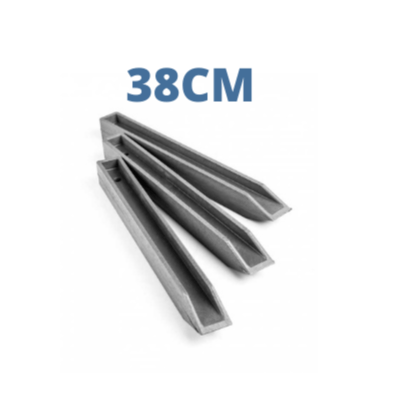
It is fixed to Ecopic stakes made of recycled plastic, with a 4 × 4 cm cross-section and 38 cm in length. Their H-shaped profile gives them excellent stability in the ground. The pack of 10 stakes with screws allows you to fix approximately 5 m of edging. The same stakes are also used for paths, lawns, flower beds and vegetable patches.


How much do you need?
Measure the perimeter of the pond, following its curves, and add a small margin for joints. Allow at least one stake every 50 cm, or approximately two stakes per metre of edging, and two stainless steel screws per stake. For a pond with a 20 m perimeter, this means one 25 m roll and around forty stakes, or four packs of ten.
| Pond perimeter | Edging | Stakes (1 every 50 cm) |
|---|---|---|
| 10 m | 1 roll of 25 m (remainder can be reused) | approximately 20, or 2 packs |
| 20 m | 1 roll of 25 m | approximately 40, or 4 packs |
| 40 m | 2 rolls of 25 m | approximately 80, or 8 packs |
The remainder of a roll can easily be used around a flower bed, vegetable patch or along a path.
How to install Ecolat edging around a pond
- Trace the outline of the pond and mark a reference point: this will determine the water level.
- Drive in the Ecopic stakes with a rubber mallet, at most 50 cm apart, just behind the future edging.
- Position the edging against the stakes, following the outline and the natural curves of the roll.
- Level it: this is the key step. Using a spirit level on a long straightedge, or preferably a water or laser level, ensure that the top of the edging is at the same height all around the pond.
- Screw the edging to each stake with two stainless steel screws. The stakes should end approximately 3 cm below the top of the edging and will be hidden once finished.
- Place the protective felt in the pond and over the edging: it protects the liner from anything sharp.
- Position the liner, pull it up against the edging, fold it over the top and hide it on the outside, under the soil, gravel or plants.
- Fill the pond: the water should reach the same level all along the edging.
The workshop's tip: check the level one last time with a little water in the pond before cutting the liner. Water never lies: if it touches one area sooner than the others, raise the edging at that point. Only cut off the excess liner once the pond is full and the water level has stabilised.
What about an existing pond?
Edging can also be installed around an existing pond. Clear the soil around the perimeter, lift the liner if it is long enough, then install the stakes and edging at the correct height before folding the liner over the top. If the liner is too short, the edging can be fixed slightly back and the liner hidden with flat stones or bank plants. This is often an opportunity to fix a leak caused by capillary action.
Be aware of capillary action: if soil, grass or roots touch the water above the liner, they will slowly draw water out and the pond will lose water without any visible leak. The edging should always protrude slightly above the water level, and the liner must be pulled up behind it.

How to finish the edges
On the garden side, fill the area along the edging with soil, bark, gravel or stones, depending on the desired style. Bank plants and trailing perennials soften the line and hide the final few centimetres. For a contemporary pond, a neat strip of gravel or pebbles highlights the edging. For a natural pond, let the vegetation grow right up to the edge and trail down towards the water.
Mistakes to avoid
- Levelling by eye: a difference of a few centimetres is enough to make the liner visible.
- Spacing the stakes more than 50 cm apart: the edging will become distorted.
- Using ordinary screws that will rust; choose stainless steel.
- Forgetting the felt between the edging and the liner.
- Cutting the liner too early, before the pond is completely filled.
- Using a roll for a straight edge: use straight slats.
Frequently asked questions
How many Ecopic stakes per metre of edging?
At least one stake every 50 cm, or approximately two per metre, with two stainless steel screws per stake.
What is Ecolat edging made of?
100% recycled plastic, made in Belgium by Ecoo. It is rot-proof and does not rot when in contact with water.
Roll or straight slat?
The flexible roll is suitable for freeform shapes and curves; the 2 or 3 m straight slat is suitable for rectangular ponds.
How to hide the liner around the edge of the pond?
Pull the liner up against a level edge, fold it over the top and hide it on the garden side under the soil, gravel or plants.
Written by the Aquiflor team, a specialist pond and garden pond shop in Nodebais (Belgium), an official Oase repair workshop. Updated in November 2026. Product specifications and installation method: Ecoo manufacturer's data sheets and instructions.
Are you building or renovating a pond? Send us its dimensions and a photo to support@aquiflor.com or call 010 86 03 54: we will help you calculate the length of edging and the number of stakes required.