A few round leaves, a flower that opens in the sun and a visible water surface: a compact water lily may be enough to add character to a small pond. However, choosing one requires more than just falling in love with a colour.
A dwarf water lily is a plant whose growth remains suitable for a small space. A young plant sold in a small pot can grow very wide. Before buying, check the variety name, its mature spread and its planting depth.

Start by measuring the small pond
Note the available surface area, the total depth and the height of the basket you will be able to install. Also identify any shelves and other plants. The useful space for the water lily corresponds to what will remain for its foliage when it grows.
Read also:
- Pond plants: creating a seasonal planting scheme
- OASE FlexiCut 2: pruning pond plants in autumn
- Invasive pond plants: limiting their spread and preparing for the next season
In a container, take into account the volume occupied by the basket and the substrate. In a buried pond, measure the depth at the intended location. A deeper bottom in another corner will not give you the correct information for the plant.
Finally, note the periods of sunlight. A bright terrace at noon may remain in the shade for much of the day. Water lilies generally prefer a sunny position and calm water; splashes from a fountain placed right next to them can interfere with their establishment.
The word "dwarf" does not replace the variety name
The terms miniature, dwarf and compact are used to describe reduced growth, but they do not give a precise dimension. Ask for the stated mature spread and the recommended depth for the chosen reference.
As a botanical example, the RHS describes Nymphaea ‘Pygmaea Helvola’, also presented as Nymphaea × helvola, as a miniature water lily with yellow flowers and leaves marked with purple. Its stated spread is in the 10 to 50 cm category.
The RHS selection also lists ‘Pygmaea Rubra’ among the water lilies suitable for shallow depths. These names provide leads to examine with a specialist; their presence in this guide does not constitute an announcement of availability on Aquishop.
A colour is therefore not enough: two yellow water lilies can have very different dimensions. Keep the botanical name on a label and in your garden journal.
Understanding the depth indicated on the sheet
You must distinguish the total height of the pond from the water height above the plant's growth point. The basket and the substrate take up part of the available depth.
For example, in a container with 40 cm of water, a basket whose growth point is 15 cm above the bottom leaves about 25 cm of water above this point. This calculation allows you to compare the container to the variety's needs, but does not constitute a universal depth recommendation.
The indications may vary depending on the sheets and the age of the plant. For ‘Pygmaea Helvola’, the RHS describes an initial placement in shallow water, then a gradual lowering as the plant establishes itself. Follow the method given for your plant rather than a single depth applied to all water lilies.
Choosing a basket that remains accessible
The basket makes it easier to manage the substrate, move it, and perform future operations. Its width, height and capacity must suit the rhizome and the available space. A smaller container does not turn a vigorous variety into a dwarf variety.
The square planting baskets offered on Aquishop come in several dimensions. Choose the format after confirming the water lily's needs, then check that it can fit, rest stably, and be removed without major disassembly.
For a narrow container, draw the location of the basket from above. Leave room for the other plants and to observe the level. Avoid filling the entire volume immediately with several large containers.
What substrate to use for the water lily?
Use a substrate suitable for aquatic plants and water lily cultivation. A light potting mix intended for patio pots may disperse or introduce elements that the pond does not need.
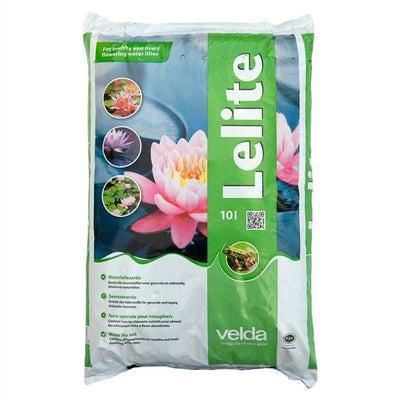
The Lelite 10 litres by Velda is a potting soil intended for water lilies. Check its composition and instructions for use on the packaging: different versions exist in the manufacturer's range.

Depending on the basket, a lining provided for aquatic planting helps retain the soil. A layer of clean gravel, laid according to the recommendations, can complete this retention. Moisten the whole thing and lower it gently to avoid a cloud of particles.
Installing the plant without burying its growth point
Prepare the basket according to the shape of the rhizome and the planting instructions. The growth point must remain in the recommended position, near the surface of the substrate. Avoid covering the entire plant indiscriminately.
For a hardy young water lily, a gradual installation at depth can help the leaves reach the surface. If temporary support is necessary, it must be stable and suitable for the pond, without an aggressive edge against a membrane.
After planting, observe the plant without moving it every day. Note its position and the date. The first leaves and the growth rate then provide benchmarks for adjusting the depth according to the variety's recommendations.
Why is a dwarf water lily not flowering?
Start by checking the conditions before multiplying products. Is the plant established enough? Is it receiving suitable exposure? Has its basket become too crowded? Does the depth match the variety?
Also observe the leaves. Very dense growth with overlapping leaves can indicate a lack of space. A recently divided or moved plant may need time before regaining its rhythm.
Nutrition is part of the diagnosis, but it does not correct a bad location. If a supplement is justified, use an aquatic fertilizer according to its instructions, placed in the intended manner. In a small volume, uncontrolled additions can quickly change the water conditions.
Maintaining a small pond without intervening every day
Remove damaged leaves and faded flowers that are accessible. Monitor the level during dry periods, as the water height above the basket changes with evaporation. Maintain consistent conditions for the plant and any other inhabitants.
Plan divisions when they become necessary, at the appropriate time for the variety. A compact water lily also grows: the word dwarf does not mean that no maintenance will be necessary.
Keep part of the surface free. The plant provides shade and shelter, but it does not replace on its own all the functions of a fish pond. A small planted container is not automatically suitable for housing koi or goldfish.
Can a hardy water lily stay outside in winter?
A hardy variety can stay in a suitable pond, but a small container fully exposed to frost requires special attention. The risk concerns especially the freezing of the entire volume around the rhizome.
Prepare the wintering according to the climate, the container, and the plant. Tropical water lilies have different temperature needs. Do not infer hardiness from the size of the flower alone or the word miniature.
The information to ask for before buying
- The exact variety name and its mature spread.
- The planting depth, with its reference point.
- The hardiness and wintering needs.
- The recommended basket size for the provided plant.
- The necessary exposure and planting period.
On some Aquishop sheets, water lilies are sold by colour without selecting a precise cultivar. If your pond requires a dwarf variety, have this criterion confirmed before ordering. A sketch and a few measurements allow you to prepare a coherent choice.
Preparing the planting
Once the compact variety is confirmed, choose the basket and the substrate corresponding to its needs and your pond.
Compare aquatic baskets →
See Lelite potting soil for water lilies →
Sources
- RHS — Nymphaea × helvola: example of a miniature water lily.
- RHS — Choosing pond plants: varieties and depths.
- RHS — Water lilies: exposure, space and calm water.
- RHS — Growing water lilies: planting, maintenance and wintering.
- Velda — Lelite: substrate function and installation advice.
- Aquishop sheets for square baskets, 10 litres of Lelite and water lilies sold by colour: formats and selection methods.