September still holds some beautiful blooms for the water garden. Pickerel weed spikes extend the colours of summer, some water lilies open their final flowers, and Hesperantha take over on the damp banks.
To make the most of this period, choose plants according to their location as well as their colour. A marginal plant and a plant established underwater have different needs. Here are four ideas for extending the pond's appeal, with references available on Aquishop and tips for preparing for the following seasons.

Why a flowering period remains a guide
A plant sheet stating "June to September" describes a typical period, not a promise of a plant covered in flowers for four months. Variety, sunlight, weather and establishment all influence the result. A young plant recently moved does not always behave like a well-established clump.
In your garden, note the dates of the first and last flowers. Add the exposure and water level. After one or two seasons, this little record will help you fill in the times when the pond lacks colour.
Look at the foliage too. A plant whose flowering has ended can still provide a useful shape to the composition. Spikes, broad leaves and low clumps add dimension even when flowers become less numerous.
1. Pickerel weed: bluish spikes above the water
Pontederia cordata combines upright leaves with spikes of small blue-purple flowers. The Aquishop sheet indicates flowering from June to September; the RHS highlights its late-summer appeal.
Install it in a shallow area compatible with its plant sheet. The depth is measured relative to the indicated planting point, not simply the bottom of the pond. Check the actual water height above the basket, especially when the level varies.
A sunny position suits this plant well. Leave it enough space to form a clump and prevent a more vigorous neighbour from overgrowing it. Its vertical flowers are particularly visible when there is an area of open water behind them.
Pickerel weed is an attractive ornamental option. If your project prioritises a pond composed exclusively of local native species, check this criterion in your selection: the Aquishop sheet does not classify it as native.
2. Marsh forget-me-not: a low and delicate bloom
The marsh forget-me-not brings small blue flowers right next to the bank. Its sheet announces flowering from May to September and a height of around 20 cm. It lends itself to a gentle transition between the water and taller plants.
Choose a damp area suited to its needs, in the sun or partial shade depending on the garden conditions. Its low growth allows you to maintain a view of the pond, provided you monitor its progress and keep useful access routes clear.
The aquatic forget-me-not also helps structure shallow areas. The RHS cites this type of vegetation among the habitats useful to the pond's small wildlife. Its appeal should therefore not be judged solely by the number of flowers visible in September.
In a small composition, combine it with a single taller plant rather than several vigorous species crowded into the same basket. Each will retain a space that is easier to monitor.
3. Water lilies: extending flowers on the surface
Depending on the variety and season, water lilies may still flower in September. Their leaves occupy a different level from marginal plants and make it possible to create balanced views from a patio or path.
The sheet for the white water lily in a 3-litre pot offered on Aquishop indicates flowering from June to September and a sunny exposure. As plants are sold by colour, ask for confirmation if you are looking for a specific cultivar or very compact growth.
The RHS recommends choosing the water lily according to the size and depth of the pond. A vigorous variety established in a small volume can quickly take up too much space. Planting depth also matters for its establishment and growth.
Remove faded flowers and damaged leaves when they are accessible without disturbing the entire plant. If flowering has been poor during the summer, examine the exposure, the crowding of the basket and the variety before adding fertiliser. The end of a season is not automatically corrected by fertilisation.
4. Hesperantha: the autumn relay on the banks
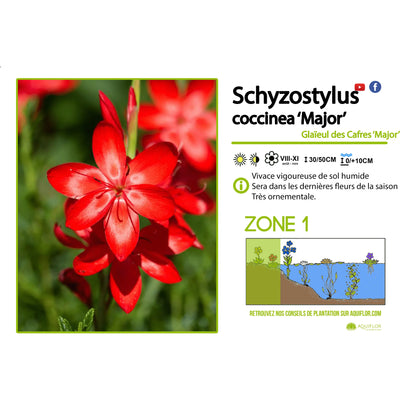
Hesperantha coccinea is still often offered under its old name, Schizostylis coccinea. Its flowers appear in late summer and autumn. The RHS describes a plant for damp but well-drained soil, preferring a sunny and sheltered position.
On Aquishop, the reference Schizostylis coccinea ‘Major’ is presented with red flowers and a flowering period from August to November. This period can be shortened by the cold and local conditions.

Place this plant at the edge, with sufficient moisture and a position compatible with its crown. It is not treated like a water lily or submerged pickerel weed. For winter, take into account the exposure and the hardiness indicated for the chosen plant.
A selection to distribute according to the areas
| Plant | End-of-season appeal | Area to prepare |
|---|---|---|
| Pontederia cordata | Blue-purple spikes and upright foliage | Shallow area, according to the planting sheet |
| Marsh forget-me-not | Small blue flowers and low vegetation | Damp edge or suitable shallow depth |
| Water lily | Flowers and leaves on the surface | Depth corresponding to the variety |
| Hesperantha coccinea | Late summer and autumn flowering | Damp bank, without deep immersion |
Depths must be checked on the sheets of the purchased references. Measure the position of the crown or the top of the basket according to the indicated convention, to avoid confusion between pond depth and water height on the plant.
Also read: Outdoor pond plants: creating a planting suited to the seasons.
How to make a pond still pleasant in September?
Start with the main view: the window, the patio or the bench from which you look at the water. Place the tall plants so as to frame the scene, with openings towards the surface. A well-placed clump of pickerel weed may be enough to provide height.
Add a low presence on the bank, then a surface plant if the volume allows. You get several levels without having to fill every space. Plants must be able to grow, and maintenance areas must remain accessible.
Then choose a simple palette. The blue of the forget-me-not and the purple of the pickerel weed can be accompanied by a white water lily. A red Hesperantha placed on another section of the bank brings a stronger accent at the end of the season. These combinations are composition ideas, to be adjusted to the available space.
Can you buy and plant in September?
The answer depends on the species, the climate, the packaging and the condition of the plant. A plant in flower bought in September does not guarantee immediate flowering once established. Check the planting calendar and the nursery's recommendations before moving or dividing a clump.
Also read:
The RHS places many aquatic plant propagation operations in spring and summer. For water lilies or major divisions, prepare the project at the right time rather than intervening only because the pond lacks flowers in autumn.
September remains very useful for observing gaps, measuring levels and preparing a selection. Keep the exact names of the chosen plants and check availability at the time of ordering.
The maintenance steps that accompany the end of flowering
Gradually remove leaves that are degrading in the water and monitor inputs from trees. Keep the still healthy parts and the bank structures that remain useful to wildlife. Maintenance by sector avoids turning the entire pond into a single intervention.
Limit fertiliser inputs to identified needs and products intended for this use. A plant ending its seasonal cycle does not necessarily have a deficiency. Also observe the water level: a drop can leave a damp root ball initially in too dry conditions.
The pond thus keeps its appeal until autumn, then prepares its restart. Flowers count, but their place in an ensemble of foliage, open water and well-designed banks makes all the difference.
Choosing the plants for your locations
Measure the available areas and exposure, then compare the growing sheets before composing your selection.
Also read:
Discover pickerel weed →
See Hesperantha ‘Major’ →
See marsh forget-me-not →
Sources
- RHS — Pontederia cordata: flowering and cultivation.
- RHS — Hesperantha coccinea: botanical name and plant needs.
- North Carolina State University — Myosotis scorpioides: flowering and growing environment.
- RHS — Water lily cultivation: choice, depth and maintenance.
- RHS — Aquatic plant propagation: intervention calendar.
- RHS — September pond: monitoring of vegetation and water.
- Aquishop sheets of the four plants linked in the article: flowering periods and characteristics of the proposed references.