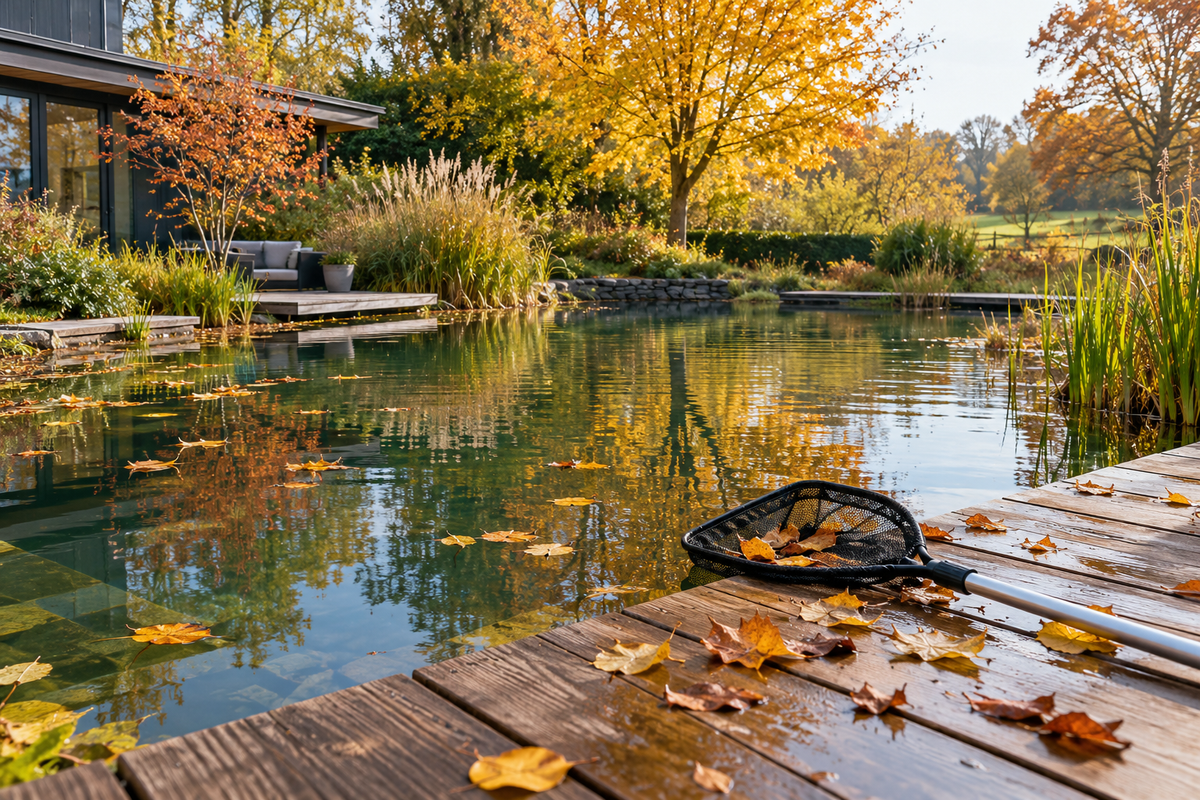
🍂 The FlexiCut 2 in 1: The essential tool for trimming your aquatic plants in autumn and winter ❄️
Autumn is a key season for preparing your pond to face winter. Leaves fall 🍁, aquatic plants flourish one last time before slowing their growth 🌿, and it's the ideal time for careful maintenance. That's where the FlexiCut 2 in 1 comes in, an ingenious tool that Nicolas, our expert at Aquiflor, presents to you in his latest video 🎥.

Why choose the FlexiCut 2 in 1? ✂️
The FlexiCut 2 in 1 is much more than just a pair of pruning shears! This tool was specially designed to make your life easier around your pond 🛠️. Thanks to its 2 in 1 system, you can cut 🌿 and retain the cut part 💪, thus preventing it from falling into the water and making your pond dirty 🌊. Clean and fast work, without effort!

A versatile and safe tool 🔐
Who has never had the fear of damaging the pond liner when trimming plants? 😰 With the FlexiCut, no panic! Its adjustable head allows you to work safely 🔧, without risking damage to your liner. It is also super versatile 🧤: perfect for cutting aquatic plants, but also branches or other plants in your garden 🌿🌸.
Trimming your aquatic plants in autumn and winter 🍁❄️
🍂 In autumn, it is essential to trim aquatic plants before they decompose in the pond, thus disrupting the balance of the water 🌊. The FlexiCut 2 in 1 helps you perform this task quickly and cleanly.
Even in winter, it remains essential ❄️! Some plants require trimming even in cold weather 🧣 to promote their recovery in spring 🌱. With its long handle (158 cm) 📏, the FlexiCut allows you to easily reach difficult-to-access areas, such as the center of the pond.
Practical accessories 🛠️
The FlexiCut is also customizable! You can buy an additional scissor head (ref. 51272) for even more precision 🔍 and comfort. Adapted to all your needs, this tool quickly becomes essential.
Why adopt it at Aquiflor? 🌿🏞️
At Aquiflor, we select the best tools to maintain your ponds 💧. The FlexiCut 2 in 1 is already unanimous among our customers for its efficiency and durability 👍. By choosing this tool, you are investing in easy and optimal maintenance of your aquatic space, while maintaining its aesthetics 🏞️.
Prepare your pond for winter with the FlexiCut 2 in 1 ❄️✂️
Pond maintenance should not be a chore 🧑🌾. With the FlexiCut 2 in 1, trim your aquatic plants with ease 🌿, even in autumn and winter. This practical, safe, and versatile tool 💪 is your ally for a flawless pond throughout the year.
👉 Find the FlexiCut 2 in 1 now at Aquiflor and prepare your pond for winter with complete peace of mind!
How to know what to cut around the pond?
Before taking out the shears, go around the pond. A leaf lying in the water, a still green clump, and a dry stem that remains perfectly straight do not require the same intervention. The goal is to remove plants that risk decomposing in the water, while retaining the parts useful to the plant and the refuges of the small fauna. A pond prepared for winter therefore does not need to be completely shaved.
Also read:
- Plants for outdoor ponds: create a planting adapted to the seasons
- Invasive plants in the pond: limit their spread and prepare for the next season
Start with damaged lily pads and already collapsed stems. Then observe the bank plants: some naturally lose their foliage, while others remain decorative or retain part of their activity. In case of doubt about a species, take a photo of the whole plant and its base before asking for advice. A correct identification is better than a systematic cut made at the wrong time.
The calendar also depends on your garden. A pond protected in a courtyard does not cool down like a pond exposed to the wind. It is more useful to look at the condition of the plants and the conditions of the day than to set a universal date. Avoid working from a frozen, unstable, or slippery bank; postpone the intervention if you cannot keep safe footholds.
A simple working method, from the edge to the water
- Prepare a drop zone. Set up a container within reach for plant waste. You will avoid multiple trips with the tool and dropping cut pieces into the pond.
- Locate the stem precisely. Follow it with your eyes to the area you want to cut. Do not plunge a blade randomly into a dense clump where a hose, cable, or the edge of a basket may pass.
- Approach the head without forcing. Adjust your position on the bank. If you have to lean excessively, the area is too far away to work comfortably from that location.
- Cut a small amount at a time. A targeted cut allows you to see what you are doing and remove the plant cleanly. Pulling on a handful of stems can move the basket or pull out healthy parts.
- Remove the waste and check the result. Collect the remaining fragments with a suitable net. Look if the water circulation is clear and if the retained plants are still well installed.
Work by zones rather than trying to finish everything in one session. This organization is particularly useful on a dense pond: you keep better visibility, you limit fatigue, and you can interrupt the intervention without leaving a large amount of cut plants in the water.
What the FlexiCut actually brings
The FlexiCut 2 in 1 OASE combines cutting with retaining the cut plant. This is its main advantage when the plant is difficult to reach: you try to retrieve the stem at the moment you section it. OASE indicates a fixed handle of 158 cm and a head whose working angle can be adjusted. The total length of the tool is distinct from that of the handle.
This reach does not mean that you will be able to reach the center of any pond. The height of the bank, your position, and the required angle reduce the actually comfortable distance. Measure from the place where your feet can remain stable to the targeted plant. For a large body of water, it is better to plan several access points rather than relying solely on a long handle.
The adjustable head helps to choose a cutting angle, but it does not make the liner invulnerable. Always keep the blades away from the membrane and the fittings. Do not use the tool to probe the bottom, lift a stone, or act as a lever. If you do not clearly see the work area, stop before cutting.

Should all plants be trimmed before winter?
No. Removing parts that rot in the water and removing all vegetation are two different decisions. Dry stems that are still solid can retain landscaping interest and serve as shelter. In the beds around the pond, selective trimming allows you to preserve certain winter silhouettes, as recommended by the Royal Horticultural Society for perennials.
Also read:
For aquatic plants, check the needs of each species. A hardy plant well installed, a tropical plant to overwinter, and a clump that has become too invasive are not managed in the same way. Trimming does not replace protection from the cold for a fragile species, nor the division of a saturated basket, nor botanical identification when the plant is unknown.
Conversely, letting all dead leaves fall into the pond increases the amount of material to remove later. The right compromise consists of intervening regularly, with small operations, without turning every maintenance into a major cleaning. You can complete the equipment with the accessories for aquatic plants, choosing only those that meet an identified task.
Adapting the autumn calendar to what is observed
The Velda pond calendar notably invites you to remove the last dead leaves from aquatic plants in November. This marker serves to schedule an inspection, not to set a mandatory cutting date for all species. Look at the actual condition of the foliage and the function of each area of the pond before taking out the tool.
A small regular tour allows you to spot accessible debris without turning every visit into a general trim. For an ornamental pond, the practical goal is to remove what degrades in the water while retaining the parts you have chosen to keep for their winter interest.
Maintaining the tool and replacing the right part
After use, remove the debris stuck in the head, clean the tool according to its manual, and let it dry before storing. Take advantage of this to look at the condition of the blades and moving parts. A cut that becomes difficult can come from dirt, a worn part, or a plant that is too resistant; forcing it further is not a diagnosis.
OASE lists the replacement head 51272 for FlexiCut 2 in 1. Before ordering it, check the reference of your tool. A visually close part is not necessarily compatible. The Aquishop sheet allows you to find the product; for uncertainty about the assembly, send a photo of your current head to the team before purchase.
Questions to ask yourself before ordering
- What do you want to cut? Tender stems accessible from the bank do not pose the same problem as a large woody clump.
- Can you retrieve the waste? Retention at the cut is useful, but a net remains practical for already floating fragments.
- Do you have stable access? A longer tool does not compensate for a dangerous edge.
- Do you already have a compatible tool? A replacement head may be enough when the rest is in good condition.
For tailored advice, prepare an overall photo, a close-up of the plants to trim, and the approximate distance from the bank. These three pieces of information allow Aquishop to guide you toward equipment consistent with your pond, rather than toward a purchase based solely on the length of the handle.
Sources and references
Velda — Pond maintenance calendar, November: autumn observation and removal of dead leaves from aquatic plants.
- OASE — FlexiCut 2 in 1, reference 51243: operation, dimensions, and replacement head.
- Royal Horticultural Society — Pond care: seasonal pond maintenance and vegetation management.
- Royal Horticultural Society — Cutting back perennials: selective trimming of perennials and maintaining certain structures in winter.