
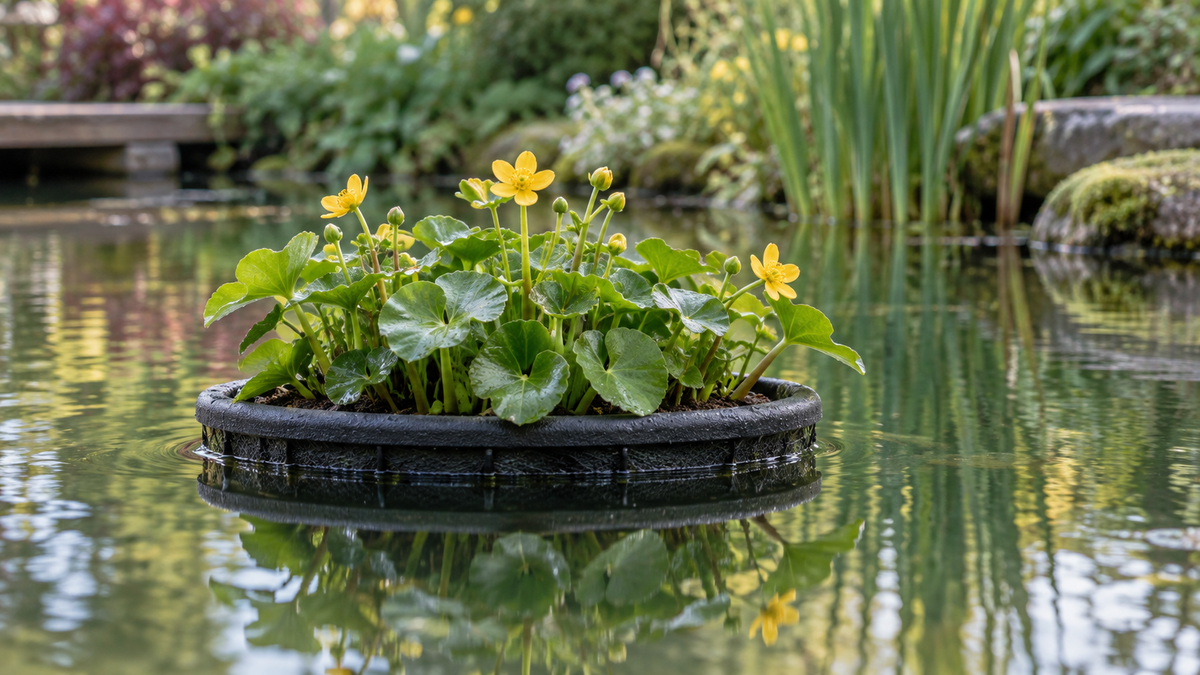
On a vegetated floating island, prioritize marginal plants that are compatible with a damp root ball and the way the support holds their roots. Then, compose the group based on adult height, vigor, and available space. A large plant that is poorly positioned can unbalance a small module; several very vigorous species can make maintenance difficult.
The real issue is therefore not just knowing which plants to buy. You must prepare for them to live together and for the retrieval of the raft once they have grown. This guide helps you build a coherent composition, from choosing the support to monitoring the first season.
Define the role of your island
Start by formulating the objective in one sentence. Do you want to add flowers to a deep area without a planting shelf? Create a plant presence visible from the terrace? Install a module intended for a water treatment project? The choice of the device and the plants must meet this objective.
The work presented by Clemson University on floating wetlands describes platforms whose roots grow into the water. These devices can contribute to nutrient management, but their performance depends on the conditions of the water body. A small decorative support for pots should not be presented as a miniature treatment plant.
For a garden pond, start with a project you can maintain. A modest group that is well-monitored allows you to learn how plants react. If you are looking for a measurable result on water quality, have the sizing and monitoring procedures specified before buying a large surface area of modules.
Read the design of the support before choosing the plants
Some models hold individual pots; others are mats featuring planting slots. Look at how the root ball is held, where the water level is, and how the roots can develop. These details are more useful than a photo of the island already covered in foliage.

The 1m by 1m floating mat offered on Aquishop illustrates a multi-slot format. The number of slots describes the support; it does not mean that just any 25 plants will form a suitable ensemble.
For a more compact project, the Velda Floating Plant Oasis accommodates six P9 pots. The manufacturer asks that the root balls be well moistened before launching. Follow the instructions for the chosen model rather than filling all devices according to a single recipe.
Build a balanced plant palette
Start with a dominant silhouette
Decide if you want a low composition, a vertical clump, or a mix of heights. In a small pond, a mass of tall stems can block the view of the water. On a larger body of water, a very low ensemble will mainly be visible from a nearby observation point.
Draw the plants at their adult size. Distribute the volumes in a balanced way and keep the subjects that you will need to monitor closely accessible from the edge of the module. Avoid concentrating the largest plants on one side just because the result looks attractive on the day of purchase.
Prepare a list, then confirm each compatibility
To search for plants suitable for a Belgian natural garden, the Natagora fact sheet is a good starting point. It distinguishes, in particular, marsh marigold and water forget-me-not among low-growing damp soil plants, and yellow iris among taller semi-aquatic plants. This classification describes their environment; it does not constitute a validation for planting on just any raft.
Therefore, present your list to the supplier along with the characteristics of the support. Ask if the effective depth is suitable and how the clump will evolve. The final choice may differ for a potted root ball, an openwork basket, and a system that allows roots to develop freely under a platform.
Avoid competition that is difficult to manage
Do not mix plants solely to obtain multiple colors. Two species may bloom at different times while having very unequal vigor. A fast-growing plant risks taking the space you reserved for its neighbor.
For a first composition, limit the number of species and note their location. This simplicity facilitates monitoring: you will identify which plants are recovering well, which ones are growing too much, and the areas where the arrangement needs to be corrected. You can enrich the palette later based on these observations.
Plan for what happens under the surface
A vegetated raft also occupies volume underwater. Clemson points out that, in a shallow body of water, the roots may eventually reach the bottom. This is a point to consider if you want to keep the module mobile or be able to easily pull it back to the shore.
Identify pipes, intakes, and other equipment present under the intended location. Leave the necessary access for their maintenance. A planting should not prevent you from removing a pump or finding a fitting, even when the foliage still seems inconspicuous.
If the level drops in summer, the module's behavior may change. Check its position in the pond's usual low conditions, not just right after filling. The goal is to be able to anticipate contact with the bottom, obstruction at the shore, or excessive tension on the anchoring.
Choose a location that you can maintain
The best view is not always the best technical location. Look at the prevailing wind, the current created by equipment, and the distance to an accessible shore. You must be able to examine and retrieve the support without improvising a risky intervention.

Plan the means of anchoring and retrieval before launching, according to the manufacturer's recommendations. A planting raft is not a platform to climb onto. The larger and more heavily vegetated the module, the more moving it may require organization and several people.
Monitor the first season with some useful observations
| Timing | Priority observation | Possible decision |
|---|---|---|
| At installation | Levelness, root ball height, and accessibility | Review the setup before moving the island. |
| During recovery | Condition of leaves and plant support | Check growing conditions for a declining plant. |
| In full growth | Distribution of volumes and competition | Prepare a targeted intervention rather than waiting for overcrowding. |
| Before winter | Dead parts, species needs, and support condition | Apply maintenance instructions adapted to the system. |
Photograph the island from the same spot every few weeks. You will see differences in growth better than by relying on your memory of its initial appearance. Also, note any unusual shifting or difficulties in reaching a plant: these details will guide adjustments.
Maintain without systematically adding products
The Clemson maintenance sheet reminds us that floating wetlands intended for water treatment do not need systematic fertilizer application: their roots use the nutrients present. It also highlights the importance of removing plant matter and the difficulty that handling a mature module can represent.
For a horticultural island in pots, follow the plant's needs and the device's cultivation instructions. Do not confuse these two contexts. If a plant turns yellow, examine its installation before concluding it has a deficiency and adding a product to the water.
To prepare your composition, gather a view of the pond, the dimensions of the support, its exposure, and the list of intended species. The floating supports and aquatic plants can then be chosen together, with a realistic outlook for maintenance.
Sources and references
- Clemson University — An introduction to floating wetlands for stormwater ponds: general operation, limitations, and influence of depth. The context studied is that of stormwater management ponds.
- Clemson Cooperative Extension — Maintaining your floating wetland (2024): access, maintenance, and plant management on treatment platforms.
- Velda — Floating Plant Oasis: design and installation of the six-pot support.
- Natagora — Les plantes de la mare (2021): landmarks on plant groups in wet environments.






