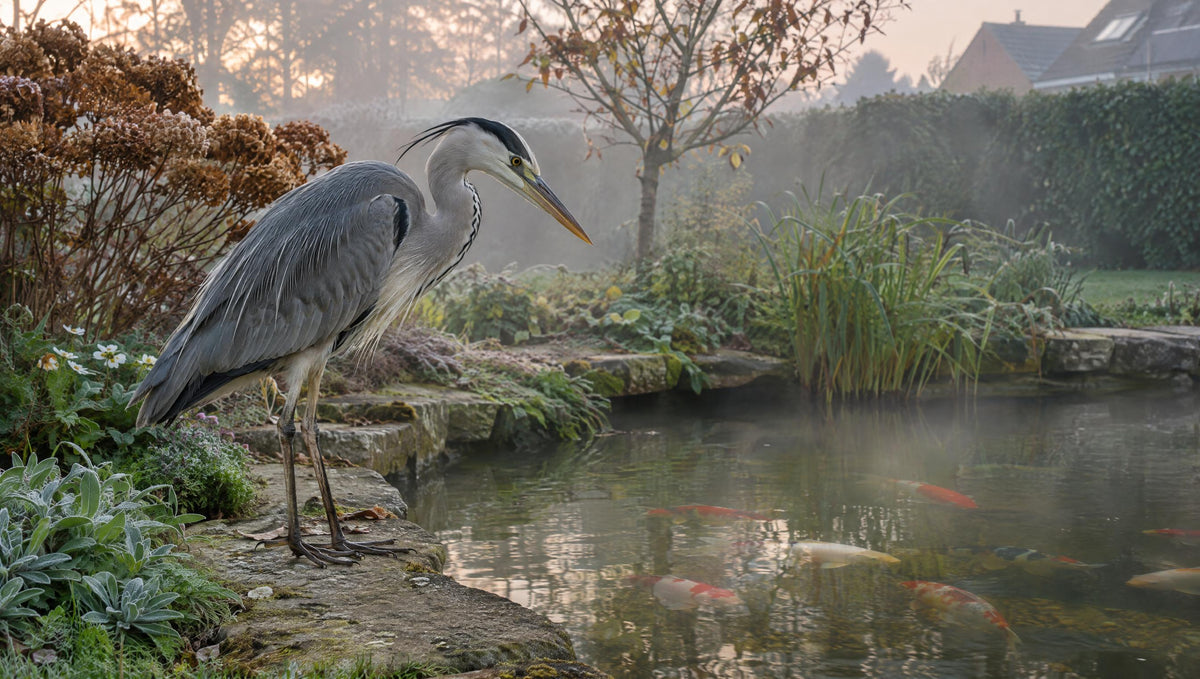
The koi remain in the deep part, the goldfish show themselves less and the distribution of food no longer attracts many. This change can accompany the cooling of the water. It can also signal a difficulty that requires a quick reaction.
The position at the bottom is not enough to make a diagnosis. What matters is the way the fish breathe, their posture, the number of individuals affected and what has changed in the pond. Here is how to examine the situation without multiplying manipulations.

Start by observing for a few minutes, from a distance
Approach calmly and stay still. Shadows, vibrations and movements at the water's edge can change the behavior you are trying to understand. Avoid throwing several handfuls of food to make them come up.
Look if the fish keep a normal position, move from time to time and breathe regularly. A calm group, in water that is gradually cooling, does not evoke the same situation as a fish lying on its side or a suddenly prostrate group.
A short video taken without chasing them is useful. It allows to compare breathing and posture later, then to transmit concrete observations to a specialist. Also note the time: a behavior seen only once does not describe the whole day.
Cold can explain a seasonal slowdown
Pond fish depend on the water temperature for their activity. When it drops, koi and goldfish generally become less active and eat less. They can spend more time in deep or sheltered areas.
Measure the water with a thermometer. The announced air temperature, that of a sunny terrace or the impression given by your hand do not constitute a measurement of the fish's living environment.
The reassuring context is a gradual change, consistent with the season, in fish that maintain their balance and show no unusual associated sign. This calls for appropriate monitoring and adjusted feeding, rather than an attempt to "wake them up".
However, cold should not become an automatic explanation. Labored breathing, a lesion or rapid deterioration must be examined even in winter. Needs also differ depending on the species: a carp is not managed exactly like a koi.
After a disturbance, look for what has changed
A transport, an introduction, work around the pond or the visit of a predator can change habits. Fish sometimes take refuge in a more discreet area after a stressful event.
Reconstruct the last interventions: arrival of new fish, filter cleaning, water top-up, treatment, major plant pruning, pump change. A precise timeline is more useful than a general assumption about the weather.
Restore calm and check the operation of the installation. Do not simply capture them to see that they are hiding. On the other hand, do not consider several days of lethargy as a normal waiting time if breathing, balance or general condition deteriorate.
One fish or the whole group?
If several fish change their behavior at the same time, quickly examine the common conditions: water, oxygenation, filtration and recent event. A breakdown or an unsuitable water supply can affect the entire population.
Also read:
If only one fish stays apart while the others behave normally, observe it more closely. An individual difficulty becomes possible, but this does not exclude a water problem: fish do not all react with the same sensitivity.
This distinction helps to organize the research. It does not allow, on its own, to choose a medication or to state that a parasite is present.
Test the water before adding a treatment
Transparent water can present unfavorable parameters. Notably record nitrites, ammonium/ammonia, pH and KH, in addition to temperature. The choice of additional analyses will depend on the history.
Ammonium and ammonia are linked; the proportion of the most toxic form varies notably with pH and temperature. Therefore, interpret the results together, following the test instructions. An isolated value, without unit or measurement conditions, can be confusing.
If the behavior changed after filling with tap water, report it. The possible presence of chlorine or chloramines must be taken into account with an appropriate control and water treatment.

The JBL ProAquaTest CombiSet for pond includes notably pH, KH, GH, ammonium and nitrite tests. Keep the numerical results and check the validity of the reagents. The mention "correct water" does not allow to follow an evolution.
Control the circulation and oxygenation
Check that the pump is actually running and that the return flow has not greatly decreased. A clogged inlet, a loaded filter or an obstructed hose can affect the installation without everything appearing stopped.
Hot water can contain less oxygen at saturation. Fish, microorganisms and the decomposition of waste also consume it. The risk therefore deserves special attention during high heat, with a large population or after a breakdown.
If the fish breathe with difficulty, improve without delay the exchanges with the air using a suitable equipment already available and seek help. Do not start a large stirring of sediments to "clean" during this episode.
An aerator like the OASE AquaOxy 1000 can complete a properly sized installation. You must choose its capacity and the arrangement of the diffusers according to the pond. The presence of bubbles does not constitute a measure of dissolved oxygen.
What signs should accelerate the management?
- Breathing significantly faster or more labored than usual.
- Loss of balance, a fish lying on its side or unable to move normally.
- Fins permanently closed, repeated rubbing or visible lesions.
- A sudden change affecting several fish.
- Rapid worsening or mortalities.
These signs justify a quick opinion from a veterinarian competent in fish, with the water measurements and observations. Look at the skin and respiratory movements from the outside; do not pull back the opercula yourself and do not improvise a sample.
The same attitude can have several causes. A specialized examination may be necessary to distinguish a gill issue, an infection or another problem. A photograph alone does not reveal everything.
The errors that often complicate the situation
Avoid chaining an antiparasitic, salt and another product because the first did not give an immediate result. The compatibilities and effects on the filter must be known. A poorly chosen treatment can add a constraint to an already unstable situation.
Do not also replace all the water without preparation. A major intervention can abruptly change the temperature or parameters. In case of measured pollution, the correction must be organized with appropriate water and advice adapted to the situation.
Finally, do not overfeed inactive fish. Remove the abandoned food and adjust the distribution to the appetite, the temperature and the food recommendations. Feeding more does not correct a lack of oxygen or a water imbalance.
Prepare a useful report to understand the problem
Note temperature, water results, number of fish affected and last interventions. Add a calm video and the references of the pump and the filter: these elements make the advice much more precise.
See the analysis case for pond →
Consult the AquaOxy 1000 aeration kit →
To go further:
- How many fish can be accommodated in a pond?
- Why do fish come to breathe at the surface of the pond?
Sources
- OATA — How to Look After Pond Fish: behavior, temperature, feeding and water monitoring.
- RSPCA — Keeping Your Fish Healthy: signs to observe and recourse to a veterinarian.
- Merck Veterinary Manual — Environmental Diseases of Aquatic Animals: oxygen, ammonia, temperature and water-related risks.
- Aquishop sheets of the JBL CombiSet Pond and the AquaOxy 1000 linked in the article: equipment characteristics.