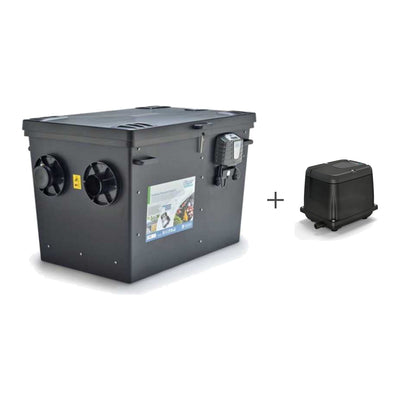
The short answer: a drum filter passes water through a very fine screen wrapped around a cylinder. When the screen becomes clogged, the drum rotates and nozzles automatically rinse it: waste leaves the system before rotting, without manual cleaning. Behind it, a biological stage, often a moving bed, processes dissolved waste. It is the standard solution for heavily stocked koi ponds. Oase’s ProfiClear Premium Compact-L filters at 60 µm, and Oase particularly recommends it for koi ponds up to 35 m³.
Key points
- Very fine screen (60 µm on the ProfiClear Compact-L), automatic rinsing.
- Waste leaves the system instead of decomposing in the filter media.
- Gravity-fed version (filter at water level) or pumped version (filter above the pond).
- The moving bed requires a dedicated air pump, in addition to pond aeration.
- For a less heavily stocked pond, a screen filter such as the BioTec ScreenMatic² remains a very good solution.
How does a drum filter work?
In a conventional filter with filter media, the trapped debris remains in the filter until the next cleaning. During this time, it decomposes, releases ammonia and phosphates, and consumes oxygen. The more heavily stocked the pond is, the more frequently it must be cleaned.
The drum filter solves this problem. Water enters a cylinder covered with a stainless steel or polyester screen and passes through it to the outside. Everything larger than the mesh remains trapped. When the screen becomes clogged, the water level rises on one side; a sensor detects it, the drum rotates, and a row of nozzles rinses the screen from the outside in. The waste falls into a trough and is discharged into the sewer or garden. The cycle lasts a few moments and repeats as often as necessary.

Why is the drum filter so popular for koi?
Koi are large fish that eat a lot and produce a lot of waste. A heavily stocked koi pond quickly clogs a filter with filter media, especially in summer. The drum filter offers three advantages:
- Clearer water, thanks to a very fine mesh: the ProfiClear Compact-L traps everything larger than 60 µm.
- Better water quality: waste is removed before it decomposes, reducing the workload on the biological stage.
- Almost no more chores: the drum cleans itself. You just need to check the screens and waste discharge from time to time.
Gravity-fed or pumped: which version should you choose?
The ProfiClear Premium Compact-L is available in two versions, which are installed differently.
| Gravity-fed | Pumped | |
|---|---|---|
| Filter position | At water level | Out of the water, above pond level |
| Water inlet | By gravity, DN 110 PVC bottom drain and skimmer | Via a pump, 2" threaded inlet |
| Return to the pond | Via a return pump | By gravity, DN 110 outlet |
| Inlet flow rate | 10,000 to 25,000 l/h | 10,000 to 20,000 l/h |
| Ideal for | New pond with bottom drain | Existing pond without bottom drain |
Flow rates and fittings: Oase data for the ProfiClear Premium Compact-L (ref. 49981 gravity-fed, 49979 pumped).
The gravity-fed version is the most efficient when building or renovating a pond: the bottom drain sucks up waste where it settles, and the pump, placed after the filter, only circulates clean water. The pumped version adapts to an existing pond: a pump pushes water to the filter placed above pond level, and the water flows back down by gravity. For this version, allow for a 50 mm pipe between the pump and the filter: the required flow rate is quickly lost in a thinner pipe.


What is the moving bed air pump for?
The Compact-L includes a Moving Bed chamber filled with 60 liters of Hel-X 13 media. These small plastic media provide a large surface area for bacteria. They only work well when constantly moving: it is the air blown into the bottom of the chamber that keeps them moving, keeps them clean, and provides oxygen to the bacteria. Oase recommends the AquaOxy 2500 as the air pump to connect to the filter: 2,500 l/h, approximately 40 l/min at 1 m depth, 40 W. Our ProfiClear Compact-L gravity-fed and ProfiClear Compact-L pumped packs include the filter and this air pump.
Do not confuse: the moving bed air pump works for the filter. For oxygen for the fish, provide separate aeration, with its own diffusers in the pond. Install the air pumps away from water, ideally above pond level.
For what pond volume?
Oase rates the Compact-L up to 120 m³ in the pumped version and 140 m³ in the gravity-fed version, and particularly recommends it for koi ponds up to 35 m³. Our packs are designed for ponds from 10 to 40 m³. Beyond 35 m³ with koi, the higher XL range is more suitable. Volume does not tell the whole story: a very heavily stocked or generously fed pond deserves the model above.

Can a screen filter be enough?
Yes, in many cases. The BioTec ScreenMatic² Set 90000 is a complete gravity-fed kit: filter with a continuous screen that separates impurities larger than 300 µm, self-cleaning Bitron C 110 W UV-C unit, AquaMax Eco Premium 20000 pump, and BioKick bacterial activator. Oase rates it for ponds from 5 to 25 m³ in its kit description, and up to 22.5 m³ with koi. The screen removes large waste, the filter media provide fine and biological filtration, and they clean directly in the filter. It costs less than a drum filter, but requires more maintenance.
In summary: for a very heavily stocked koi pond, a desire for crystal-clear water, and a minimum of maintenance, the drum filter is the best choice. For a moderately stocked koi pond, a properly sized ScreenMatic² gives excellent results.
The workshop's advice: think about waste discharge from the start. A drum filter regularly discharges small amounts of loaded water: you need a drain to the sewer, a soakaway, or an area of the garden that can accept it. This water rich in organic matter makes excellent fertilizer for flower beds.
What else should you plan for?
- A water pump suited to the filter's flow range (return pump for gravity-fed, supply pump for pumped).
- A UV-C unit if the pond is prone to green water: the drum does not trap microscopic algae in suspension.
- Pipes and fittings: DN 110 PVC for gravity-fed inlets and returns, 50 mm reinforced hose for the pumped circuit, stainless steel hose clamps.
- Separate pond aeration for the fish.
- Electrical supply protected by a 30 mA residual current device, and access to water for the rinsing nozzles depending on the models.
Errors to avoid
- Undersizing the pump relative to the filter's flow range.
- Forgetting waste discharge or placing it too high.
- Using the moving bed air pump to oxygenate the pond.
- Installing a gravity-fed version without suitable bottom drain or skimmer.
- Relying on the drum against green water: you need a UV-C for phytoplankton.
Frequently asked questions
How does a drum filter work?
Water passes through a very fine screen wrapped around a cylinder. When it becomes clogged, the drum rotates and nozzles automatically rinse it; the waste is discharged out of the system.
What is the filtration fineness of the ProfiClear Compact-L?
Its screen traps everything larger than 60 µm, according to Oase.
Gravity-fed or pumped: what is the difference?
In gravity-fed, the filter is at water level and receives water through a bottom drain and a skimmer; a pump returns the filtered water. In pumped, a pump supplies the filter placed above the pond and the water flows back down by gravity.
Does a drum filter replace the UV-C?
No: it traps particles, but not microscopic algae in suspension. A UV-C remains necessary against green water.
Written by the Aquiflor team, a specialized pond and lake store in Nodebais (Belgium), an official Oase repair workshop. Updated in November 2026. Technical specifications: Oase manufacturer data sheets for the products mentioned.
Are you hesitating between a drum filter and a ScreenMatic? Send us the volume of your pond, the number of koi, and a few photos to support@aquiflor.com or call 010 86 03 54: we will help you choose.