The short answer: an automatic feeder dispenses several small portions a day at set times. The fish digest the food better, fewer pellets are lost at the bottom, and the filter is less burdened. Choose a solar model (Superfish Solar Fish Feeder S or XL, 1 to 6 meals a day, no cable) for simplicity, or a mains model (Koi Pro Fish Feeder, up to 24 meals a day) for finer adjustment in a koi pond. Set the ration according to the water temperature, and test it for a few days before going on holiday.
Key points
- Several small meals are better than one large one: better digestion, cleaner water.
- Solar: no cable, 1 to 6 meals, approximately 3 months of autonomy without sunlight once charged.
- Mains: 1 to 24 meals, finer adjustment, 10 m cable.
- Pellets from 2 to 9 mm depending on the model.
- The ration follows the water temperature: reduce it, then stop when it cools down.
Why feed with an automatic feeder?
In nature, a koi carp nibbles all day. In a pond, we often feed it once or twice a day, in large quantities. Result: some of the food is not eaten, sinks, decomposes, and loads the water with nutrients that feed the algae. The filter has to absorb a large amount of waste all at once.
An automatic feeder changes the game: it distributes the daily ration in small portions, at regular times. The fish eat everything that falls, digest better, and the production of waste is spread out. Superfish summarizes it like this: giving a small amount of food regularly is good for the health of the fish and the pond, and limits water pollution. It is also the solution for holidays, weekends, and days when you come home late.

Solar or mains: which feeder to choose?
| Solar Fish Feeder S | Solar Fish Feeder XL | Koi Pro Fish Feeder | |
|---|---|---|---|
| Power supply | Solar, lithium battery | Solar, lithium battery | Mains, 10 m cable |
| Reservoir | 6 liters | 12 liters | 7 liters |
| Meals per day | 1 to 6 | 1 to 6 | 1 to 24 |
| Range | 1, 2 or 3 m, 120° | 1, 2 or 3 m, 120° | — |
| Pellets | Medium | 2 to 9 mm | 2 to 9 mm |
| Mounting | Screw-on base or stakes | Base and mountings | Wall and floor mount |
Specifications: Superfish product sheets.
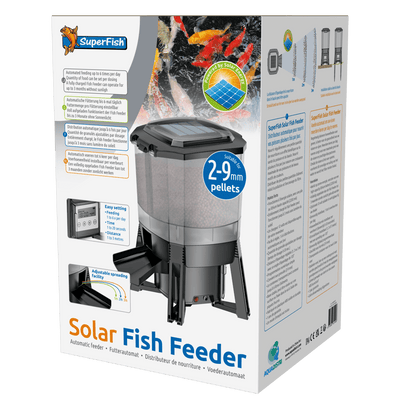
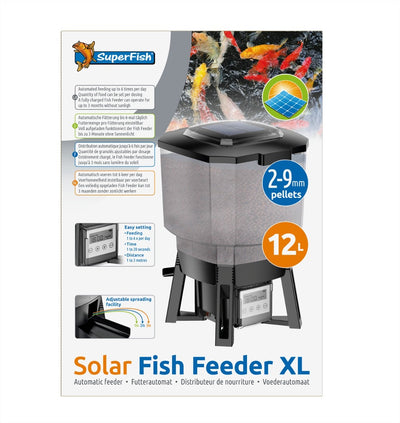
Solar models require no cable: the integrated panel recharges a 2,200 mAh lithium battery which, once charged, allows it to operate for about three months without sunlight. The Solar Fish Feeder S and its 6-liter reservoir are suitable for most ponds; the Solar Fish Feeder XL, with 12 liters, is designed for heavily stocked ponds and long absences. Both project the food over a wide area, at 1, 2 or 3 m depending on the setting, which prevents the largest fish from monopolizing everything. For a feeder installed in the shade, a 12 V charger allows you to recharge the battery without sunlight.
The mains model, the Koi Pro Fish Feeder, goes further in portioning: from 1 to 24 distributions a day, with an adjustable quantity per dose. It is the tool of koi enthusiasts who want to give very small portions every hour in full season, for steady growth. It mounts on the wall or floor and has a 10 m cable.


How to set the ration?
- Start with the current ration: what your fish eat in a few minutes, multiplied by the number of meals you give today.
- Divide it by the number of scheduled distributions: with 6 meals, each portion is six times smaller than a single meal.
- Adjust the dosing duration (from 0 to 20 seconds on the Solar Fish Feeder S) by observing: if pellets are still floating after a few minutes, reduce.
- Spread the meals during the day, when the water is warmest and the fish are most active, and avoid feeding just before night.
- Check every week the reservoir level and the absence of leftovers at the bottom.
The workshop's advice: the feeder does not replace your observation. Still spend a few minutes by the pond during a meal, once or twice a week: it is the best time to spot a fish that is no longer eating, swimming sideways, or rubbing itself.
And according to the season?
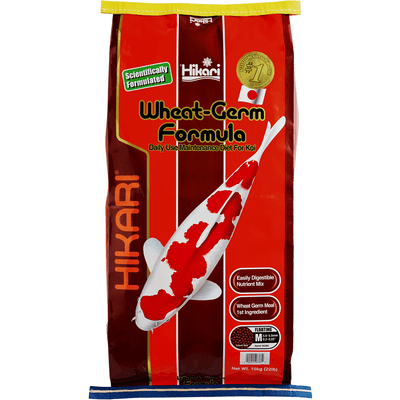
The ration must follow the water temperature, as with hand feeding. Above 18 °C, Hikari indicates 2 to 4 meals a day, each dose consumed in 5 minutes: this is the period when the feeder gives the best, with a basic food like Hikari Staple. When the water drops to 12 to 15 °C, reduce the number of meals and gradually switch to a wheat germ food like Hikari Wheat-Germ. Below 12 °C, one ration a day at most is enough. Around 6 to 7 °C, stop and store the feeder for the winter, after emptying and cleaning it.
Moisture and food: a damp pellet sticks, molds, and blocks the mechanism. Fill the reservoir in dry weather, put only the quantity needed for one or two weeks, and close it tightly. Food that has absorbed moisture is thrown away.
Going on holiday with a feeder
It is the ideal situation for a feeder, provided you prepare it. Install it at least a week before leaving and observe the quantities. During the absence, it is better to slightly underfeed than to overfeed: healthy adult koi tolerate a few days of reduced rations very well, while too much food in a warm pond can degrade the water. Also check that the pump and filter are clean before leaving, and ask a neighbor to keep an eye on the water level.

Where to install the feeder?
- By the pond, where the fish are used to coming to eat.
- Away from the skimmer suction, so that the pellets are not sucked in before being eaten.
- In full sun for a solar model, or within reach of a socket protected by a circuit breaker for a mains model.
- Securely fixed, with the base screwed on or the stakes, so that a gust of wind or a cat does not knock it over.
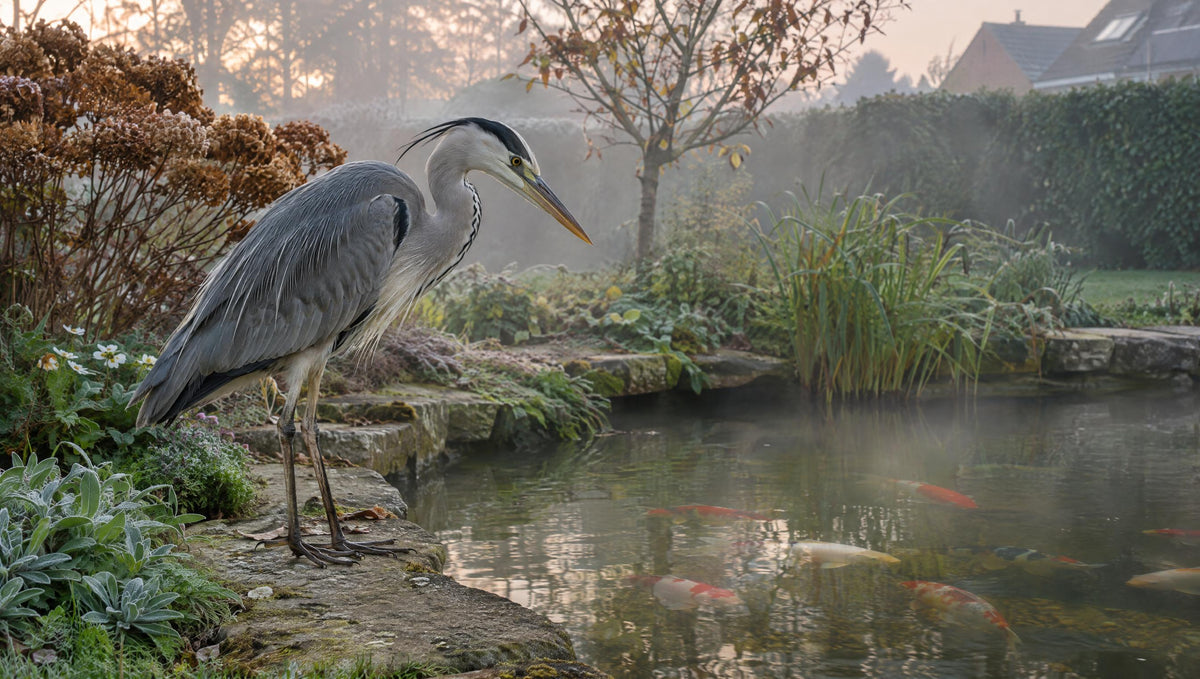
- Out of reach of herons if possible: a feeder that always attracts fish to the same place can also attract predators.
Errors to avoid
- Keeping the summer ration in autumn: the fish digest less and leftovers accumulate.
- Filling the reservoir for a month: the food absorbs moisture.
- Installing the feeder the day before leaving, without adjustment.
- Choosing pellets too large for the mechanism or for the fish.
- Forgetting to store it in winter.
Frequently asked questions
Does a solar feeder work without sunlight?
Yes: once the lithium battery is charged, the Solar Fish Feeder works for about three months without sunlight according to Superfish. A 12 V charger is available as an option.
How many meals to program per day?
In full season, several small meals spread throughout the day. Hikari indicates 2 to 4 meals above 18 °C; a feeder allows you to fractionate further with smaller portions.
What pellet size does a feeder accept?
The Solar Fish Feeder XL and the Koi Pro Fish Feeder accept pellets from 2 to 9 mm; the Solar Fish Feeder S is designed for medium pellets.
Should the feeder be used in winter?
No: when the water drops to 6 to 7 °C, we stop feeding. Empty, clean, and store the feeder until spring.
Written by the Aquiflor team, a store specializing in ponds and ponds in Nodebais (Belgium), official Oase repair workshop. Updated in November 2026. Specifications: Superfish product sheets; rations: Hikari recommendations.
Are you hesitating between solar and mains? Send us the size of your pond and the number of fish to support@aquiflor.com or call 010 86 03 54.