

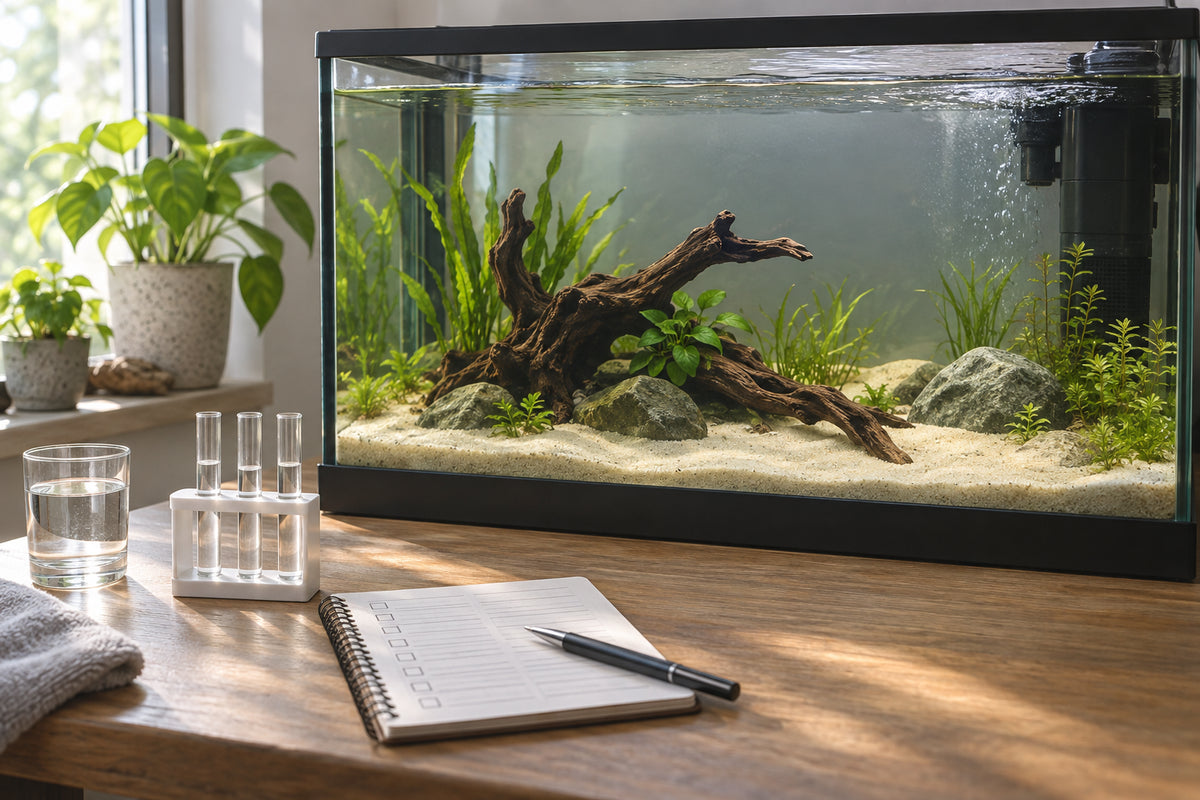
You have just filled your aquarium. The filter is running, the plants are installed, and the water is becoming clear. Yet, an essential step is still taking place on a microscopic scale: the establishment of biological filtration. It is during this phase that nitrites can accumulate if their production exceeds their conversion.
Understanding the nitrite spike above all allows you to better organize the start-up. You should neither blindly wait for a date nor cause heavy pollution to obtain a nice curve. The goal is to prepare an aquarium capable of gradually welcoming its population, with consistent test results.

Why is a new filter not immediately mature?
A filter performs several functions. The pump circulates the water. The mechanical elements retain particles. The biological media house microorganisms that help convert nitrogenous waste. These functions do not necessarily become operational at the same pace.
Circulation can work from the first day while the biological community is still being established. The water looks clean because particles are removed, without this proving a sufficient capacity to process the waste of future fish.
Maturation depends on the environment: available media, temperature, oxygen, water quality, inputs, and possible seeding. Two aquariums started on the same day can therefore evolve differently.
Where does the nitrite spike come from?
Nitrification converts ammonia compounds into nitrites, then nitrites into nitrates. At the start, the different conversion capacities are established gradually. If nitrites are produced faster than they are used, their concentration increases; it can then decrease as the system develops.
Nitrifying bacteria are not limited to the often-cited names of Nitrosomonas and Nitrobacter. Recent studies on freshwater aquariums also show the role of Nitrospira, some members of which perform complete nitrification, as well as other microorganisms. For the hobbyist, monitoring the function remains more accessible than identifying each organism.
How to read a spike curve without making it a calendar?

The graph shows a general idea: a concentration can rise, reach a maximum, then go back down. It does not allow you to predict the day of the spike in your aquarium. Its amplitude and duration vary, and a theoretical curve does not replace your measurements.
A recent study monitored three household aquariums during their setup. The microbial and chemical trajectories were not identical between the tanks. This type of observation reminds us that an average duration does not constitute an individual validation of the start-up.
It is also possible not to observe a marked spike: measurements too far apart, low inputs, plant activity, or already colonized media can change what we see. You must then examine the protocol and the data, without adding a large amount of waste simply to make the NO2 rise.
Prepare the start-up before the arrival of the fish
Check that the filter is correctly assembled, that the water follows the intended path, and that the media remain bathed in an appropriate circulation. Prepare the filling water according to its characteristics. For tap water, an appropriate conditioner like JBL Biotopol can be used according to its instructions.
Then choose a fishless maturation protocol adapted to the substrate and the setup. A tank with a soil that releases ammonia is not monitored exactly like a tank on low-load sand. The inputs required for the protocol must be controlled; ammonia-based household products are not suitable for improvisation.
Stocking is prepared in parallel: compatible species, adult size, group needs, and available volume. The end of the biological start-up does not authorize a population that would exceed the physical or behavioral capacities of the tank.
The measurements to follow and what they say
| Parameter | Question it helps to answer |
|---|---|
| Ammonium/ammonia | Are the first nitrogenous compounds accumulating? |
| Nitrites, NO2 | Is this intermediate step detectable or rising? |
| Nitrates, NO3 | How is this form of nitrogen evolving, taking into account new water and plants? |
| pH and KH | Does the environment remain consistent with the project and biological operation? |
| Temperature | Are the conditions stable and adapted to the future inhabitants? |
The JBL ProAquaTest CombiSet Plus NH4 includes NH4/NH3, NO2, NO3, pH, and KH. A thermometer completes this monitoring. Follow the instructions and note the units: a nitrate reading cannot be used in place of a nitrite result.
Record the dates, inputs, and water changes. The same value does not have the same meaning before a planned input in the protocol, just after a dilution, or several days later. The tests must be close enough to understand the evolution; they are often daily during the sensitive phases of a freshwater start-up.
What place for Aquipond Aquarium NitriBoost?
Aquipond Aquarium NitriBoost 150 ml is intended to accompany the biological start-up of the freshwater aquarium. The sheet indicates, for the start-up, 10 ml for 50 liters every two days for two weeks. Check these instructions on your bottle and calculate the quantity based on the volume actually concerned.
The frequency of application does not constitute a calendar for introducing fish. The capacity of the tank must be checked by the tests and the protocol followed. Likewise, the mention "up to 750 liters" does not necessarily represent a complete start-up treatment of this volume: several applications consume more product than a single dose.

When can the start-up be considered sufficiently advanced?
The decision rests on repeated measurements and on the demonstrated capacity to process the inputs of the protocol, with ammonium/ammonia and nitrites returning to appropriate undetectable levels for the test. A single zero result obtained in water with almost no load does not provide the same information.
Have the data validated if you are starting out. Then introduce the animals gradually, without abruptly increasing meals. The tests continue after the first introductions: the actual load changes and the filtration must remain capable of handling it.
Actions that can restart an imbalance
Replacing all media, cleaning aggressively, letting the masses dry, or permanently stopping circulation can disrupt the established community. A sudden increase in the number of fish or feeding can also exceed the available capacity.
Prepare the maintenance to preserve the useful media and quickly restore proper operation. If you change filters, study the transition before removing the old one. Buying a larger device does not immediately give it the biological maturity of the one it replaces.
What if fish are already present during the rise?
The subject then becomes a water quality correction. Check the aeration, reduce food inputs according to the needs of the species, and prepare an appropriate renewal after analyzing the new water. Do not let the animals suffer a spike under the pretext that it would be a mandatory step.
If the fish are breathing with difficulty, lose balance, or if mortality appears, quickly ask for a veterinary opinion. An activator does not replace this care.
To organize your start-up, contact Aquiflor with the volume, soil, filter, products used, and your analysis chart. These elements allow you to judge the real progress and prepare an adapted stocking.
Our guides on this subject
- How to detect an excess of nitrites in an aquarium?
- How to reduce nitrates in an aquarium?
- Nitrobacter: definition and role in the nitrogen cycle
- Nitrobacter in aquarium: role of bacteria
- Where to find nitrifying bacteria for your aquarium?
- Can you grow aquarium bacteria yourself?
- When to add bacteria to an aquarium?
On related topics:
Sources
- Study on microbial succession and the start-up of household aquarium biofilters.
- McKnight and Neufeld, 2024 — diversity of nitrifying communities.
- OATA — setting up a freshwater tank aquarium.
- Merck Veterinary Manual — management of start-up problems.
- Aquipond — NitriBoost Aquarium and related Aquishop sheets.















