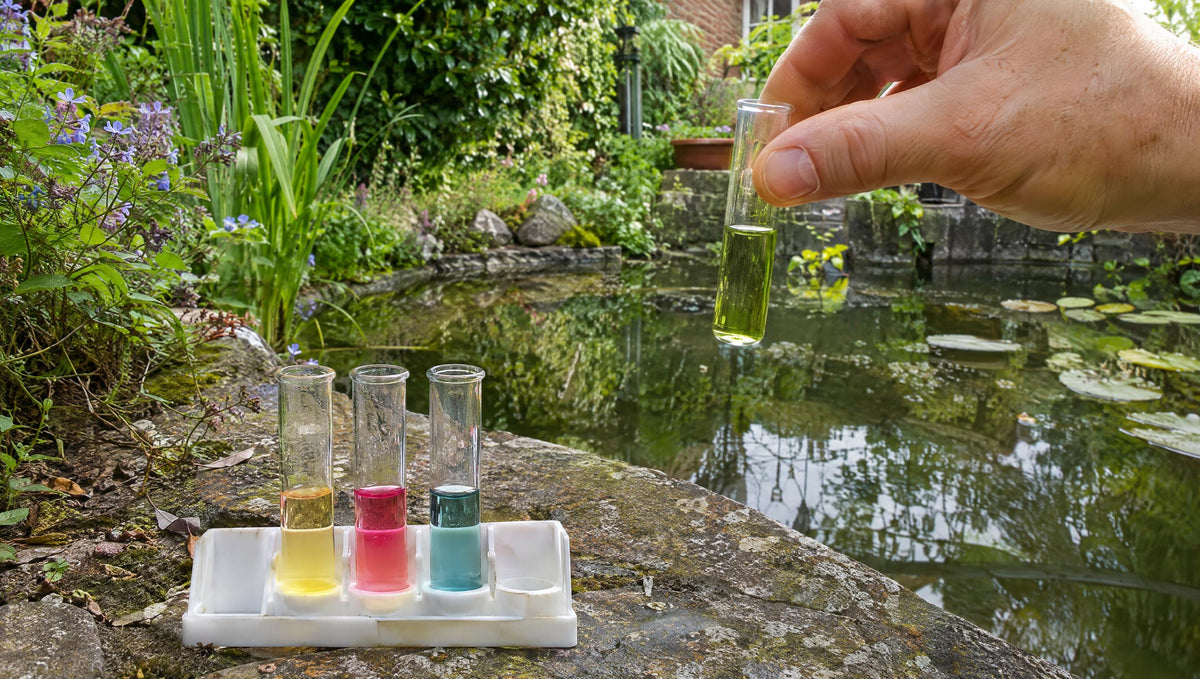
Clear water can contain nitrites. Conversely, slightly colored water may have stable parameters. To understand what is happening in a pond, observing the fish and taking a few measurements complement each other.
pH, GH, KH, and nitrites provide four different pieces of information. Reading them together helps you avoid correcting the hardness when the problem is with the filter, or trying to change the pH without understanding its variations. Here is how to go from the test result to a useful decision.

The four parameters at a glance
| Parameter | What it indicates | The question to ask |
|---|---|---|
| pH | Acidic, neutral, or alkaline | Is it suitable for the fish and does it remain sufficiently stable? |
| GH | Hardness mainly related to calcium and magnesium | Does the water have mineralization suitable for the animals kept? |
| KH | Alkaline reserve measured by the test | Does the buffering capacity provide sufficient protection against pH variations? |
| Nitrites, NO₂ | Intermediate in the nitrogen cycle | Does the biological filtration correctly convert nitrogenous waste? |
Keep the kit instructions. Units and precision vary depending on the tests: a value without units, recalled from memory, can be misinterpreted. Photographing the result next to the color chart also makes it easier to communicate with an advisor.
pH: monitor its trend
pH indicates the acidity or alkalinity of the water. The scale is logarithmic: a variation of one unit does not represent a small proportional difference. Therefore, avoid sudden corrections intended to quickly reach a figure read on the internet.
In a planted pond, photosynthesis and respiration change the amount of dissolved carbon dioxide. This can cause the pH to fluctuate during the day. Mississippi State University explains that these variations become more pronounced when the buffering capacity is low.
If you suspect instability, take a measurement in the morning and then at the end of the day, using the same test, over several comparable days. Also record the temperature and weather conditions. An isolated result does not show this range.
Stability remains important, but it does not make any value acceptable. The result must also be suitable for the species present. Before correcting, check the KH and, if fish are present or a filter has recently been disturbed, the ammonium/ammonia: a rise in pH can increase the proportion of toxic ammonia.
KH: understand the buffering capacity
In common pond terminology, KH refers to carbonate hardness. Standard tests mainly provide an indication of alkalinity, that is, the water's ability to neutralize an acidic input. Bicarbonates and carbonates play an important role in this.
A reserve that is too low can allow the pH to vary more. The biological operation of the pond, water inputs, and the characteristics of the source water influence this reserve. KH should therefore be monitored over time, especially when the setup changes.
Aquipond KH+ is intended to increase carbonate hardness. Its usefulness is assessed after measurement. It is not necessary to add it simply because the pond is approaching spring or because a neighbor uses the same product.
Calculate the volume actually affected, follow the packaging instructions, and check the development after each addition. The correct quantity depends on the measured deficiency and the volume of water; it cannot be deduced from the surface area of the pond alone.
GH: different information from KH
GH measures total hardness, mainly related to dissolved calcium and magnesium. The USGS recalls this definition: it is not a measure of all the mineral substances present in the water.
GH and KH can change together in some waters, but they are not interchangeable. Water can have high alkalinity with relatively low hardness. There is therefore no universal rule requiring GH to always be higher than KH.
Aquipond GH+ meets a need to correct GH. If the KH is already satisfactory, choosing the corrector corresponding to the deficient parameter helps avoid an unnecessary intervention on the other.

The Aquipond GH+ data sheet recommends gradual additions and monitoring of GH and pH between applications. Keep this logic of small steps: adding several correctors simultaneously complicates the interpretation of results.
Nitrites: a result to take seriously
Nitrites appear in the conversion of nitrogenous waste. An established biological filter normally allows their conversion to nitrates. The practical goal is to maintain undetectable nitrites with a suitable test, without confusing this reading with an absolute guarantee of absence.
A spike can occur after starting the pond, over-cleaning the biological media, a breakdown, adding many fish, or overfeeding. Reconstruct recent events: they often guide the diagnosis.
In the event of an unusual result, check the measurement, the operation of the aeration, and the circulation in the filter. Reduce food inputs depending on the situation and quickly ask for suitable advice if the fish are breathing with difficulty or changing their behavior.
A partial water change can be part of the response, but the replacement water must be suitable and prepared if necessary. The proportion and pace depend on the measurements, the fish, and the available water. An improvised complete drain can create other difficulties.
Finally, pay attention to the units: some documents express nitrites as NO₂, others as nitrite nitrogen, NO₂-N. The figures cannot be compared directly. Always transmit the name of the test and its unit.
Three examples to choose the right action
Nitrites after a major cleaning
You have rinsed all the filter media and nitrites become measurable a few days later. The priority is biological function, oxygenation, and waste load. Adding GH+ without a GH deficiency does not address this cause.
Aquipond NitriBoost can accompany the seeding of the filter within its conditions of use. The data sheet indicates, among other things, a temperature above 10 °C and a pH of 6.5 to 8. You must continue the analyses: adding bacteria does not prove that the filter is immediately operational.
Low GH with satisfactory KH
Confirm the result and compare it to the water used to fill the pond. If a correction is necessary for the species kept, Aquipond GH+ corresponds to the parameter to be raised. Then follow the development after water changes to understand why the deficiency returns.
Very variable pH and low KH
Compare the morning and evening measurements and check the reliability of the KH test. A gradual correction of alkalinity may be relevant. Also examine the vegetation, algae, and overall operation: the corrector does not dispense with understanding the observed variations.
How to obtain comparable measurements?
Use a clean container, free of traces of soap or household products. Respect the sampling volume, the number of drops, the order of the reagents, and the waiting time. Dirty test tubes and expired reagents can distort the reading.
Read the color chart under the conditions indicated by the manufacturer. For hardness tests by titration, the color change marks the result according to the kit method. Do not transpose the instructions of another brand.
The JBL ProAquaTest CombiSet Pond includes pH, KH, GH, ammonium, nitrites, and phosphates. It does not include a measurement of dissolved oxygen or nitrates: these checks require complementary tests.
When to redo the tests?
The key times for your monitoring remain the spring restart, a major water change, an intervention on the filter, the arrival of fish, and any unusual behavior. During a correction or startup, bring the checks closer together depending on the observed risk.
A simple logbook is enough: date, time, temperature, results, quantity of renewed water, and intervention performed. You will thus see if a result constitutes an isolated accident or a trend. At Aquiflor, this information provides a much more useful basis for advising a treatment than a description limited to "the water looks clean".
Measure before correcting
Start with an analysis, then choose the product corresponding to the parameter to adjust.
See the pond analysis kit →
Discover Aquipond GH+ →
Discover Aquipond KH+ →
Our guides on this subject
- Aquipond Nitriboost: a balanced pond in spring
- Bactogen: instructions and dosage
- Nitrifying bacteria: their role in water balance
- Bacteria for ponds: what are they used for?
- Heatwaves: what changes underwater in the pond
- GH too low in a pond: how to raise it?
- GH+ for ponds: compare price and dosage
- KH too low in a pond: stabilize the pH
- Nitrite spike in a pond or aquarium: how to react?
- Filling a pond: rainwater or tap water?
On related topics:
- Green water in the pond: what to do?
- Nitrite spike in an aquarium: filter startup
- How many fish can be kept in a pond?
Sources
- USGS — Hardness of Water: definition of hardness.
- Mississippi State University — pH and Alkalinity: daily variations and buffering capacity.
- Mississippi State University — Total Alkalinity: distinction between alkalinity and hardness.
- University of Florida IFAS — Ammonia in Aquatic Systems: nitrogen cycle and relationship between pH and ammonia.
- Merck Veterinary Manual — Management of Aquarium Fish: biological filtration and water quality.
- JBL — Why test the water?: checks and measurement methods.
- Aquishop data sheets for Aquipond GH+, KH+, NitriBoost and the JBL kit, linked in the article: uses and conditions specific to the products.