Glass panes turn green, leaves become covered in fuzz, or the water takes on a soup-like hue: green algae in aquariums can be caused by more than one problem. A slight presence is part of tank life. However, a proliferation that hides the décor, hinders plants, or accompanies a deterioration in water quality warrants an investigation into the cause.
To act effectively, first identify where the green is: in the water, on surfaces, or in the form of filaments. You can then combine cleaning, controlling inputs, and making appropriate adjustments.

Three situations not to be confused
| What you see | Useful check | Intervention to consider |
|---|---|---|
| Green water throughout the volume | Observe a sample against a white background | Look for suspended proliferation and check clarification |
| Film or spots on the glass | Compare a small cleaned area with the rest | Clean with a compatible tool and monitor how quickly it returns |
| Threads on plants or décor | Photograph the supports and affected areas | Remove the filaments and examine the growth conditions |
A slimy blanket that detaches from the bottom requires a different check. See our guide to slimy deposits in aquariums before treating it as simple filaments.
Start by checking the condition of the fish and equipment
Look at their breathing, swimming, and appetite. If the animals show abnormal behavior, immediately check the temperature, filtration, and relevant water parameters. The green color alone is not enough to explain their condition.
Check the outflow rate, the cleanliness of the filter sponge, and the operation of the heater. A filter can still make noise while circulating less water. Look for clogging or a hose problem before considering a replacement.
Once these points have been checked, you can organize the actions to control the algae. Keep a record of the measurements and interventions, especially if several people maintain the tank.
Why do algae thrive during certain periods?
In a recently set-up aquarium, plants are adapting and biological filtration is establishing itself. This phase requires gradual adjustments. A proliferation can also appear in an older tank after a change in lighting, an increase in feeding, or a major modification to the décor.
The possible causes combine: abundant light, nutrient inputs, accumulated waste, and plants that are growing less well. It is therefore rarely useful to choose a single explanation based on the color of the algae.
Go back to the previous weeks. A timer left on forced operation or a mistakenly doubled ration are concrete elements to correct. This observational work prevents adding a product without understanding what has changed.
Monitor the actual lighting of the tank
Note the time it turns on and the time it turns off, but also look at the daylight. An aquarium can receive several hours of direct sunlight before its lights even turn on.
Check the programming and any automatic modes. For a new planted aquarium, Tropica recommends in its start-up protocol an initial duration of six hours daily for the first few weeks, followed by a gradual adjustment. This guideline applies to this specific context; it is not a universal setting for all tanks.
Also adapt the intensity to the plants. Strong light requires consistency with the other growing conditions. Increasing CO₂ or fertilizers without a diagnosis to "keep up with the light" can create other difficulties.
Measure nutrients without systematically aiming for zero
Nitrates and phosphates contribute to plant nutrition. Monitoring them allows you to examine inputs and consumption. In a planted aquarium, the goal is not to blindly eliminate all elements necessary for the plants.
The JBL ProAquaTest CombiSet Plus NH4 includes nitrates, pH, KH, nitrites, and ammonium. Add a phosphate test if this measurement is useful: it is not included in this kit.
Compare the tank water with fresh water when the source of an input remains uncertain. Respect the reaction time of the reagents and note the units. A result should not be interpreted solely from a photograph of the color scale.
When can a phosphate remover be relevant?

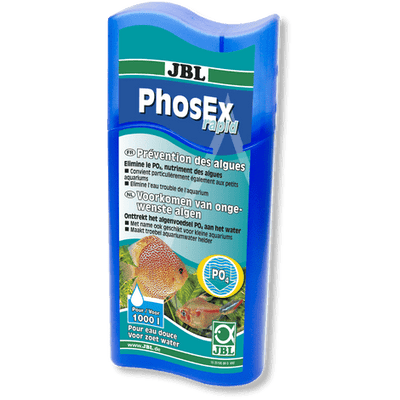
The JBL PhosEx rapid is a liquid treatment intended to lower excessively high phosphates in freshwater aquariums. Its presence in a maintenance program must be justified by the tests and the needs of the tank.
Read the current instructions before use and plan a check after treatment. If the source of input remains active, the problem may return. A correction product therefore completes a search for food, fresh water, and waste; it does not replace this search.
Clean surfaces with a compatible tool
For glass, choose an accessory suitable for glass or acrylic. A grain of sand trapped in a pad or magnet can scratch the wall. Clean the tool and avoid sliding it against the substrate.
The biOrb pads are designed for the acrylic walls of biOrb aquariums. For another material or fragile décor, check the recommended use before scrubbing.
Remove the loosened waste and heavily degraded leaves during maintenance. For filaments, our guide dedicated to filamentous algae details a gradual approach.
If the water itself remains green
Fine mechanical filtration can retain certain materials, but it must be monitored to prevent clogging. Check that the flow remains sufficient and that maintenance does not simultaneously destroy the filter's biological supports.
A suitable UV-C clarifier can be considered against suspended organisms. It must match the volume, circuit, and flow rate recommended by its manufacturer. It does not directly illuminate algae attached to leaves or stones.
Before this purchase, have the type of cloudiness and the installation specified. A UV device does not correct excessive feeding, poorly adjusted lighting, or an unsuitable population on its own.
Choose an algaecide with the right checks
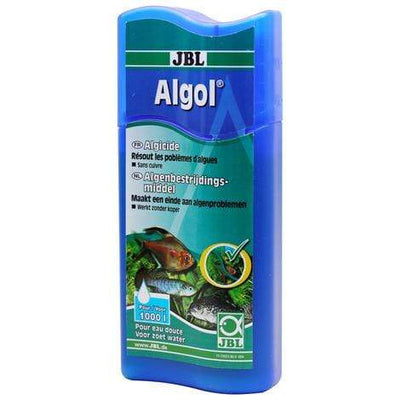
The JBL Algol is a reference for freshwater aquariums. Its use requires reading the current label, calculating the actual volume, and checking the organisms present. JBL notes the possible sensitivity of dwarf shrimp and certain mosses.
Do not consider the "copper-free" mention as a guarantee of universal compatibility. Maintain the oxygenation conditions required by the instructions and plan the removal of degraded materials. A treatment does not replace the correction of the conditions that favor recurrence.
Build a routine that lasts over time
Choose a few reproducible checks: lighting schedule, ration distributed, outflow condition, surface maintenance, and appropriate tests. The pace depends on your aquarium, but regularity makes comparison easier.
Evaluate the speed at which algae return after cleaning, not just the immediately obtained appearance. Slower growth and plants that recover are useful information for adjusting the next steps.
To establish a suitable plan, contact the Aquiflor team with the volume, population, lighting, measurements, and a photo. You will be able to select the necessary tests and equipment without multiplying blind purchases.
Our guides on this subject
- AlgExit: should active charcoal be removed from the filter?
- Algae in the aquarium: what role does lighting play?
- Bio-Exit Green: should active charcoal be removed?
- Aquarium heater: what wattage to choose?
- UV lamp for aquarium: choosing the replacement
- Cleaning the inside of aquarium glass
- Artificial plants for aquarium: choosing well
- Aquarium carpeting plants: choice and planting
On related topics:
Sources and useful readings
- Tropica: distinguish green water, filaments, and surface deposits.
- Tropica: gradual adjustments at the start of a planted aquarium.
- JBL: precautions regarding Algol and shrimp.
- OATA: water control and aquarium maintenance.
- Aquishop data sheets of the products related in the article.