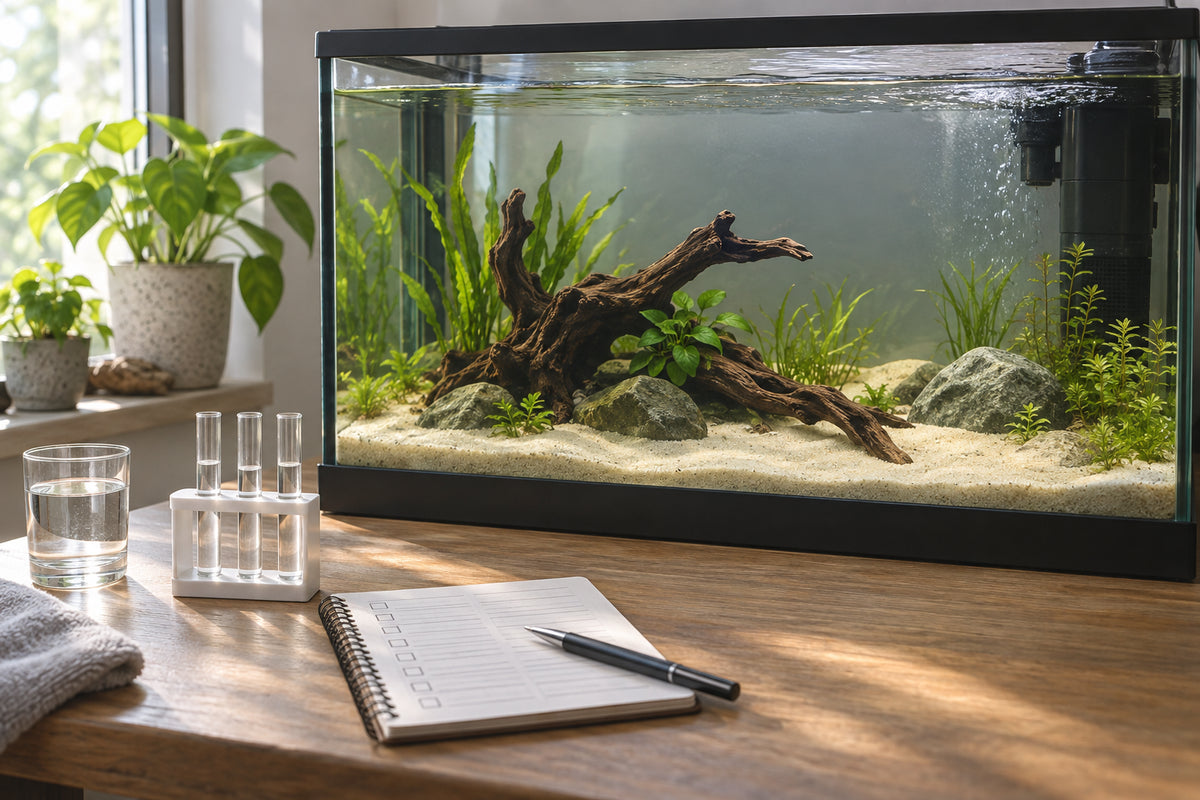
Excess nitrites are detected with a water test, not by appearance. An aquarium can be perfectly clear while its fish are exposed to nitrogen pollution. Conversely, cloudy water may have another cause. Unusual behaviors should be a cause for concern, but they are not sufficient on their own to conclude there is a nitrite problem.
To find out where you stand, you need to measure the NO2, read the result correctly, and place it in the context of the tank's history. Here is a practical method to avoid confusion and provide useful information if intervention becomes necessary.

Nitrites and nitrates: two different measurements
Nitrites have the formula NO2, nitrates have the formula NO3. Both are involved in the nitrogen cycle, but their results are not interpreted in the same way. A value cited for nitrates should never be used as a threshold for nitrites.
Read also:
- Nitrite spike in an aquarium: understanding the filter startup
- How to reduce nitrates in an aquarium?
During nitrification, microorganisms convert ammonia compounds into nitrites, then nitrites into nitrates. If production exceeds the conversion capacity, nitrites can accumulate. This happens notably at startup, after filter disruption, or when the load increases sharply.
What signs can sound the alarm?
Rapid breathing, fish gathering near the outlet, or seeking air at the surface warrant an immediate check of the water and aeration. Nitrites can disrupt oxygen transport in the blood. However, a lack of oxygen, gill damage, or another water quality problem can cause similar behaviors.
Do not wait until all fish show the same signs. Their sensitivity varies depending on the species and conditions. In case of distress, loss of balance, or mortality, quickly seek the help of a veterinarian competent in fish, while restoring the operating conditions of the setup.
To document the behavior, a short video taken without chasing the animals is useful. Note when the phenomenon started and whether it affects one species, a few individuals, or the entire tank. This observation complements the water analysis; it does not replace it.
Choosing a test that actually measures NO2
Check the list of parameters included in your kit. A device that measures pH or conductivity does not directly provide the nitrite level. Multiparameter tests can be practical for general monitoring, but their scale must allow you to read relevant low concentrations.
The JBL ProAquaTest CombiSet Plus NH4 includes nitrites, nitrates, and ammonium/ammonia, with pH and KH. This grouping helps examine several stages of nitrogen degradation. It does not automatically measure all useful parameters: oxygen, for example, requires a suitable test or device.

Performing a usable measurement
- Read the instructions before starting. Each test has its own volumes, order of addition, and reaction time.
- Check the reagents. Check their expiration date, storage, and bottle identification. An upside-down cap or a soiled tip can compromise handling.
- Collect the water in the provided equipment. Avoid containers that have held soap or household products. Follow the rinsing instructions in the manual.
- Measure the volumes and additions carefully. An eyeball estimate does not replace the fill mark. Hold the bottles as requested by the manufacturer.
- Respect the reading time. Use a timer. A color viewed too early or too long after the reaction is not necessarily comparable to the color chart.
- Note the value and the unit. Add the date, time, and recent interventions.
If your test uses two test tubes and a comparator block, use the whole set. The system allows you to take into account the water's own coloration. JBL specifies that its color chart must be used under the intended conditions; a reproduction on screen or a home print does not guarantee the same colors.
Handle the reagents away from children and follow the precautions on their label. Never pour the tested sample back into the aquarium. Once the measurement is finished, clean and store the equipment according to the instructions to ensure reliable equipment for the next check.
What result should prompt action?
In an established aquarium, the desired benchmark is the absence of detectable nitrites with a suitable test. A positive reading should lead you to verify the result and look for the cause. There is no single concentration that guarantees safety for all species and all waters.
Pay attention to the units. Some results are expressed in NO2, others in nitrite nitrogen, noted NO2-N. These are not directly interchangeable values. To go from NO2-N to NO2, the factor is approximately 3.3. Send a photo of the label or the result if you have a doubt, instead of comparing two unitless numbers.
A value between two colors does not deserve artificial precision. Note the readable range and confirm the measurement if necessary. If the shade exceeds the top of the scale, do not conclude that the value is exactly equal to the last number: the test may be out of range. Any dilution must follow a method validated by the manufacturer.
When to re-test?
| Context | Monitoring to plan |
|---|---|
| Starting aquarium | Frequent checks according to the maturation protocol, often daily in freshwater |
| Positive result or suspected increase | Quick verification, then monitoring after corrective measures |
| Filter replaced, major cleaning, or treatment | Enhanced monitoring during the readaptation period |
| Stable aquarium | Regular routine, completed as soon as behavior or operation changes |
The best logbook is the one you actually use. One line with five pieces of information is better than a photo lost among the images on your phone: date, NO2, NH4/NH3, intervention, and observation of the fish. Also keep the name of the test, especially if you change brands or have the water checked in the store.
If nitrites are present, look for the trigger
Reconstruct the last few days. Did you add fish? Increase feedings? Replace all sponges? Did the filter stop? Was food spilled in the tank? Did you use a medication or fill the aquarium with insufficiently prepared water?
This timeline prevents you from only treating the number. Check the actual flow rate and remove accessible waste without turning over all the substrate or sterilizing the filter. Also measure ammonia compounds, pH, and temperature to prepare a coherent correction.
A partial change with suitable water can reduce the concentration, but its extent must take into account the measurements, the new water, and the condition of the fish. An old, highly acidic aquarium requires particular caution with sudden variations. Do not delay professional advice by trying several products in succession.
Products come after the diagnosis
JBL Denitrol can accompany the biological restart according to its instructions. JBL Biotopol is used to prepare new water within its field of use. These functions are different: neither of these purchases exempts you from checking the cause and the evolution of the problem.
To interpret your results, contact Aquiflor with the complete values, units, volume, population, and recent changes. If the fish show marked distress, also seek a veterinarian without waiting for a simple routine check.
To go further:
Sources
- JBL — NO2 test, comparator, and reading precautions.
- OATA — freshwater aquarium water analysis.
- Merck Veterinary Manual — water quality, nitrite toxicity, and units of measurement.
- Aquishop sheets for tests and related products in the article.