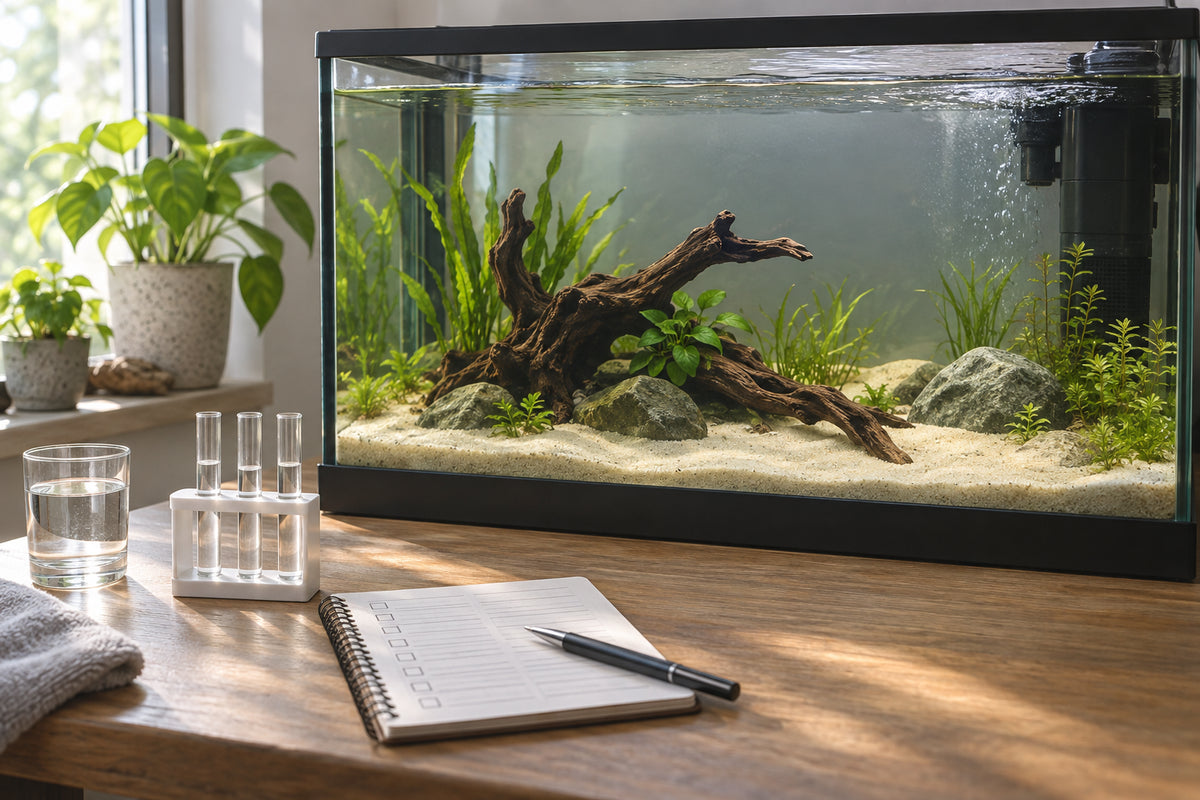
Bacteria are added to an aquarium when an identified biological need justifies it: start-up, restarting a filter, disruption after certain interventions, or as planned in the instructions for a bacterial activator. The right time depends on the condition of the tank and the product used. It is not simply a fixed date on the calendar.
Before opening the bottle, ask yourself two questions: what has happened in the aquarium, and what do the tests show? The answers help distinguish useful support from an addition that leaves the cause of the problem intact.

What we are trying to support
The biological filter houses microorganisms that help convert nitrogenous compounds. Ammonium/ammonia and nitrites require particular monitoring. However, bacteria do not constitute a single group with interchangeable functions: breaking down organic waste, ensuring nitrification, and reducing nitrates correspond to different processes.
The word "bacteria" on a label is therefore not enough. Read the intended use, the type of water concerned, and the indications. A product intended for pond sludge does not become an aquarium activator just because it contains microorganisms. Aquipond pond treatments must remain within their indicated area of application.
At start-up: supporting a monitored maturation
When an aquarium has just been installed, the media may not yet have a community capable of handling the future load from the fish. A suitable activator can be part of the start-up protocol. It is added at the time and under the conditions specified in its instructions, with prepared water and functional filtration.
Also read: Nitrite spike in an aquarium: understanding filter start-up.
The addition does not, on its own, validate the immediate introduction of the entire planned population. Monitor ammonium/ammonia and nitrites, then introduce the fish gradually once the system has been assessed. Clear water or the number of days passed does not constitute a biological test.
Preparing the tank without fish helps avoid deliberately exposing them to a rise in pollution. The protocol must take into account the actual inputs present: substrate, plants, maturation method, and products used. Do not combine several incompatible methods simply to gain a few days.
After cleaning: see what has really changed
Measured rinsing of a pre-filter and the complete replacement of all media do not represent the same intervention. In the first case, a large part of the colonized media remains in place. In the second, the biological capacity can be much more disrupted.
After routine maintenance carried out correctly, systematic addition is not the only way to preserve the balance. Maintaining useful media, restoring circulation, and properly preparing fresh water count for a lot. If you follow a commercial maintenance program, respect its instructions without interpreting the addition as a universal obligation for every aquarium.
After a major intervention, increase testing and avoid immediately increasing feeding or the population. An activator can support the recovery according to its instructions; it does not replace monitoring the remaining capacity of the filter.
After a breakdown or filter change
An interruption of filtration deserves to be described precisely: approximate duration, temperature, condition of the media, circulation, and oxygenation during the shutdown. There is no single timeframe after which all filters will behave in the same way.
If the filter water has become abnormally stagnant or smelly, ask for advice before returning its contents to the tank. The priority is to assess the installation, restore its operation, and test the water. Adding a bottle without resolving the breakdown leaves the system in the same unfavorable conditions.
During a change of equipment, prepare the transition. When the equipment and health status allow, keeping a part of the mature media or temporarily running both filters can help maintain continuity. The new device must, however, be installed according to its instructions and monitored with tests.
After medication: check compatibility
Some treatments can affect the microorganisms in the filter. This depends on the product, its instructions for use, and how the treatment was carried out. Do not assume that all medications require the same biological restart.
Consult the instructions for the treatment and those for the activator. A water change, removal of residues, or a special step may be planned. Adding bacteria while an incompatible product is still active is not necessarily relevant. In the event of a prescribed treatment, ask the veterinarian how to organize the resumption of filtration and testing.
After a water change: distinguish the functions
A large part of the useful microorganisms lives on surfaces and media. A partial water change therefore does not remove the entire biological community. Its effect also depends on the preparation of the new water and the stability of the parameters.
The conditioner and the activator have different roles. JBL Biotopol prepares tap water into freshwater according to its instructions. JBL Denitrol is presented as a biological activator. Respect the order and any indicated timeframes for the products used, without transposing those of another brand.
If nitrites are already detected
A rise in nitrites first requires protecting the fish and searching for the cause. Check aeration, circulation, and other parameters. A partial renewal with suitable water may be necessary; its extent is decided by taking into account the situation and the available water.
Also read:
An activator is not a reason to passively wait for the values to drop. If the fish are breathing with difficulty or losing their balance, quickly consult a veterinarian competent in fish. Salt, medications, and treatment mixtures must not be added randomly to support the bacteria.
How to use an activator methodically?
- Identify the correct use. Start-up, maintenance, or restart may correspond to different doses.
- Estimate the volume concerned. The commercial volume of the tank does not take into account all the space occupied by the decor and the substrate.
- Check the bottle. Storage, expiration, and duration of use after opening must follow the label.
- Read the equipment instructions. If a UV-C or other equipment is present, apply only the indications of the product used; do not invent a universal shutdown time.
- Maintain suitable circulation and oxygenation. Do not cut off all filtration in the hope of letting the bacteria "settle".
- Record the addition and continue testing. The result is assessed in the water, not by the number of milliliters poured.

The tests to keep at hand
The JBL ProAquaTest CombiSet Plus NH4 allows, among other things, to monitor NH4/NH3, NO2, and NO3, with pH and KH. These measurements answer different questions: nitrates do not allow you to directly deduce the nitrite level, and pH helps interpret the ammonia compounds.
Keep the results before and after the intervention. If several actions were taken on the same day, write them all down: cleaning, feeding, water change, addition of fish, and products. This avoids automatically attributing an improvement to a single bottle when several factors have changed.
Choose the useful time for your tank
In a stable aquarium, the best maintenance remains consistent and predictable. Suitable feeding, reasonable population, preserved media, and regular tests limit crisis situations. Bacteria in a bottle find their place in this set when they meet a need or a precise protocol.
Are you hesitating after an intervention? Send to Aquiflor the tests, the filter model, and the timeline of the last few days. The team can help you select the suitable activator and tests, or identify the technical point to correct as a priority.
To go further: