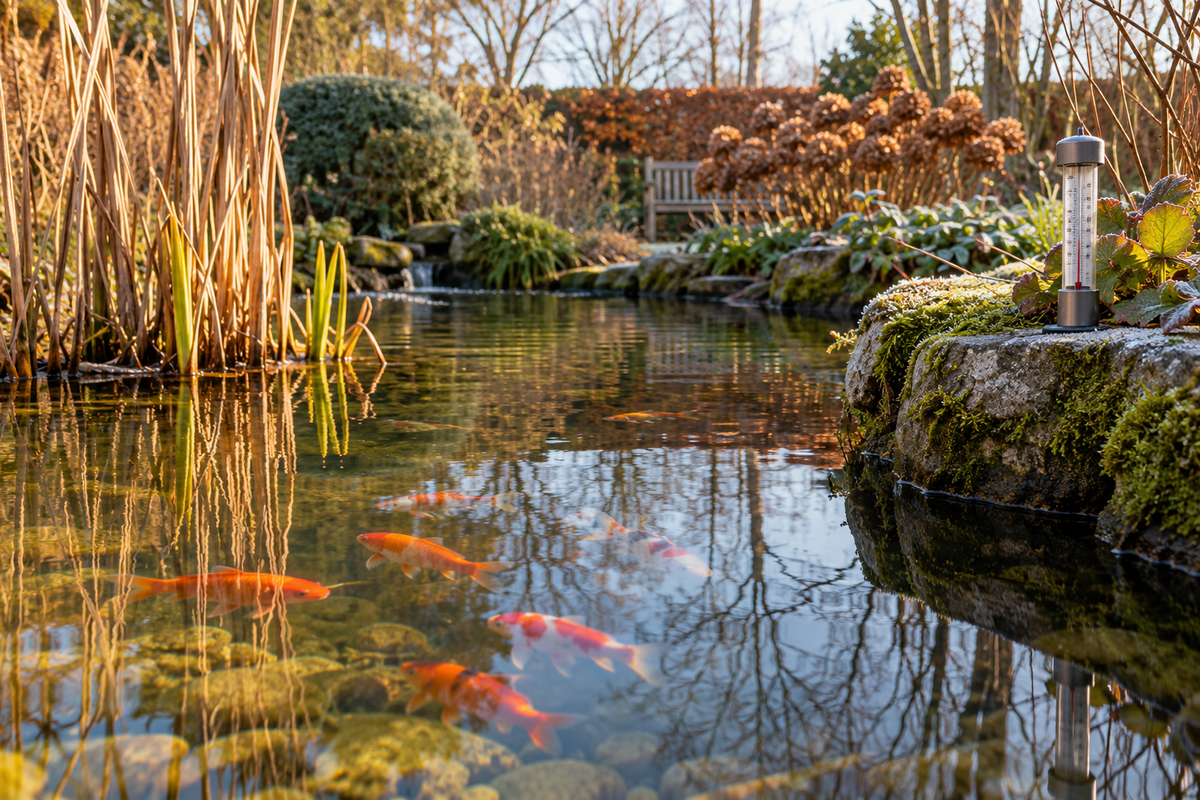
A common goldfish and an Oranda may share the same color without having the same winter needs. Similarly, a koi that has been in a suitable pond for several years does not prepare for the cold like a recently purchased, weakened, or previously indoor-kept fish.
To protect fish sensitive to the cold, start by identifying them, assessing their condition, and checking the actual conditions of the pond. A stated depth or an anti-freeze device is not enough to guarantee a successful wintering. Here is how to decide what can stay outside and what requires a prepared indoor solution.

Not all goldfish prepare in the same way
Common goldfish, comets, and shubunkins are among the varieties commonly kept in outdoor ponds. The Aqueon guide distinguishes them from more delicate forms and reminds us of their ability to get through relatively cold winters in appropriate conditions.
Also read:
This does not mean that a shallow container, exposed on a terrace, offers the same conditions as a well-designed pond. The available volume, exposure, duration of frost, and water quality remain decisive.
Breeds selected such as Orandas, Ryukins, or telescopes deserve greater caution. The OATA recommends keeping fancy goldfish in an indoor aquarium. Aqueon also indicates that their time outdoors requires returning them indoors in climates with harsh winters.
The right reflex, in Belgium or a region regularly subject to frost, is therefore to arrange their housing before the severe temperature drops. Their body shape and fins do not, on their own, allow for setting a reliable minimum temperature.
Koi, sturgeon, tropical fish: three different situations
Koi acclimated to a suitable pond
In cold water, the activity and appetite of koi decrease. A calm fish, maintaining its balance and breathing without difficulty, can simply follow the seasonal rhythm. The RSPCA describes this slowdown and the search for sheltered areas in pond fish.
However, avoid turning "the koi withstands winter" into a sufficient rule. A very heavily stocked pond, accumulated waste, or a freezing installation can put a population adapted to the climate in difficulty.
Sturgeon have a particular feeding program
They do not automatically follow the koi fasting period. The OATA reminds that they continue to be fed in winter with appropriate food. You must also take into account their oxygen needs and actual access to sinking pellets.
Identify the species and its size before choosing the installation and the food. A general "cold-water fish" indication does not replace this check.
Tropical fish kept outdoors during the summer
A summer stay does not turn a tropical fish into a hardy pond fish. Its return indoors must be planned according to the specific needs of the species and the measured water temperatures. Waiting for a freezing night to improvise exposes to avoidable difficulties.
Prepare the destination, filtration, and monitoring before the transfer. A heated room is not enough if the receiving container is new, too small, or incompatible with the other occupants.
Weakened fish require individual attention
Sensitivity does not depend solely on the species. A thin, injured fish, showing an abnormality, or one that recently arrived deserves a special assessment. Note what you observed before the cooling: was it eating normally, swimming with the group, has its appearance changed?
Labored breathing, loss of balance, or visible lesions justify a competent fish veterinarian opinion. The Merck Veterinary Manual reminds the importance of environmental factors: unsuitable water can produce signs that look like an infectious disease.
Do not automatically decide to warm or treat the fish based solely on a photo. You must link the signs to the temperature, tests, and pond history. The same actions do not suit all situations.
Assess the pond before buying equipment
Prepare a simple sheet with the volume, depths, species, number of fish, and devices in operation. Add a few water temperature readings, especially during a cold period. The weather indicates what is coming; the thermometer shows what the fish are experiencing.
- Does the pond have an area suitable for wintering its population?
- Are the pipes, filter, and water returns exposed to frost?
- Could a breakdown or overflow cause the level to drop?
- Are leaves and organic deposits managed?
- Is there safe access to check the equipment in winter?
This sheet facilitates useful advice. Indicating only "my pond is one meter deep" leaves out the surface, volume, exposure, and species needs. No single figure guarantees that all fish can spend the winter there.
An anti-freeze protects an opening, not all fish from the cold
The OASE IceFree Thermo 330 helps maintain a locally open area thanks to its heating element and frost control. Its function is not to keep an entire pond at a tropical temperature or to make a delicate variety hardy.
Aeration can also contribute to winter operation, with a setup adapted to the depth and configuration. Check the equipment instructions and the diffusion location instead of repeating a summer setting without examination.
Regularly check the opening and the level. A plugged-in device is not sufficient proof of operation. Planning who will monitor the pond during an absence is part of protecting the fish.
Prepare an indoor housing that actually works
The receiving container must allow the fish to swim and have an established biological filtration. Filling a container with pond water does not guarantee that this new system can treat their waste. Biological media and their operation count much more than the origin of the water alone.
Maintain a stable temperature and choose compatible companions. Delicate varieties can be disadvantaged for feeding when they cohabit with faster goldfish. Decorations must respect their fins and, for certain varieties, their protruding eyes.
Organize the transfer with advice taking into account the temperature difference and the chemistry of both waters. Avoid sudden transitions from a cold pond to a warm aquarium. A fish already in difficulty requires a procedure adapted to its condition.
After installation, check ammonium/ammonia and nitrites, observe the fish, and adjust meals to the container's operation. The arrival of new occupants increases the load to treat. Also prepare replacement water when the network contains chlorine or chloramines.
Useful tests to monitor wintering
The JBL ProAquaTest CombiSet Pond kit brings together measurements of pH, KH, GH, ammonium, nitrites, and phosphates. It allows monitoring several pond parameters and documenting a request for advice.

It does not measure dissolved oxygen or nitrates. If these checks are necessary, plan the corresponding tests. Keep the results with their date, the temperature, and observations: a trend often explains more than an isolated value.
Maintenance bacteria do not replace thermal protection
Autumn preparation can include waste reduction, but a bacterial product does not correct a species poorly adapted to the cold. For organic deposits, the combination of targeted mechanical maintenance and biological monitoring is prepared during an appropriate period.
A PondoVac 4 allows extracting accessible deposits. Aquipond Bactovase targets the organic fraction of sludge. Check its conditions of use on the manual; do not expect immediate action under the ice.
These solutions integrate into an anticipatory maintenance. Avoid a major stirring of the bottom at the time when the fish are wintering quietly.
Prepare winter based on your population
Start by identifying the fish, measuring the water, and checking the equipment. You can then choose a pond protection or organize a coherent indoor welcome.
See the analysis kit for ponds →
Discover the IceFree Thermo 330 →
Sources
- OATA — How to Look After Fancy Goldfish: housing, delicate varieties, and compatibility.
- Aqueon — Goldfish Care Guide: common goldfish and selected varieties in ponds.
- RSPCA — Caring for Your Pet Fish in Winter: seasonal behavior and stability.
- OATA — How to Look After Pond Fish: sturgeon feeding and water maintenance.
- Merck Veterinary Manual — Environmental Diseases of Aquatic Animals: environment quality and signs of difficulty.
- OASE — IceFree Thermo 330: function of the anti-freeze device.
- Aquishop product sheets related in the guide: test characteristics and maintenance equipment.