A comet darts across the pond with rapid movement. An Oranda advances more leisurely, with its rounded body and characteristic head growth. Both are goldfish, but their silhouette already hints at different needs.
The best goldfish for your setup is one whose adult size, swimming style, diet, and winter care you can accommodate. Colour comes next. This guide covers eleven varieties, from the common goldfish to the Bristol Shubunkin, to help you recognise their characteristics and prepare for their arrival.

One species, very different forms
Domestic goldfish belong to the species Carassius auratus. Successive selective breeding has produced elongated or short bodies, single or double tails, distinctive eyes, and different colours.
A single tail remains a single caudal fin, even when it has two lobes clearly separated by a fork. A double tail has a different structure and is sought after in several varieties known as 'fancy' goldfish.
Do not confuse goldfish with koi carp. Koi belong to a different group and notably have barbels around their mouths. The presence of red and white is not a sufficient criterion for identifying them.
1. The common goldfish
Its elongated body and relatively short fins make it an easily recognisable silhouette. Orange is the most familiar colour, but common goldfish can also be white, yellow, or have several coloured areas.
Also read:
It can grow much larger than the small fish sold in shops: allow for an adult that can reach around 30 cm, with individual variations. A small container is not an acceptable method for limiting its growth.
In a suitable pond, it is a common choice for those who appreciate active swimming and observation from the bank. Its hardiness does not preclude filtration, sufficient volume, and water monitoring.
2. The Shubunkin
The Shubunkin is distinguished by its calico coat, combining patches of several colours on a background that can appear bluish. The patterns vary widely: it is interesting to look at the fish from several angles and in natural light.
The name covers different forms. The London Shubunkin resembles the common goldfish in its silhouette and fins; other bloodlines have a more developed caudal fin. Therefore, all Shubunkins should not be defined by an identical long tail.
These active fish are commonly intended for ponds and spacious setups. The choice must account for their adult development and their cohabitation with fish of a similar pace.
3. The Comet
The Comet has a slender body and a distinctly elongated single tail, generally forked and pointed at the ends. This silhouette produces a lively and ample swimming style.
It is notably available in orange, red, white, or red and white. A red and white pattern may be designated as Sarasa depending on the commercial presentation; however, you must look at the shape of the fish to identify its variety.
The Comet needs swimming space. Avoid thoughtlessly pairing it with very slow fish: during feeding, its speed may allow it to take most of the food.
4. The Fantail and the distinction with the Veiltail
The Fantail has a shorter and taller body than common forms, with a double tail held like a fan. The length of the fins varies depending on the bloodline.
The French term 'veiltail' is sometimes used broadly in trade. However, the Veiltail is a distinct variety: its long and wide caudal fin hangs down more like a veil. Confusing the two prevents a proper understanding of the expected proportions and behaviour.
When choosing, observe an individual that swims freely, keeps its balance, and reaches its food. The beauty of the fins must go with an ability to live comfortably in the intended setup.
5. The Ryukin
The Ryukin has a tall body and a marked rise of the back behind the head. This silhouette distinguishes it from the Fantail, whose profile is more gradual.
Ryukins can be found with shorter or longer fins, and in several colours. Two fish bearing this name can therefore have quite different appearances.
Plan for a spacious aquarium, with circulation compatible with their swimming and well-chosen companions. A compact shape does not mean that a small volume is sufficient.
6. The Oranda
The Oranda is recognisable by its fleshy growth on the head, called wen. Its size changes with the individual and the bloodline; it is not relevant to promise an identical appearance at a specific age.
The Redcap is a well-known form, with a white body and a red area on the top of the head. Other Orandas feature red, orange, dark, or calico coats.
When choosing, check that the fish swims, sees, and feeds properly. If the head growth interferes with the eyes or mouth, ask for expert advice. Do not try to modify it yourself.
7. The Ranchu
The Ranchu has a compact body, a dorsal line without a dorsal fin, and head growth. It occupies an important place among the varieties appreciated by selective goldfish enthusiasts.
Its back and proportions allow it to be distinguished from other close forms, such as the Lionhead. Breeding standards have nuances; for an individual owner, the condition of the fish and its ease of swimming remain priorities.
A stable environment, suitable filtration, and compatible companions are essential. Do not choose a Ranchu assuming that its small size at the time of purchase will be final.
8. The Telescope, including the Black Moor
Telescopes have protruding eyes. The Black Moor is a well-known dark form, but fish with telescopic eyes also exist in other coats.
This particularity requires thinking about the decor and access to food. Avoid sharp surfaces and passages where the fish could injure itself. Also observe competition with other occupants.
A modification of an eye, an injury, or difficulty feeding is not solved by automatically adding a product to the water. Have the problem and the keeping conditions assessed.
9. The Celestial Eye
Its eyes are oriented upwards and it does not have a dorsal fin. This combination makes it very different from common goldfish.
It requires a carefully chosen setup and cohabitation. Effective access to food must be checked: the presence of pellets in the aquarium does not prove that every fish can find and consume them.
This variety is intended for someone ready to follow these particular needs. Before purchasing, seek information from a specialist who knows how to keep this type of fish.
10. The Bubble Eye
The Bubble Eye has fluid-filled pouches under the eyes. These delicate structures require an environment designed to limit injuries.
The decor, filtration requirements, and companions deserve special attention. A fish whose swimming or feeding is difficult should not be chosen solely for a spectacular characteristic.
As with the other highly selected forms, prepare the housing before arrival and ask for precise advice on the filtration model and layout. Stable and clean water remains essential.
11. The Bristol Shubunkin
The Bristol is a form of Shubunkin developed in the United Kingdom. Its large caudal fin, with rounded contours, can resemble a heart or the letter B depending on the bloodlines and standards.
It has a single tail. It is therefore not a double-tailed fish like the Fantail. Its standard coat is calico, and its growth can be significant.
The Goldfish Council describes active fish that can grow large, including in ponds. It would be misleading to systematically present the Bristol as a small fish reserved for the aquarium because of its tail. Check the bloodline's needs and the breeding conditions with the seller.
Outdoor pond or indoor aquarium?
Common goldfish, Comets, and Shubunkins are usual choices for suitable ponds. Delicate varieties require more precautions: the OATA recommends indoor keeping for fancy goldfish.
Also read: How many fish can be accommodated in a pond?
Frost, rapid variations, food competition, and predators must enter the decision. A device maintaining an opening in the ice does not turn all varieties into hardy fish.
In an aquarium, the volume must be planned for adults and the full population. As a benchmark for fancy goldfish, the OATA recommends at least 100 litres for an adult, then an additional 50 litres per fish. This figure does not replace the assessment of swimming space, filtration, and compatibility, and does not apply as a universal rule to all forms.
Monitored water and accessible food
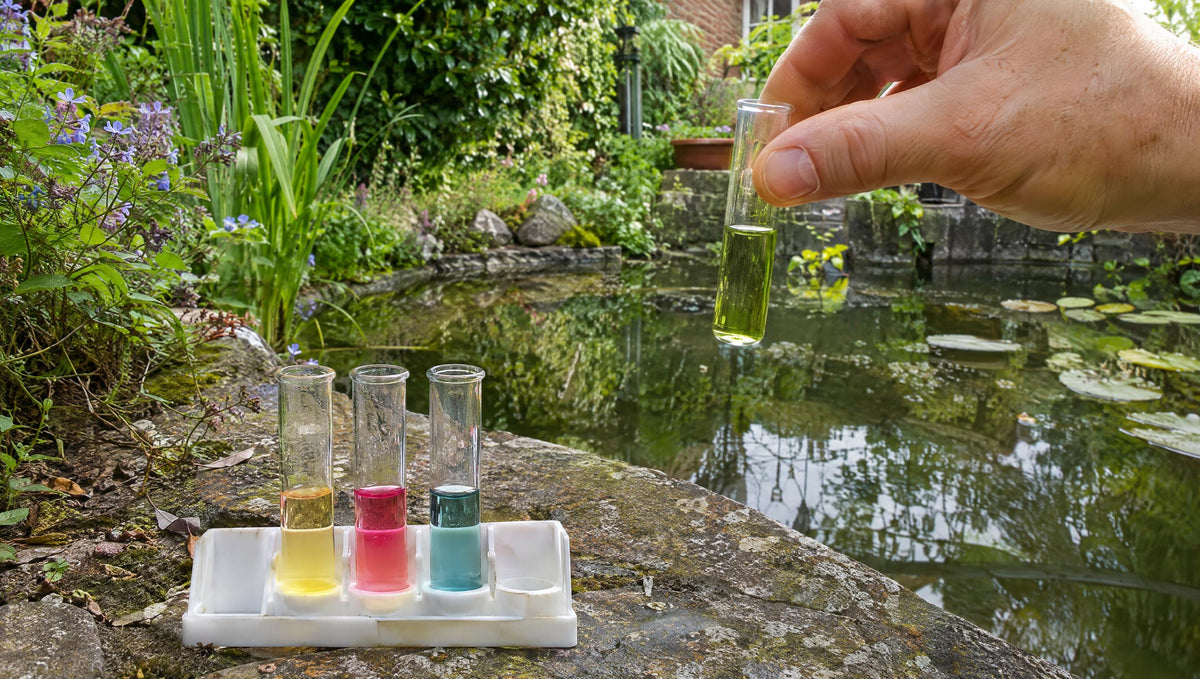
Prepare an established biological filtration before introduction and add the fish gradually. Control ammonium/ammonia and nitrites, as well as the parameters adapted to the system. Clear water is not an analysis.
The JBL ProAquaTest CombiSet Pond kit covers several useful measurements for the pond, including pH, KH, GH, ammonium, and nitrites. It does not contain a dissolved oxygen test or nitrates.
For pond goldfish capable of taking floating food, the Aquifood Pond Fish Food Mix Goldfish 3 mm allows you to observe consumption. Adapt the size, formula, and portions to the population and the season.

For delicate forms, the feeding method may require a different formula, notably sinking. Check that each individual eats without difficulty and that the fastest do not monopolize meals.
The checklist before choosing
- Identify the variety and anticipate its adult size.
- Check the available volume, swimming space, and filtration.
- Plan for wintering before installing the fish outdoors.
- Observe balance, breathing, eyes, and fins.
- Choose compatible companions and organize health monitoring for new arrivals.
- Plan for sustainable maintenance: a well-kept goldfish can live many years, sometimes more than twenty years.
Never release a goldfish into the wild. If your setup is no longer suitable, seek a responsible solution with a professional or a competent organization.
Prepare for arrival before choosing the colour
A coherent population and a suitable pond allow you to enjoy the fish in good conditions. Start by checking the water and the needs of the varieties that interest you.
Sources
- Goldfish Society of Great Britain — Varieties: distinctions between silhouettes and fins.
- Bristol Aquarists’ Society — Goldfish Varieties: classification of single and double forms.
- The Goldfish Council — Bristol Shubunkin: single tail, shape, and growth.
- OATA — How to Look After Fancy Goldfish: housing and compatibility.
- Aqueon — Goldfish Care Guide: species, pond, and maintenance.
- RSPCA — Fish Health: fish observation.
- Aquishop sheets for the tests and foods mentioned.