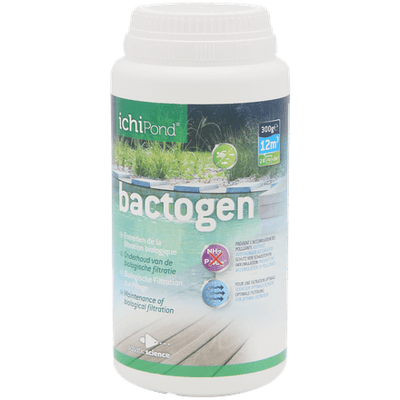
The instructions for use for Bactogen can be found on the official Aquatic Science page and on the product packaging. If you have lost the instructions, start by noting the reference and the size of your bottle. You can then check that the instructions you are consulting correspond to the product you have.
Reading the instructions is not limited to a quantity of powder. Temperature, the start-up phase, maintenance, and the actual volume must be understood together. Here are the points that help avoid the most common misunderstandings.

Where can I find reliable information?
First, consult the manufacturer's page for Bactogen. It explains the use, the start-up and maintenance doses, as well as storage conditions. The Aquatic Science documentation portal also provides access to the brand's documents.
The Aquishop Bactogen product sheet for 12 m³ provides useful information about this product. If an instruction appears different from the one on your bottle, send a complete photo of the label so the version can be checked.
Avoid combining pieces of instructions from different products. Bactogen, Biobooster+ and another bacterial preparation do not necessarily have the same role or schedule.
What is Bactogen used for?

Aquatic Science presents Bactogen as a preparation of bacteria, minerals and trace elements intended for the maintenance of biological filtration and the management of organic pollutants.
This role does not replace the need to run the filter, remove waste and monitor the water. Adding a bacterial product does not mean that the filtration is immediately ready to accommodate more fish.
If the animals are breathing abnormally or gathering at the surface, quickly check the water conditions and seek advice. Do not consider a bacterial application as a sufficient response to an urgent problem.
Manufacturer's instructions to distinguish
The French page consulted provides for use when the water exceeds 10 °C and surface distribution in areas with good current flow. It recommends checking the pH and hardness before any potential correction.
| Phase | Instruction published by Aquatic Science |
|---|---|
| Start-up | 25 g per 5,000 litres per day, for five days |
| Maintenance | 25 g per 5,000 litres per application, three to four times a month |
The dose corresponds to two 12.5 g measuring spoons. Check this data on the current packaging. The phase to follow must correspond to the situation of the pond; the two programs should not be added together.
Moving from measuring spoons to grams
A measuring spoon belongs to a specific product. Its capacity should not be inferred from its resemblance to that of another bottle. A kitchen spoon is also not a reliable measure of weight.
Calculating from the dose above amounts to 5 grams per cubic metre per application. For a confirmed 8 m³ pond, this represents 40 grams. If the start-up phase is followed according to the instructions, five applications represent a total of 200 grams.
Weigh with suitable equipment and clearly distinguish the daily quantity from the total of the program. Do not pour in at once what is intended for several days.
Understanding the volumes indicated on the bottle
A designation such as "for 12 m³" should not be read without its program. The packaging must be compared to the number of applications it contains and the dose actually required.
On the 300-gram presentation associated with 12 m³, the calculation of five 60-gram applications uses the entire product. This does not mean that there is then a reserve for several months of maintenance.
Before ordering, note separately your initial need and your maintenance need. This method allows you to compare the sizes without extrapolating the duration of a bottle from the volume displayed alone.
Measuring the water temperature
The air temperature does not replace that of the pond. After a mild day, the water may still remain cold. Use a thermometer intended for this purpose and observe the evolution rather than a weather impression.
The threshold published for Bactogen concerns this preparation. It should not be automatically transferred to all pond bacteria. The formulations and conditions of use may differ.
If you hesitate about a restart period or a pond whose temperature varies greatly, send your measurements to the advisor. Adding more powder does not automatically compensate for unsuitable conditions.
What to do with the filter, the UV, and the other products?
Check the proper functioning of the circulation and the condition of the mechanical parts. A clogged filter deserves maintenance in accordance with its instructions. Preserve the biological media according to the method provided for the equipment.
The Bactogen page consulted does not provide a universal duration of UV shutdown applicable to all installations. Therefore, do not add a rule found for another brand. Ask for the instruction corresponding to your product and your circuit to be specified.
Also list recent treatments. If you use a pack or a sequence including Biobooster+, follow the instructions for this combination. Do not turn an association instruction into an obligation to systematically add all the products in the range.
Store the product and keep a record of the applications
The manufacturer's sheet provides for storage in a dry place between 10 and 25 °C and announces twelve months under normal storage conditions. Check the dates and instructions on your bottle.
Keep the original packaging with its label and use a clean and dry utensil. Unknown storage or a product whose identity is uncertain justifies a check before use.
Note the dates, quantities and analysis results. Clearer water is not enough to assess the entire filtration. The checks must follow the population, recent changes and useful parameters.
Aquipond options according to need
To prepare a biological maintenance program, you can also examine Aquipond Bacto Maintenance. Its preparation method is specific; it is not replaced by that of Bactogen.
Also read:
For the organic fraction of the sludge, Aquipond Bactovase may be more directly linked to the identified need. It does not make mineral deposits such as soil or sand disappear.
When removal is necessary, a PondoVac vacuum allows you to study a targeted cleaning. Plan for the disposal of the aspirated water and the monitoring of the level. The choice of bacteria and the choice of cleaning are built together, according to the condition of the pond.
Have your reading of the instructions checked
Send to support@aquiflor.com a clear photo of the bottle, your water volume, the temperature and the list of recent interventions. Specify if you are looking for a start-up or regular maintenance.
This preparation allows you to check the reference, the calculation and the schedule before application. Above all, it avoids confusing a dose, a packaging size and a complete program.
To go further:
Sources
- Aquatic Science — Bactogen, instructions for use, dosage and storage.
- Aquatic Science — documentation portal.
- OATA — water quality monitoring and fish pond maintenance.
- Aquishop sheets for Bactogen, Bacto Maintenance, Bactovase and PondoVac linked in the article.