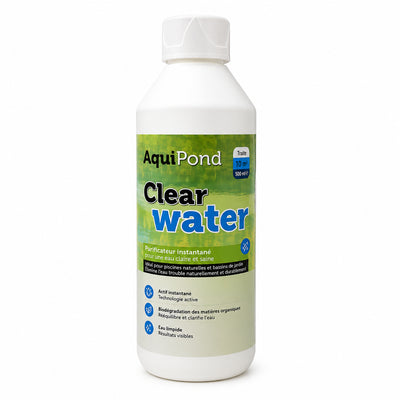
Cloudy water can hide fish and make it difficult to assess maintenance. When the problem is caused by fine suspended particles, a clarifier can help clump them together for easier removal. Aquipond ClearWater is designed for this process: analyze, clarify, and then remove the materials.
Its use requires preparation. The volume, water parameters, filtration, and oxygenation must be examined. Before any application, confirm that the instructions correspond to your packaging, especially the directions regarding aeration and the time before a possible new treatment.

Why does pond water become cloudy?
Cloudiness can come from mineral particles, organic debris, or suspended algae. Heavy rain, a moved basket, or the resuspension of bottom material can quickly change the appearance of the water.
Also read:
- Green water in the pond: what to do, in what order?
- Filamentous algae in the pond: what to do, in what order
- How to keep pond water clear throughout the year?
A relatively transparent brown tint can also be linked to dissolved substances from plant materials. It does not behave like water loaded with particles. Filaments attached to supports are yet another issue.
Describe the color, the presence of deposits, and the time of appearance. These observations help determine whether a clarifier meets the need or if another intervention should take priority.
How to understand the action of ClearWater?

The Aquipond ClearWater data sheet describes an action that binds suspended materials to form aggregates that are easier to collect. This clumping is called flocculation.
The practical point is essential: the materials must then be removed by a suitable means. Their settling at the bottom does not mean they have left the pond. Visual clarification and waste extraction are two steps of the same maintenance.
The product therefore does not replace properly maintained filtration or the search for the cause of the cloudiness. A repeated influx of soil or waste can continue after an improvement in appearance.
Analyses to perform before starting
The ClearWater data sheet requires a water analysis, with particular attention to KH and GH. These measurements should not be skipped to save time.
KH provides information on the buffering capacity related to carbonates, while GH describes another dimension of mineralization. The two values are not interchangeable. Have the results interpreted with the requirements of the instructions and those of the pond inhabitants.
The JBL ProAquaTest CombiSet for ponds includes pH, KH, GH, ammonium, nitrites, and phosphates. It does not measure dissolved oxygen. Additional tests may be necessary depending on the situation.
Avoid automatic mineral correction. If an adjustment is justified, it must be calculated and monitored, with the appropriate product. Keep the results and their units to send to your advisor.
Confirm the volume and the complete protocol
Take the actual volume present in the pond. For an irregular shape, the maximum depth cannot be applied to the entire surface. The levels, slopes, and current level matter.
The name of a package size is not enough to reconstruct a precise dose. Check the label of the product received, its concentration if indicated, the quantity required, and the preparation requested.
Before starting, you must also know the management of the pump, aeration, and filtration at each step. If the documents at your disposal give different instructions, have them clarified by Aquiflor or Aquipond. Do not stop aeration and do not schedule a new application based on uncertain information.
Why oxygen deserves special attention
The ClearWater data sheet indicates a risk of oxygen depletion linked to biological activity around the accumulated materials. A pond already low in oxygen does not constitute a favorable situation for treatment.
Check the condition of the equipment and the behavior of the fish. Abnormal breathing or gathering at the surface requires quick advice. A clarifier should not delay the search for the cause of this distress.
Heat, population, and the amount of waste influence the context. A visible waterfall or bubbles do not provide a precise measure of dissolved oxygen. If this data is necessary, use a suitable measurement method.
Choose a time when you can monitor the installation. The needs of the animals must remain integrated into the protocol, even when the water already appears clearer.
Prepare the filter to receive more materials
Locate the compartments that retain waste and check that they are accessible. A heavy load may require increased attention after the intervention.
Follow the maintenance method for the mechanical parts and monitor the flow rate. Distinguish their cleaning from that of the biological media: a complete and simultaneous cleaning of all masses can disrupt the operation of the filter.
The data sheet suggests examining a re-seeding with Aquipond Bacto Maintenance after the maintenance concerned. The need, the timing, and the preparation must be integrated into the confirmed program. The addition of bacteria does not exempt from water testing.
Remove deposits with a PondoVac vacuum
When materials settle in an accessible area, a PondoVac 4 or a PondoVac 5 can help extract them. The choice depends on the depth, access, and waste management.
Prepare the evacuation of the aspirated water and monitor the level. Work in a targeted manner to avoid resuspending deposits across the entire bottom.
Do not assume that a waste bag retains all fine particles. Check the capacities of the accessories and the destination of the discharged water. The goal is to remove the materials concerned without bringing them back into the pond.
ClearWater and Bactovase have different roles
ClearWater aims at a clarification process for suspended materials. Aquipond Bactovase can be considered for the organic fraction of the deposits.
Both needs can exist in the same pond, but this does not justify an improvised simultaneous application. Organize the steps and check the compatibilities.
The nature of the sludge also matters. Bacteria intended for organic materials do not make sand or soil disappear. A repeated mineral influx must be corrected at its source.
The limits to keep in mind
No clarification time can be guaranteed independently of the pond. The material load, filtration, and conditions of use influence the result. Wait the time provided in the confirmed protocol before concluding failure.
Clearer water does not prove that all parameters are suitable for the fish. Continue useful tests and observe the animals. Clarification is also not a certification of potability or swimming quality.
Respect the precautions on the label. The data sheet indicates a danger in case of ingestion and possible irritation of the eyes and mucous membranes. Keep the identified product, out of reach of children and pets, and follow the handling instructions.
Prepare your maintenance with Aquiflor
Before use, send to support@aquiflor.com the photo of the ClearWater label, the volume, the KH/GH results, and the filtration references. Add the species present and the list of products recently used.
Once the protocol is confirmed, record the intervention and observations. To maintain the result, reduce food waste, accumulated leaves, and soil influx. It is this continuity of maintenance that allows you to enjoy a pond that is easier to observe for a long time.
Sources
- Aquipond — ClearWater data sheet and precautions; the operational instructions must be confirmed for the packaging used.
- Penn State Extension — origins of cloudiness in ponds.
- USGS — particles and dissolved coloration.
- RHS — pond filtration.
- Aquishop data sheets for ClearWater, JBL, Bacto Maintenance, Bactovase, and PondoVac linked in the article.