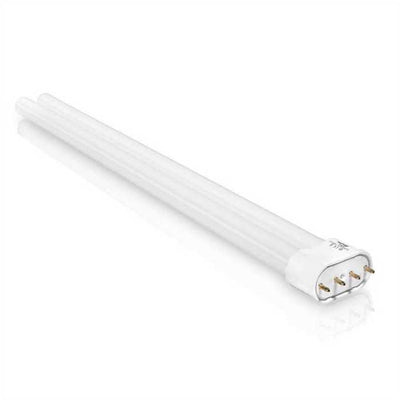
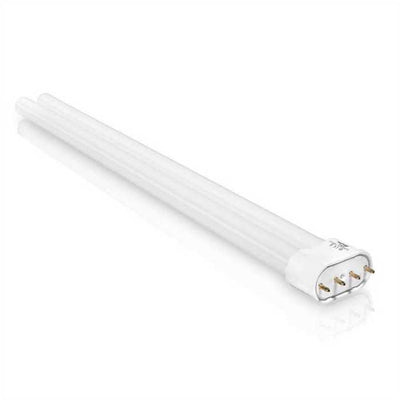
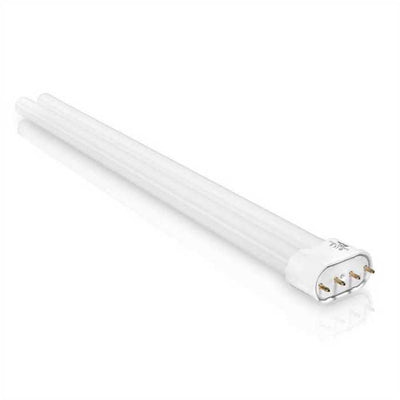
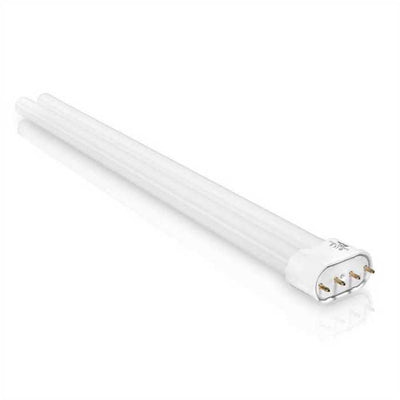
In short: a UV-C lamp loses its effectiveness long before it burns out. Oase manuals recommend replacing it after approximately 8,000 hours of operation, or one full season. That is why it is replaced in spring, before the water turns green. This guide explains how a UV-C clarifier works, how to find the right lamp in three checks, how to replace it safely, and when UV is no longer enough.
How UV-C makes water clear
Green water in a pond is not dirty: it is full of microscopic algae suspended in the water, too small to be caught by the filter foam. The UV-C clarifier passes the water along a tube that emits type C ultraviolet radiation. This radiation damages the algae, which clump together into larger particles, then get trapped by the filter. In a few days, the water becomes clear again. UV-C also reduces some of the germs present in the water, which is appreciated in heavily stocked ponds.

Why a lamp that turns on may no longer work
The tube emits two lights: visible blue light, and invisible UV-C radiation, which acts on the algae. Over time, the UV-C output drops while the blue glow remains. The pond turns green, and people wrongly believe the device is working. Since a lamp runs day and night from March to October, it reaches its 8,000 hours in one season. Changing it every spring is therefore not an excessive precaution: it is the normal maintenance schedule.
The signs that do not lie
- The water turns green while the lamp is on and the flow is normal.
- The lamp is more than one season old.
- The quartz surrounding it is clouded or covered in limescale: it blocks some of the UV, so clean it.
- The device was installed on a pond that has been enlarged or is more heavily stocked than originally.
Find the right lamp in 3 checks
- The power, listed on the lamp or the device plate: 11, 18, 24, 36, 55 W…
- The base: PL-L (4 pins on one side), TL or T5 (pins at both ends).
- The number of lamps: a 72 W or 110 W device often contains two.

Philips PL-L 55 W
Vitronic, Bitron 55 and 110 W

Philips PL-L 36 W
Vitronic, Bitron, FiltoClear

Oase 60 W
Bitron Eco
The most popular lamps
- Philips PL-L 55 W Lamp: Oase Vitronic 55 W, Bitron 55 W, Bitron 110 W (2 lamps), and many Pondtechnics, Xclear, Aquaforte devices.
- Philips PL-L 36 W Lamp: Vitronic 36 W, Bitron 36 W and C 36 W, Bitron 72 W (2 lamps), FiltoClear 20000.
- 24 W Lamp, 18 W and 11 W for pressure filters and small devices.
- Oase 60 W Lamp for Bitron Eco: 2 on the 120 W, 3 on the 180 W, 4 on the 240 W.

Step-by-step lamp replacement
- Unplug the device and wait a few minutes for the lamp to cool down.
- Close the valves or stop the pump to avoid flooding the room.
- Unscrew the cap or cover depending on the model, then gently remove the lamp from its base, without forcing the pins.
- Take this opportunity to remove and clean the quartz with white vinegar using a soft cloth.
- Check the O-ring: if it is flattened or cracked, replace it.
- Install the new lamp by holding it by the base, without touching the glass with your fingers.
- Reassemble, restart the water circulation, check the seal, then reconnect.
Safety: never look at an illuminated UV-C lamp outside its housing, and always unplug the device before working on it. Used lamps contain mercury: drop them off at a lamp collection point.
Workshop tip: on a device with multiple lamps, change them all at the same time. And take advantage of the replacement to check the seals: Bitron spare parts are available.
When to turn the UV on and off
Turn it on in spring, one to two weeks after restarting the filter, when the bacteria have had time to establish themselves. Leave it running day and night throughout the warm season. Turn it off during bacterial treatments, as it would partially destroy them, and in winter, when the water is cold and algae no longer grow: you save lamp hours and electricity.
The maintenance schedule
- March-April: new lamp, cleaned quartz, checked seals. Turn on one to two weeks after restarting the filter.
- Summer: continuous operation. If the water turns green, check the quartz first of all.
- Autumn: stop when the water consistently drops below around 10 °C.
- Winter: empty the device if it is at risk of freezing, store the lamp in a dry place.
Choosing the right UV power for your pond
If you are installing a new device, the power is chosen according to the volume of the pond and its population. A pond in full sun or very heavily stocked requires more watts than a shaded pond with a few fish. As a rule, koi ponds require about twice as much power as an ornamental pond of the same volume. Flow rate also matters: the water must pass slowly enough in front of the lamp to be treated. A device with too high a flow rate loses its effectiveness, even with a new lamp.
Integrated UV-C or separate device?
Many filters, such as FiltoClear or BioSmart, have an integrated UV-C. This is the simplest solution for a garden pond: one device, one installation. A separate device, such as a Bitron, is installed between the pump and the filter. It allows you to choose a higher power for a large pond or a koi pond, replace the UV without touching the filter, and add it to an existing installation that turns green despite good filtration. In both cases, the maintenance is the same: new lamp every spring, clean quartz, and seals in good condition. Write the replacement date in marker on the device or in your maintenance log: next spring, you will immediately know if the lamp has served its time.
UV does not do everything
UV-C treats green water, not filamentous algae or sludge. If your pond has mats of algae attached to the walls, you need to address the minerals and nutrients. And if your device is too small for the pond, no new lamp will be enough: a model like the Bitron Eco 120 W (up to 60 m³ with fish, 30 m³ with koi, lamp developed with Philips) changes everything.
Common mistakes
- Keeping the lamp as long as it turns on: this is the number one cause of green water in June.
- Forgetting the quartz: limescale-covered quartz can block a large part of the UV.
- Changing only one lamp on a device that has several.
- Turning on the UV right after a bacterial treatment, which would be partially destroyed.
Frequently asked questions
Can you put a more powerful lamp in the same device?
No. The electronic ballast and housing are designed for a specific power. A lamp of a different power will not turn on, or will damage the device.
My new lamp does not turn on. Why?
Check that it is properly seated in the base and that the cap is tightened: many devices have a safety that cuts the power if they are not closed. If nothing changes, the ballast may be the cause.
How long before the water becomes clear again?
With a new lamp, a clean quartz, and a properly sized device, the water generally clears in one to two weeks. The clumped algae must then be caught by the filter: remember to rinse the foam if it gets clogged during this period.
You cannot find the reference? Send a photo of your lamp or the device plate to support@aquiflor.com.