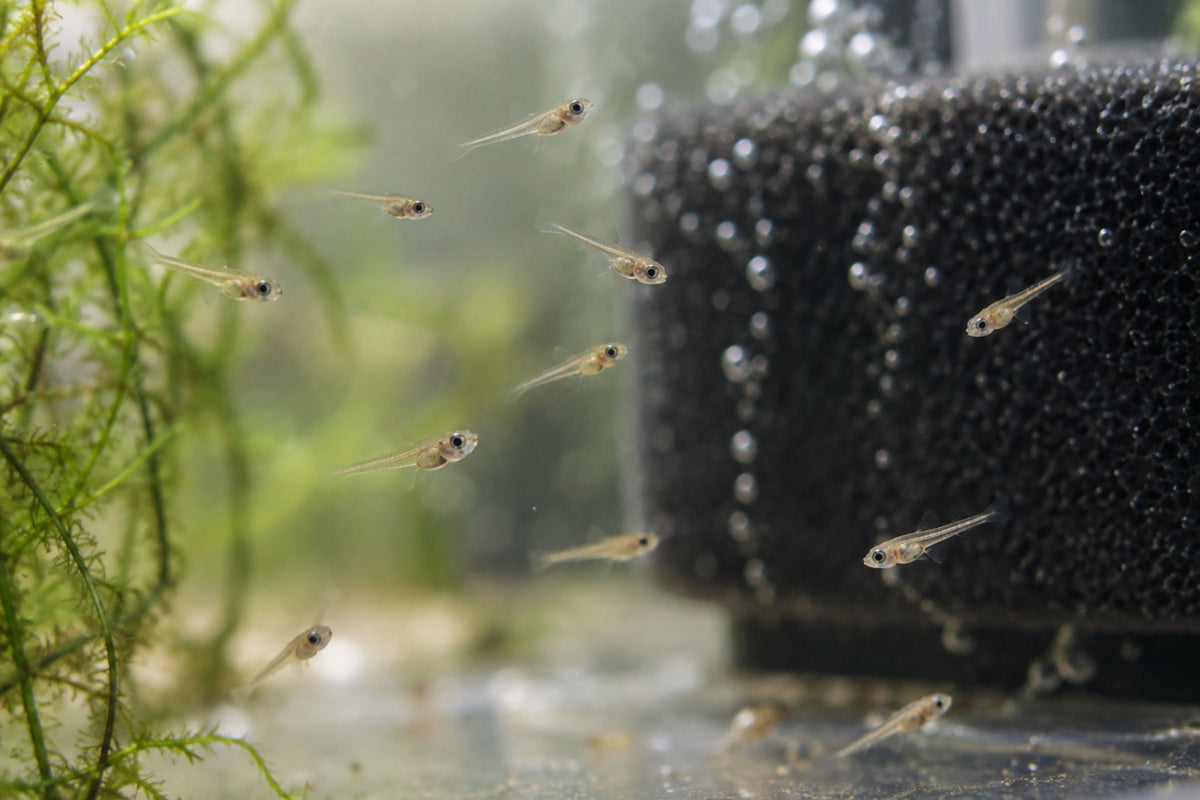
You spot tiny fish after spawning and wonder what to feed them. The first instinct is often to crush adult food. However, feeding koi fry primarily requires food that is small enough, available at the right time, and distributed without degrading the water. Needs change rapidly between a newly hatched larva and a young fish several centimeters long.
This guide helps organize this progression in an amateur breeding setup. You should not directly transpose the densities and recipes used in large fish farms to a small garden nursery.

Start by identifying the development stage
Upon hatching, larvae have reserves from their yolk sac. Their transition to external feeding accompanies their development and free swimming. Temperature influences this evolution: a schedule set only in days can therefore mislead you. Observe the larvae and prepare their food before these reserves are exhausted.
FAO documents on carp describe initial, tiny food sources, notably rotifers. This biological reference explains why a pellet sold for "small koi" may remain much too large for a larva. The word "small" on packaging should always be compared to an actual caliber and the size of the fish concerned.
If the spawning catches you by surprise, photograph the fry with a scale reference placed outside the tank and seek advice quickly. Do not take them out of the water to measure them. Specify the approximate hatching date, their behavior, and the nursery temperature.
What food should you provide according to the fry size?
| Observed situation | Feeding direction | Point to check |
|---|---|---|
| Recently hatched larvae, reserves still present | Prepare the first food and monitor development. | Avoid accumulating food before it is consumed. |
| First external feeding | Appropriate microscopic organisms or starter food intended for this stage. | Caliber actually capturable and ingestion observed. |
| Fry capable of grasping larger prey | Artemia nauplii and transition towards adapted specialized food. | Do not assume all larvae in the group are at the same stage. |
| Young koi accepting small pellets | Juvenile food of appropriate diameter. | Appetite, temperature, and water quality. |
A very fine powder is not automatically a complete early-age food. The label must specify its purpose and conditions of use. Also, ask if it floats, remains in suspension, or sinks: this changes how you present it to the fish and monitor for leftovers.
Artemia: useful when fry can eat them
Artemia nauplii are small crustacean larvae obtained by hatching eggs in a separate setup. They constitute practical live food for fry developed enough to capture them. The very first stages may need smaller organisms: seeing prey moving in the tank does not prove they are being swallowed.
JBL ArtemioPur contains eggs intended to produce nauplii. This bottle is not poured directly into the nursery like ready-to-use food. It requires salt-water cultivation, aeration, and appropriate harvesting equipment, according to the instructions.

The JBL instructions provide for separating the nauplii from egg shells, collecting them on an adapted sieve, then briefly rinsing them in fresh water. Avoid transferring culture brine into the koi tank. Staggered production between several small containers can facilitate the availability of freshly hatched food, provided you can clean and monitor each culture correctly.
Asking which early-age food is suitable for your fry allows you to buy the right caliber and associated equipment without confusing food for Artemia and food for fish.
Distribute little, observe, then adjust
Prepare fractional feedings rather than a large quantity intended to last all day. The number of meals and quantities depend on the food, the stage of the fish, and the rearing device. Follow the manufacturer's instructions and have your organization adjusted if the fry are numerous.
After each distribution, look at the area where the fish feed. Is the food accessible to them? Are some staying behind? Is a deposit forming at the bottom? These observations serve to modify the presentation or quantity. Adding more because the fish seem small can aggravate the problem if the food is not consumable.
Use a small, dedicated, dry utensil for powders. A reproducible measure facilitates adjustments: you can gradually reduce or increase a known quantity. A changing pinch given by several people makes monitoring much more difficult.
The nursery must support this feeding
Feeding and water quality are inseparable. A nursery requires a prepared biological filtration, sufficiently gentle circulation, and intakes protected against the entrapment of small fish. Also, verify that the protection does not clog to the point of stopping flow.
Monitor ammonium/ammonia and nitrites, as well as temperature and pH. The JBL ProAquaTest CombiSet Plus NH4 is particularly useful for tracking these nitrogenous compounds in freshwater. Respect the reaction times and the method for reading the tests; keep the dated results.
Remove leftovers with a gentle device adapted to the size of the fry. A large pond vacuum is not intended to directly clean a nursery populated with larvae. During careful siphoning, collect the water in a container allowing you to verify that no fish have been drawn in. Replenishments must use prepared and compatible water, without sudden temperature differences.
Successfully transitioning to pellets
Increase the caliber according to the fish's real capacity to take the food. A mouth that consistently grasps and then spits out food deserves your attention. Do not change food, temperature, and installation simultaneously: you would lose the benchmarks necessary to understand a drop in appetite.
When young koi can swallow this diameter, Aquifood Mini 2–3 mm can take its place in their diet. This product is intended for water above 12°C. It concerns a stage subsequent to the initial larval feeding and must be distributed according to appetite and packaging instructions.
Three mistakes that unnecessarily complicate breeding
Relying on green water without verifying what it contains. Its color guarantees neither the presence of appropriate prey nor good oxygenation. A culture intended for larvae is prepared and monitored; it is not just a matter of leaving a container in the sun.
Multiplying improvised food recipes. Egg yolk, flour, or poorly dosed homemade mixtures can quickly load a small amount of water. To start, identified food, accompanied by precise instructions, offers benchmarks that are easier to master.
Forgetting the space required later. From the start, plan for the growth and future accommodation of young fish. If you cannot manage the population, ask a specialist for help. No ornamental fish should be released into a stream or a natural pond.
Sources and useful reading
- FAO: biology and early stages of common carp, used as biological benchmarks, without transposing intensive production methods.
- JBL ArtemioPur: instructions for culture and use of nauplii.
- JBL ArtemioSet: harvesting and rinsing of nauplii.
- OATA: water quality and pond fish maintenance.