The short answer: in Belgium, allow at least 80 cm to 1 m of depth in part of the pond for goldfish, roach, or small schooling fish to safely overwinter outdoors, and preferably 1.20 to 1.50 m for koi. This deep area remains below freezing and maintains a stable temperature. Add an opening in the ice (ice-free device or air pump) so that gases can escape. A shallower pond is not necessarily doomed, but it requires more precautions.
Key points
- Water is densest at around 4°C: it sinks to the bottom and stays there in winter.
- Goldfish, roach, small schooling fish: 80 cm to 1 m in part of the pond.
- Koi: 1.20 to 1.50 m, and a large volume.
- The deep area must be wide enough, not just a hole.
- Always an opening in the ice and oxygen.
Why does depth matter so much in winter?
Water has a very particular property: it is heaviest at around 4°C. In winter, when the surface cools, the lighter cold water stays on top and eventually freezes, while the water at around 4°C accumulates at the bottom. It is this deep and stable layer that serves as a refuge for the fish. The deeper and larger the pond, the greater this "warm" water reserve, and the less likely it is to be reached by ice during a long cold snap.
In a pond that is too shallow, the ice can descend very close to the bottom, the temperature varies greatly between day and night, and the fish no longer have a stable resting area. This is where the most losses are observed at the end of winter.
What depth according to the fish?
| Fish | Recommended depth | Note |
|---|---|---|
| Goldfish, roach | 80 cm to 1 m | Very hardy |
| Notropis, minnows, small schooling fish | 80 cm to 1 m | Notropis: pond of at least 5 m³ |
| Ide, tench | 1 m and more | Large volume |
| Koi carp | 1.20 to 1.50 m | Large volume and serious filtration |
Aquiflor team guidelines for a climate like that of Belgium. The larger the pond, the more stable it is.
The surface area of the deep zone also matters
A 1.20 m hole the size of a bucket in the middle of a 50 cm pond is not enough. The deep zone must be wide enough to contain a real water reserve and accommodate all the fish without them crowding together. Plan a deep zone that occupies a good part of the bottom, with sloped walls so that the fish can naturally descend into it. This is also where the sludge settles: a well-designed bottom is easier to clean.
My pond is too shallow: what to do this winter?
- Keep an opening in the ice permanently with a floating ice-free device like the Oase IceFree Thermo 330: 330 W, built-in frost controller that only heats when it really freezes, ice-free zone announced up to -20°C.
- Provide oxygen with an air pump, placing the diffuser at mid-depth and not at the bottom, so as not to mix and cool the refuge layer.
- Stop feeding when the water is cold.
- Cover part of the pond during extreme cold, with an insulated board or a net and a tarp, always leaving an opening.
- For a very small pond or an above-ground tank, bring the fish in into a large aquarium or a cool tank.

IceFree Thermo 330
330 W ice-free device

AquaOxy 1000
Silent aeration

Secoh kit no. 3
Ponds from 20 to 40 m³
Should the filtration pump be left running?
A pump that draws from the bottom and discharges at the surface stirs up all the water and destroys the refuge layer at 4°C. If you leave the filtration running in winter, reduce the flow and raise the intake so that it does not draw water from the bottom. Many small pond owners stop the filtration and only keep a small aeration. We detail both options in our article should filtration be stopped in winter.
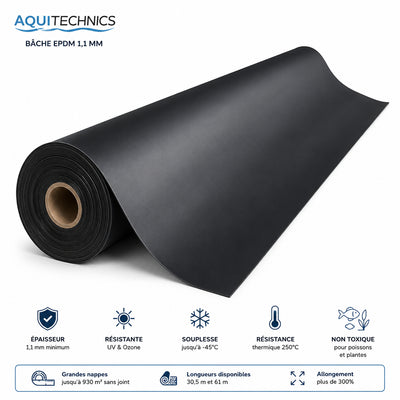
The workshop's advice: if you are creating or enlarging your pond in the spring, think "winter" from the earthworks. Digging 30 cm deeper in the central area only costs a few extra m² of EPDM liner, and that is what will make the difference for your fish for years.
Planning the depth in a new pond
If you are preparing a pond for the spring, now is the time to decide its depth. With an EPDM liner, you dig the depth you want; the calculation formula for the surface area includes the maximum depth, allowing you to immediately see the effect on the amount of liner. Preformed ponds are generally limited to 45 to 70 cm: they are suitable for plants and small fish, with an opening in the ice, but not for koi. See our comparison preformed pond or EPDM liner.
Never break the ice with a hammer or shovel: the shockwave strongly stresses the resting fish. Melt an opening with hot water in a pot placed on the ice, or use an ice-free device.
Frequently asked questions
What is the minimum depth for goldfish in winter?
About 80 cm to 1 m in part of the pond, with an opening in the ice.
What depth for a koi pond?
Rather 1.20 to 1.50 m, with a large volume and suitable filtration.
My pond is 50 cm: can my fish stay outside?
It is risky in extreme cold. Keep an opening in the ice with an ice-free device, aerate at mid-depth, cover part of the pond, or bring the fish into a cool tank.
Where to place the diffuser of an air pump in winter?
At mid-depth, not at the bottom, so as not to mix and cool the layer of water at around 4°C where the fish rest.
Written by the Aquiflor team, a store specializing in ponds and ponds in Nodebais (Belgium), official Oase repair workshop. Updated in November 2026. IceFree data: Oase data sheet.
Do you want to know if your pond is deep enough? Send us its dimensions and your fish to support@aquiflor.com or call 010 86 03 54. See also our pond and pond aeration.