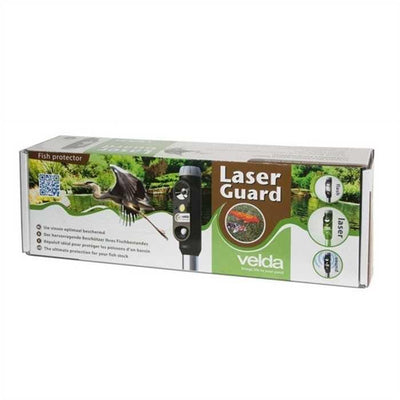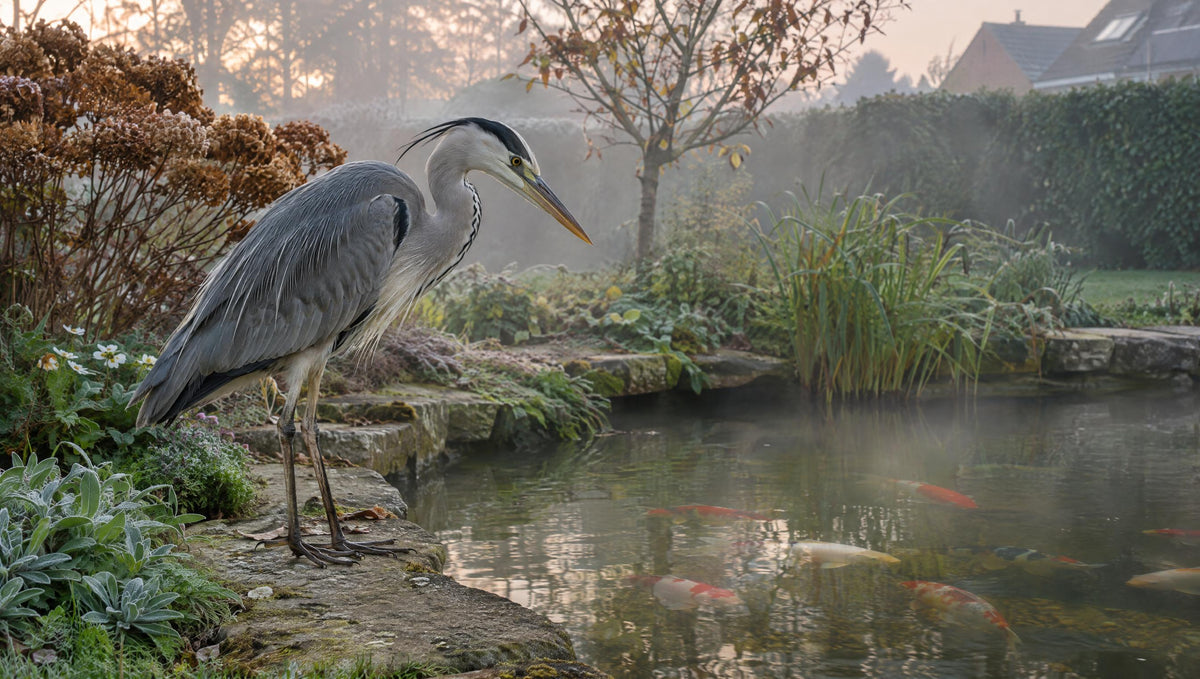
The short answer: the grey heron fishes on foot, standing at the edge or in shallow water, often early in the morning. Once it has found a fishy pond, it will return until it is empty. No single protection is perfect: the best strategy combines an active deterrent such as the Laser Guard (motion detector, flashes, laser and sounds), shelters where the fish can hide, edges without shallow areas and, as a last resort, a net. Act on the first visit: a heron that has caught nothing is easier to discourage.
Key points
- The heron fishes on foot: it needs a place to stand and shallow water.
- It will return as long as it finds fish.
- Combine a deterrent, shelters, suitable edges and, if necessary, a net.
- A stationary decoy quickly loses its effect: move it regularly.
- The heron is a protected species: keep it away, do not harm it.
How does the heron hunt and when does it come?
The grey heron is a patient hunter. It lands a few meters from the pond, approaches on foot, then stands still at the edge or enters the shallow water. As soon as a fish passes within reach, its beak strikes like an arrow. It often comes at dawn, when the garden is quiet, but also during the day if it feels safe.
Velda describes its calendar well: in spring, herons look for food for their chicks; in summer, the young that have left the nest come to fish for themselves; in autumn, food becomes scarce and pond fish become easy prey. Colorful fish in clear water are particularly visible. The heron's beak can also seriously injure large fish that it cannot swallow. And after a first catch, it will return until the pond is emptied.

Line 1: the active deterrent
A deterrent reacts when the heron arrives, instead of remaining stationary. Velda's Laser Guard is one of the most comprehensive. Its motion detector monitors approximately 12 meters with a 100° angle, and triggers three combined effects:
- Variable-frequency light flashes, which create an unpleasant disturbance at the site.
- Green laser beams, which herons perceive as dangerous moving obstacles.
- Sounds: the cry of a distressed congener, dog barking and the cry of a poisonous frog.
Each cycle lasts approximately 60 seconds. It consumes little (7.2 W), operates at 24 V low voltage and has a 5 m safety cable, with protection against water splashes (IP44). Place it on the side where the heron usually lands, aiming at the bank rather than the house, and consider the neighbors regarding the volume and orientation of the sounds.


Line 2: shelters for the fish
A fish that can hide is a fish that survives. Provide areas where the heron cannot see or reach the fish: a deep part of at least one meter, tubes or shelters sunk at the bottom, dense submerged plants, and shaded surfaces. A floating island or a planted floating basket creates a shaded area under which the fish take refuge as soon as a silhouette appears. They also improve the water quality.
The workshop's advice: very clear water and a light bottom make koi visible from afar. Submerged plants, a little shade and shelters at the bottom do not harm the beauty of the pond: they give the fish the reflex to hide, and it is this reflex that saves them.
Line 3: edges that do not allow fishing
The heron needs a place to stand: a gently sloping beach, a shallow ledge, a flat stone at the water's edge. Without these support points, it cannot fish comfortably. In an existing pond, a few adjustments are often enough:
- Steep edges, with a quick drop to the depth.
- A clearly visible wire stretched about twenty centimeters from the ground and a few dozen centimeters from the edge, around the perimeter: the heron walking towards the water encounters it and often gives up. Never use transparent fishing line, which can injure birds.
- Dense bank plants that hinder access to the water.
- No flat stone at water level on which it can stand.
Line 4: decoys and net
Herons are territorial: a fake heron can deter a congener from landing. But a stationary decoy eventually stops fooling anyone: move it every two or three days, and remove it during the nesting period, where it can instead attract. The tilting grey heron moves with the wind, which reinforces the illusion.
The net stretched over the pond is the safest protection, but also the least aesthetic. It is justified in autumn, when it protects against both herons and leaves, or against a particularly stubborn heron. Stretch it well above the water, without it touching the surface, so that the heron cannot land on it and the birds do not get caught in it.
Protected species: the grey heron is protected in Belgium as in France. All the solutions in this article aim to keep it away without harming it. Never use a trap or any device that could entangle it or put it in danger.

Line 5: detection sprinkler and electric fence
Two additions surprise the heron at the exact moment it approaches. The Garden Sniper by Aquaforte is a motion detector sprinkler: as soon as an animal enters the monitored area, it projects a short jet of water, over a stated range of 10 meters. It connects directly to a hose with a Gardena-type connector and also scares away cats. Orient it towards the heron's path, away from walkways, windows, and the neighbors' garden, and check that it does not trigger constantly when your own animals pass by. The manufacturer specifies not to use it when there is a risk of frost: it is a protection from spring to autumn.
The Pond Defence 100 fence by Aquaforte surrounds the pond with 100 meters of wire. Its generator sends a pulse through the wire: the heron that touches it while walking towards the water receives a shock and does not approach again. According to the manufacturer, the pulse is harmless to children and pets, and the consumption is very low. Place the wire all along the edge, where the heron enters the water to fish. Use only equipment designed for this purpose, never an improvised electrical setup at the water's edge.
As for ultrasonic or light devices sold as universal repellents, always check that they are properly aimed at the heron and under what conditions: repeated triggers can also disturb residents, household pets, and the small wildlife you like to see in the garden. Permanent lighting of the pond is not a good answer.
And the other predators?
The heron is not alone in being interested in fish. The kingfisher mainly takes small fish and fry; the cormorant can attack large ponds near a body of water; cats sometimes watch from the edge, and in some regions the otter is returning. The same principles apply: deep areas, shelters at the bottom, edges without support points and, for nocturnal predators, a motion detector deterrent. Observing the pond at different times of the day helps identify the visitor and choose the right protection.
What to do after an attack?
- Count the fish and observe them: an injured fish hides, swims poorly, or shows V-shaped marks on its back or sides.
- Isolate the injured fish if possible, in clean and well-oxygenated water: an open wound easily becomes infected.
- Monitor the water quality: perform a test and avoid any additional stress.
- Install protection immediately: the heron will return the very next morning.
- Ask for advice for deep wounds: an injured koi deserves a specialized opinion.
Errors to avoid
- Waiting for the second visit to act.
- Relying on a stationary decoy for the whole season.
- Leaving a shallow beach at the edge of a koi pond.
- Removing all plants: the fish no longer have shelter.
- Placing a net that touches the water or hangs loosely.
Frequently asked questions
What is the range of the Laser Guard?
Its motion detector covers approximately 12 meters with a 100° angle, according to Velda.
Is a fake heron effective?
It can deter a congener from landing, but it loses its effect if it remains stationary. Move it every two or three days and combine it with other protections.
What time does the heron come?
Often at dawn, when the garden is quiet, but also during the day if it feels safe.
How to help the fish hide?
With a deep area, shelters at the bottom, dense submerged plants, and a floating island that provides shade.
Is an anti-heron electric fence dangerous?
According to Aquaforte, the pulse of the Pond Defence fence is harmless to children and pets. Use only a kit designed for this purpose.
Written by the Aquiflor team, a store specializing in ponds and ponds in Nodebais (Belgium), an official Oase repair workshop. Updated in November 2026. Features: Velda, Ubbink and Aquaforte product sheets.
A heron visiting your pond? Send us a photo of the pond and its surroundings to support@aquiflor.com or call 010 86 03 54: we will help you choose the most suitable combination of protections.