Filamentous algae attach themselves to leaves, mosses, and roots, then form strands that sometimes return after each cleaning. To reduce them permanently, you need to address two elements: remove the existing mass and understand what promotes its regrowth.
Start with precise maintenance, then adjust the tank conditions based on observations and measurements. No single action guarantees the permanent absence of filaments, but a regular method helps to better control their development.

Recognizing filaments without putting everything in the same category
The term "filamentous algae" brings together different organisms that have a thread-like appearance. Some are thin and flexible, others more firmly attached. Their color and texture do not always allow for precise identification with the naked eye.
Photograph the area and observe the colonized supports. Threads on a moss, a slimy carpet on the sand, and uniformly green water require different checks. If the appearance corresponds more to a continuous layer, refer to the guide to slimy deposits.
Also look at the extent of the problem. A small isolated clump does not automatically justify treating the entire aquarium. Plants that are largely smothered, on the other hand, require a more organized intervention.
Preparing a removal session
Before starting, plan a container for waste, a small brush reserved for the tank, pliers, a net, and possibly a suitable siphon. Prepare the replacement water if the maintenance removes some of it.
Locate the animals present in the areas to be worked on, especially fry and shrimp. Take the time to clear a limited area rather than pulling out a large mass that takes several plants with it.
If an intervention requires cutting off a device, follow its instructions and put it back into service correctly after maintenance. Do not leave a filter stopped during a long session simply because its output slightly interferes with the movements.
Coiling, removing, and collecting fragments
Flexible filaments can often be gently coiled around a small brush or a scrubbing brush. Support the fragile plants to avoid uprooting them. If the algae resist, do not force it to the point of tearing all the leaves.
Regularly take out the tool to remove the collected material in a container. A loaded brush that is shaken in the aquarium puts fragments back into circulation. Collect what floats with a net or controlled suction.
Work methodically: one root, one group of plants, then the next area. This organization allows you to see where the filaments remain attached and to compare their return during the next maintenance.
When to prune an overgrown plant?
A very damaged or almost entirely covered leaf can be removed if it suits the plant. However, assess the amount of remaining foliage. A radical pruning of all plants reduces their ability to recover and greatly changes the tank.

The JBL ProScape Tool S 16 spring scissors are particularly suitable for mosses and small grassy surfaces. Their curved shape allows for localized work. Check that their length corresponds to the access in your tank.
After pruning, collect the cut pieces. Take this opportunity to check if waste is accumulating in a too dense clump or behind a decoration element.
Looking for inputs that maintain regrowth
Observe a complete meal. Does the food reach the targeted fish? Does a part always fall in the same place without being consumed? Are several people each distributing a ration? A small change in organization can avoid an unnecessary input.
Also examine the new water, fertilizers, and plant waste. In a planted tank, nutrients are necessary, but their inputs must correspond to the needs. Stopping all fertilization without knowing what is missing or accumulating can weaken the plants.
Note what you actually add, in quantity and frequency. This list is more useful than a vague estimate when you ask for advice.
Measuring before correcting nitrates or phosphates
Monitoring nitrates and phosphates helps to examine the balance of inputs. It does not allow, on its own, to attribute each filament to a precise element. The algae present also consume nutrients, and a measurement represents a given moment.
The JBL ProAquaTest CombiSet Plus NH4 includes nitrates, pH, KH, nitrites, and ammonium. Complete it with a phosphate test if necessary. Note the units and use the reagents according to their instructions.
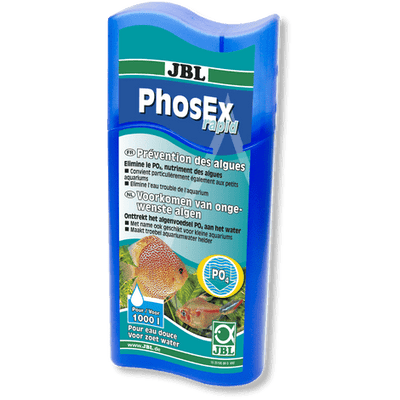
If an excess of phosphates is established, the JBL PhosEx rapid for freshwater aquarium can be an option to consider. Its use must take into account the plants and the current instructions. Look in parallel for the origin of the input to avoid depending on a repeated correction.
Adjusting the light without changing all the settings
First check the timer. Lighting intended for a limited duration can remain on much longer after a manipulation. Then observe the exposure to the sun and the areas where the lamp shines most strongly.
A reasoned reduction in duration or intensity can be part of the plan, depending on the plants present. Change an identifiable setting and note it. A very planted aquarium with CO₂ injection does not have the same constraints as a poorly lit tank with a few slow plants.
To go further, consult our article on the role of lighting in algae problems. Turning off the tank for a long time is not a universal solution to filaments.
Maintaining a functional biological filtration
Remove the waste from the prefilter and check the flow according to the manufacturer's instructions. Preserve the colonized biological supports. A large simultaneous cleaning of the soil, the filter, and the decoration can destabilize the installation.
A UV clarifier acts on what circulates in its chamber. It does not directly remove the filaments attached to the leaves. Its eventual interest must be evaluated according to the present turbidity, without replacing the removal actions and the search for causes.
In case of doubt about a drop in flow, communicate the exact reference of the filter and a photo of its installation. A worn part, a pinched hose, or a clogged prefilter require different answers.
Shrimp and algae-eating fish: choosing inhabitants for their needs
Some animals consume certain algae, but they do not eat all filaments and do not eliminate maintenance. Their introduction must be compatible with the volume, the parameters, the other species, and the maturity of the tank.
Do not choose a fish only for a cleaning function. Check its adult size, its diet, and its behavior. It will always need suitable food and care when the algae have decreased.
Framing the eventual use of a product
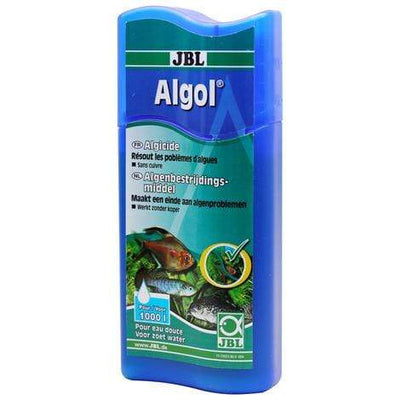
An anti-algae is chosen according to its indication and the population. For JBL Algol, the manufacturer notably reports a possible sensitivity of dwarf shrimp and certain mosses. Consult the current instructions and ask for advice if your tank contains them.
Avoid mixtures and doses calculated on the external volume of the tank. Plan the oxygenation and the removal of materials according to the chosen protocol. Do not use a pond treatment in an aquarium without explicit indication for this use.
Checking that regrowth slows down
Choose two reference areas and photograph them after each maintenance. Note the date of removal, the modified settings, and the analyses. The goal is to know if the filaments return less quickly and if the plants develop better.
If the situation stagnates, send these elements to the Aquiflor team. A simple history allows to examine the next step with more precision than a list of products tried without dates.
To go further:
- Green algae in an aquarium: understanding the causes and acting
- UV lamps for aquariums: choosing a compatible replacement