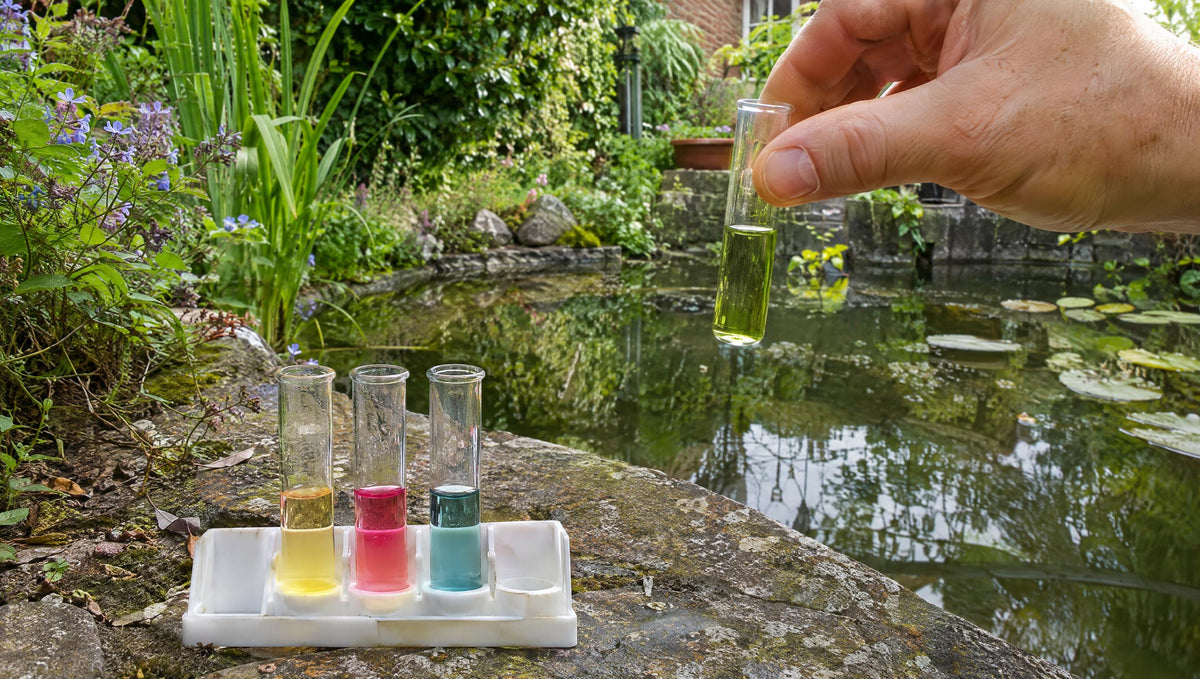
Two ponds may appear equally clear while offering very different conditions for the fish. In one, the parameters remain stable. In the other, the buffering capacity is depleted or nitrites appear after a filter failure.
Understanding water chemistry means learning to interpret the relationships between a few measurements. You do not need to turn your garden into a laboratory. You need to know what each test describes, what it does not show, and what action can actually correct the situation.

The pond is constantly transforming what enters it
Food, leaves, make-up water, and maintenance products introduce different materials. The fish and microorganisms transform them. Plants use some of them, while cleaning and water changes can export others.
Read also:
Mechanical filtration retains particles that must then be removed. Biological filtration transforms certain dissolved compounds. These two functions complement each other, but they do not measure the same thing or solve all problems.
Before looking for a perfect value, ask a simple question: what has changed? A doubled ration, a filter cleaned too thoroughly, several days of heat, or a large amount of make-up water can explain a change.
pH: describing acidity, then observing its stability
pH indicates whether the water is acidic, neutral, or alkaline. Its scale is not linear: a difference of one unit represents a major change in hydrogen ion activity.
In a planted pond, photosynthesis and respiration can cause the pH to vary during the day by changing the dissolved carbon dioxide. To compare your usual results, measure under similar conditions and note the time.
If you suspect large fluctuations, readings at different times, especially in the morning and at the end of the day, can help you understand how the pond functions. A single value does not describe this entire progression.
Avoid correcting the pH in isolation without checking the KH and ammonia compounds. Quickly raising the pH can increase the proportion of toxic ammonia when ammoniacal nitrogen is present.
KH: understanding buffering capacity
KH tests used in ponds provide an indication of the buffering capacity associated mainly with carbonates and bicarbonates. They help monitor the water's ability to resist certain acidic variations.
This buffering capacity is not inexhaustible. Nitrification consumes alkalinity. Depending on the composition of inputs and the pond's operation, KH can therefore change. Low-mineralized rainwater can also alter the balance through dilution.
Aquipond KH+ is intended to raise this parameter when a measurement and the pond's needs justify it. Calculate based on the actual volume and follow the current instructions, with successive checks.
The goal is to achieve an appropriate reserve and a stable environment. Adding KH+ at fixed intervals without measuring can cause you to miss the cause of a problem or lead to an unnecessary correction.
GH: minerals, mainly calcium and magnesium
General hardness, or GH, describes mainly the presence of dissolved calcium and magnesium. It provides information about an aspect of mineralization useful to aquatic organisms.
GH and KH are linked to the composition of the water, but remain two distinct measurements. Water can have a relatively high buffering capacity without having an equivalent general hardness. There is therefore no universal rule requiring GH to always be higher than KH.
Aquipond GH+ is intended to increase general hardness. It addresses a different need from KH+. Check both parameters before choosing and proceed gradually according to the product instructions.
Also measure the water used for make-up. This helps explain why a pond changes after repeated water replacements.
Ammonium and ammonia: read the result with pH and temperature
Fish nitrogenous waste and the degradation of organic matter increase ammoniacal nitrogen. In water, the balance is divided between ammonium, NH4+, and non-ionized ammonia, NH3.
The latter form is particularly concerning for fish. Its proportion increases especially with pH and temperature. Therefore, the same overall measurement does not represent the same risk in all conditions.
Read exactly what your test measures and the units used. Some methods indicate a concentration expressed in nitrogen, others in the compound. Use the manufacturer's chart or a competent interpretation rather than comparing figures from different methods.
In an established fish pond, the goal is to avoid a detectable accumulation. If a value appears, check the feeding load, the condition of the filter, and the history before adding several correctors.
Nitrites and nitrates: two different stages
Nitrifying bacteria transform ammonia/ammonium into nitrites, then nitrites into nitrates. This process requires oxygen and conditions compatible with their activity.
Nitrites are undesirable in a fish pond. They can disrupt oxygen transport in the blood; therefore, respiratory difficulty does not automatically mean the water lacks oxygen.
Nitrates are generally less toxic than nitrites at comparable concentrations, but their accumulation still needs to be monitored depending on the species and the system. Nitrification does not make them disappear: it produces them.
Aquipond NitriBoost is offered for inoculating nitrifying bacteria. It does not replace the filter's establishment time or testing. Follow its conditions of use; it does not guarantee the immediate elimination of a nitrite spike.
Oxygen: the measurement that is not visible in clarity
Water contains dissolved oxygen, used by fish, bacteria, and other organisms. Plants and algae produce it in the light through photosynthesis, but respiration also continues at night.
Temperature influences the amount of oxygen that water can hold at saturation. Warm water holds less than cold water, all other things being equal. Consumption related to waste and population also counts.
A waterfall or diffuser contributes to exchange, without proving that the concentration is sufficient everywhere. The flow rate of an air pump, expressed in liters of air per hour, is not a measurement in milligrams of dissolved oxygen per liter of water.
In the case of gasping fish, quickly check the system and seek advice depending on the severity. An on-site oxygen measurement provides information that pH or nitrite tests cannot replace.
Phosphates and organic matter: understand the inputs
Phosphates are part of the nutrients used by organisms, especially algae and plants. A high measurement invites you to examine the food, debris, runoff, and the quality of the make-up water.
A low result does not prove the absence of all phosphorus in the pond: some may already be present in the biomass or deposits. Therefore, interpret the test with the condition of the pond and its maintenance.
For accessible deposits, a PondoVac 4 physically removes material. Aquipond Bactovase targets the organic component of sludge according to its instructions. A biological action does not mean that all mineral elements have left the pond.
Build a simple and reliable monitoring system
The JBL ProAquaTest CombiSet Pond kit groups pH, KH, GH, ammonium, nitrites, and phosphates. It allows you to cover several complementary parameters. Plan separate measurements for temperature, dissolved oxygen, and nitrates if they are necessary.

Record the results with the time, temperature, units, and interventions. OATA recommends regular checks; a new pond, a failure, unusual signs, or a population change justify closer monitoring.
Respect the reaction times and use properly stored reagents. If a value surprises you, check the procedure and confirm the measurement before a major correction, without delaying urgent intervention when the fish are in distress.
An example to connect the figures
Imagine a pond where nitrites appear after an increase in meals. The first job is to check the operation of the filter, oxygenation, and load. Changing only the GH does not address the observed problem.
Another situation: a falling KH with pH fluctuations. You need to examine the buffering capacity and water inputs. Before raising the pH, also check the ammoniacal nitrogen. The order of checks prevents a correction from improving one figure while worsening another risk.
Measure, understand, then correct
Start with a complete reading and the pond volume. Then choose the Aquipond product corresponding to the identified need and check the effect after application.
See the analysis kit →
Consult Aquipond KH+ →
Consult Aquipond GH+ →
To go further:
Sources
- UF/IFAS — Ammonia in Aquatic Systems: ammoniacal forms and nitrification.
- Mississippi State University Extension — pH and Alkalinity: pH and buffering capacity.
- Mississippi State University Extension — Total Alkalinity: distinction between alkalinity and hardness.
- USGS — Hardness of Water: calcium and magnesium.
- USGS — Dissolved Oxygen and Water: oxygen and temperature.
- Merck Veterinary Manual — Environmental Diseases of Aquatic Animals: interpretation and risks of parameters.
- RHS — Pond Algae and Blanket Weed: nutrients and maintenance.
- OATA — How to Look After Pond Fish: water monitoring.
- Aquishop sheets for the tests and Aquipond products mentioned.