A gentle first week is sometimes enough to wake the fish and make you want to bring the pond back to full activity. The filter, however, does not necessarily regain its summer capacity at the same pace. This is the gap that needs to be managed in spring.
To limit the risk of green water, prepare the system before increasing feeding. The order of steps matters: observe, analyze, restore the equipment, then monitor the recovery. The calendar provides a guideline; the water temperature and test results guide decisions.

Before you start: how did the pond spend the winter?
Two setups may require different interventions. In the first, the filtration continued to operate. In the second, the system was shut down and some of the equipment dismantled. Reconstruct the winterization before choosing your program.
Read also:
Note the equipment that remained in the water, the filter media preserved, and any breakdowns. A filter that has been shut down with materials that have stagnated should not be reconnected without inspection and maintenance according to its instructions.
Also observe the animals. Unusual breathing, an isolated fish, or loss of appetite requires a water check and, if necessary, expert advice. These signs should not automatically be attributed to the end of winter.
Perform an initial analysis before adding anything
Measure the temperature, pH, KH, GH, and nitrites. Complete with ammonium depending on the situation, especially if the filter has been disturbed or if the fish have been present throughout the winter. Keep these results as a starting point.
The JBL ProAquaTest CombiSet Pond allows you to check pH, KH, GH, ammonium, nitrites, and phosphates, among others. Respect the reaction times and the volumes of the kit. A sample taken in a hurry can lead to an unnecessary correction.
If the KH is insufficient, examine the stability of the pH before choosing a correction. If nitrites are detected, look for what is limiting their conversion and adapt the feeding load. The two problems are not corrected with the same product.
Aquipond KH+ can meet a measured need for carbonate hardness. An addition should not be systematic every spring: the pond water and the replacement water may already have a sufficient reserve.
Restore the hydraulic system
Inspect the pipes, fittings, and valves before restarting. Look for cracks, displaced seals, and points where frost may have damaged the installation. Clean the elements provided for in the instructions, with the devices unplugged.
After starting, follow the water from the beginning to the end of the circuit. Check the return to the pond, any overflows, and the level during the first few hours. A slowly leaking fitting may go unnoticed during a quick check.
Compare the flow rate to that of a clean installation operating normally. If the water circulates little, look for the obstruction before relying on the filter to clarify the pond. An electrically powered pump is not proof of sufficient flow.
Clean the mechanical part and preserve the biological media
Remove the waste accumulated in the chambers and mechanical elements according to their maintenance method. Biological media require more restraint: an aggressive washing of all media can reduce the already established community.
Avoid systematically stripping these media with chlorinated water. Use the method recommended for the filter and limit the duration of the interruption. The biological function depends notably on appropriate circulation and oxygen supply.
Aquaculture literature from the University of Florida IFAS reminds us that nitrification consumes oxygen and alkalinity. It is therefore not limited to the presence of a bag of bacteria. The operation of the circuit and the parameters remain decisive.
Prepare the UV before a strong proliferation
Check the lamp reference, its service life, and the condition of the quartz. Replace the parts that have reached their end of life according to the instructions. A device that turns on may nevertheless require maintenance to properly fulfill its role.
The clarifier acts on suspended algae that pass through its circuit. It does not directly remove filaments attached to stones and does not replace mechanical filtration. Confirm that the flow rate and assembly correspond to the requirements of the device.
Perform the disassembly operations while powered off and do not bypass the safety features of the housing. If you plan a biological addition, then check the product's instructions for use regarding the UV; there is no universal shutdown time for all treatments.
Support the recovery with Aquipond NitriBoost
Aquipond NitriBoost is offered to seed the filtration system, especially at the beginning of the season or after a major cleaning. It can find its place once the circuit has been restored and the water conditions checked.

The manufacturer's data sheet indicates a pH between 6.5 and 8 and a water temperature above 10 °C for optimal operation. Measure these parameters in the pond before application. A mild day does not guarantee that all the water has reached this temperature.
Respect the packaging instructions and continue the analyses. The filter does not automatically become capable of accepting a sharp increase in food after the addition. The evolution of ammonium and nitrites allows you to verify the actual recovery.
Remove the deposits that have accumulated during the winter
Start with the leaves and accessible debris. If an accumulation of sludge interferes with the operation of the ornamental pond, localized suction with a PondoVac 4 allows you to work by sectors.
Prepare the evacuation and avoid stirring up the entire bottom. Spring can correspond to an active period for amphibians: identify nesting sites and shelters before maintenance. The RHS notably recommends not moving nests from one pond to another.
Aquipond Bactovase concerns the organic fraction of the sediments and can complete the program according to its conditions of use. Bacteria intended for sludge and those used to support the filter meet different objectives.
Gradually resume meals
Fish that show themselves at the surface do not, on their own, measure the capacity of the filter. Resume with quantities adapted to their activity and the chosen food, then observe the consumption and water results.
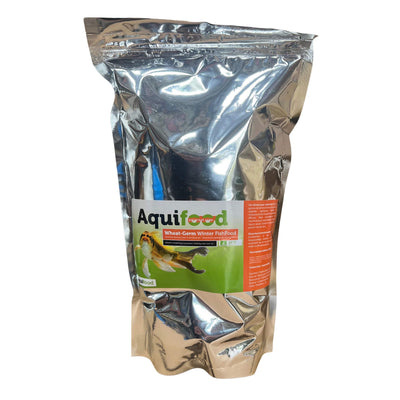
Aquifood Wheat-Germ floating 3 mm is offered for feeding during the low season. Follow the conditions of this formula and the needs of the species present. The name Wheat-Germ does not define a universal minimum temperature for all brands.
After an increase in rations, monitor the parameters before moving to the next step. A return of cold may justify a new adaptation. It is better to follow an irregular recovery than to maintain a quantity decided solely because the calendar indicates April.
If the water still starts to turn green
Go back to the list of checks: flow rate, lamp, quartz, filter, inputs, and measurements. Green water does not automatically prove a failure of the restart, but it deserves to be brought closer to the observed operation.
Avoid combining a complete drain, a full cleaning, and several treatments. You would lose the possibility of understanding what changed. Correct the identified point, then monitor visibility and the behavior of the fish.
A few algae on a stone or a light biofilm do not necessarily require intervention. A balanced pond remains alive. The priority is water adapted to its inhabitants and an installation capable of following the load of the season.
The tracking sheet to keep near the equipment
- Date, water temperature, and test results.
- Flow rate status and intervention on mechanical parts.
- UV lamp reference and replacement date.
- Product added, quantity, and conditions at the time of application.
- Evolution of meals, visibility, and fish behavior.
This information makes any advice much more precise. It will also be useful the following year to anticipate the steps, without automatically repeating a treatment that was only necessary one season.
Prepare a measured recovery
Start with the analysis, then support the filtration when the conditions are suitable for the product.
To go further: How to maintain a garden pond throughout the seasons?
Sources
- RHS — Pond maintenance in March: equipment inspection, feeding, and wildlife protection.
- University of Florida IFAS — Ammonia in Aquatic Systems: conditions of biological operation.
- RHS — Choosing a Pond Filter: mechanical and biological filtration.
- Aquipond — NitriBoost: uses and conditions indicated by the manufacturer.
- Aquishop data sheets for JBL, Aquipond KH+, Bactovase, PondoVac, and Aquifood linked in the article: characteristics and conditions specific to the products.