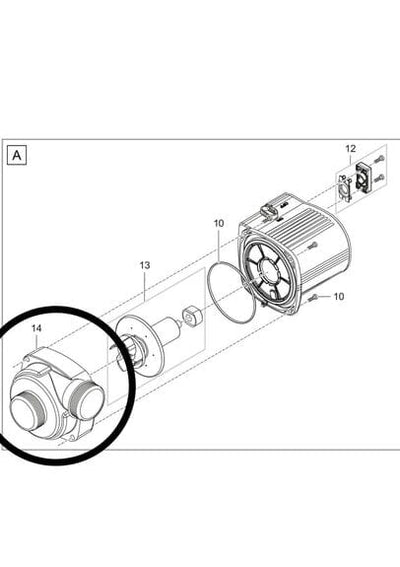
In short: an AquaMax Eco Premium pump that loses flow, vibrates, or stops is almost never destined for the bin. In the vast majority of cases, the cause is a clogged strainer, a worn rotor, or a damaged housing—three parts that can be replaced in a few minutes. This guide helps you make the right diagnosis, identify the exact part for your model, and reassemble the pump correctly. Our Nodebais store is an official Oase repair workshop: if the problem requires more than simply replacing a part, we can take over.
Why repair rather than replace
An AquaMax Eco Premium is a quality pump, designed to run day and night for years. Its electronically regulated motor and robust body generally outlast the surrounding wear parts. Replacing a rotor or housing costs only a fraction of the price of a new pump, requires no special tools, and extends the device's life by several seasons. It also makes more sense for the environment: keep the motor, replace what wears out.

Symptoms and their causes
| Symptom | Most likely cause | What to do |
|---|---|---|
| Gradually decreasing flow | Clogged strainer or filter shells | Clean the strainer, check the hose |
| Low flow despite a clean strainer | Worn rotor or damaged vanes | Replace the rotor |
| Rattling noise or vibration | Gravel or debris in the chamber, damaged rotor | Open, clean, check the rotor |
| Water leak or air intake | Cracked housing, defective seal | Replace the housing or seal |
| Repeated stops | Dry-run protection or blockage | Check the water level and suction |
| The pump no longer starts at all | Power supply, cable, or electronics | Check the socket, then contact the workshop |
Understanding the pump in one diagram
Step 1: basic check (10 minutes)
- Unplug the pump before doing anything. This is non-negotiable.
- Remove it from the water and take off the filter shells or strainer.
- Rinse them under running water outside the pond. A clogged strainer is by far the leading cause of flow loss.
- Check the discharge hose: a crushed, kinked, or algae-filled hose slows down the entire system.
- Reassemble and test. If the flow has returned, the problem is solved.
Step 2: open and check the rotor
If the flow remains low or the pump is making noise, open the housing following the instructions for your model. The rotor will be visible: it is the small magnetic impeller that circulates the water. Examine it carefully:
- Broken or damaged vanes: a stone or snail has gotten through. The rotor must be replaced.
- Abnormal play: if the rotor moves laterally or rubs, the shaft or bearings are worn.
- Limescale or algae deposits: clean with diluted white vinegar, then rinse thoroughly.
A worn rotor can be identified by a loss of flow or an abnormal noise. When disassembling, always check the strainer as well: a damaged strainer is often what allowed the debris through.

AquaMax 13000 rotor
Original Oase part

AquaMax 13000 housing
Original pump body

AquaMax Eco Premium 13000
If the pump is too old

Finding the right part for your model
This is the most important point: each pump size has its own rotor and housing. The rotor for the 13000 is not suitable for the 5000, 7000, or 9000 models, and vice versa. Locate the exact model on the pump label or on its invoice, then choose:
- AquaMax Eco Premium 5000 and 7000 rotor: the same rotor for both models.
- AquaMax Eco Premium 9000 rotor.
- AquaMax Eco Premium 13000 rotor.
- AquaMax Eco Premium 21000 rotor.
- For the other parts (filter shells, adapters, connection kits), the AquaMax Eco Premium 13000 spare parts page lists 11 original Oase parts to choose from one by one. Equivalent pages exist for the 9000 and the 21000.
Beware of older models: AquaMax Eco Premium models from previous generations had different numbers (8000, 10000, 12000, 16000, 20000). Their parts are not always interchangeable with newer models. Send us a photo of the label if in doubt.
Step 3: replace the housing if necessary
The housing is the body that surrounds the rotor. A cracked housing, often due to frost or impact, allows air in or water out, and the pump loses efficiency. Replacing it restores the seal without replacing the entire pump. Take advantage of this disassembly to check the rotor and seals at the same time: everything can be checked in a single intervention.
Step 4: reassemble correctly
- Clean the mounting surfaces and check that the seals are clean, flexible, and properly positioned.
- Insert the rotor without forcing it: it must turn freely by hand.
- Close the housing, following the assembly direction indicated in the manual.
- Reattach the filter shells and the suction adapter if your installation uses one.
- Lower the pump back into the water, let the air escape, then reconnect.
Workshop tip: keep a spare rotor in the shed. In the middle of summer, a stopped pump means a filter that is no longer running and fish lacking oxygen. With the part on hand, the breakdown can be fixed in fifteen minutes instead of waiting several days.
Prevent wear
- Clean the strainer every two to four weeks during the season.
- Elevate the pump on a brick or slab so it does not suck up silt and gravel.
- Use a hose of the correct diameter: a hose that is too narrow makes the pump work harder.
- Never let it run dry: the built-in safety will cut it off, but repeated stops indicate a water level or suction problem.
- Protect it from frost once stopped: store it in a bucket of water in a sheltered place, or leave it running at the bottom if it remains in service during the winter.
The annual maintenance checklist
Once a year, ideally in spring before restarting the filter, give your pump a complete overhaul. Remove it from the water, disassemble the strainer and filter shells, and clean them thoroughly. Open the housing, remove the rotor, check the vanes and shaft, then descale the parts with white vinegar if the water in your region is hard. Check the condition of the cable along its entire length, especially where it passes over the edges of the pond, where it often rubs against stones. Also check the hose clamps and the hose connection. Record the date of this overhaul and the parts replaced in your maintenance log: this way, the following year, you will know if the rotor is starting to wear out. This twenty-minute routine prevents most breakdowns during the season.
When should you contact the workshop?
If the pump no longer starts at all when the socket is powered, if the cable is damaged, or if the motor overheats abnormally, do not try to open the motor block. The Nodebais store is an official Oase repair workshop: we diagnose the pump, tell you if the repair is worthwhile, and use only original parts. And if your pump is quite old, a recent AquaMax Eco Premium often consumes significantly less thanks to its adjustable flow.
Frequently asked questions
How long does a rotor last?
It depends on the operating hours and the cleanliness of the water. In a well-maintained pond, a rotor lasts several seasons. In water laden with sand or limescale, it wears out faster.
Can I use a rotor from another brand?
We advise against it. An ill-fitting rotor vibrates, wears out the bearings, and can damage the motor. Original Oase parts guarantee a quiet, economical, and reliable pump.
My pump is still under warranty, what should I do?
Do not open the motor block and contact us with proof of purchase before doing anything: we will tell you the steps to follow.
You do not know which model you have? Send a photo of the pump label to support@aquiflor.com or call 010 86 03 54: we will tell you the exact part.