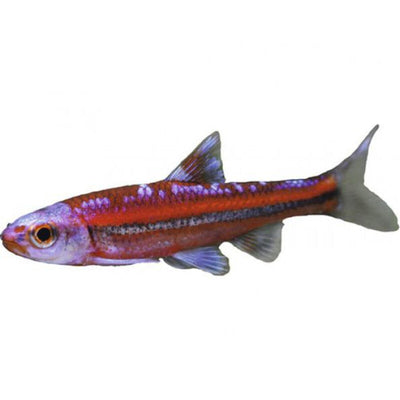
The short answer: the Notropis chrosomus, known as the rainbow goby (in Dutch regenboogelrits), is a small North American freshwater fish that lives in schools and shines with blue, pink, and silver reflections. It grows to about 6 to 8 cm in length, spends the winter outdoors in a pond of at least 5 m³, and should be kept in groups of at least 10 individuals. It is one of the most spectacular fish for a planted pond, a natural pool, or a biotope, and gets along well with other small, peaceful species.
Key points
- Schooling fish: at least 10 individuals; the effect is much more beautiful with 20 or 30.
- Sold at 4 to 5 cm, reaching about 6 to 8 cm as an adult.
- Hardy: it spends the winter outdoors in a pond of at least 5 m³.
- It prefers clear, well-oxygenated, and rather cool water.
- During spawning, the males turn bright red, neon pink, and intense blue.
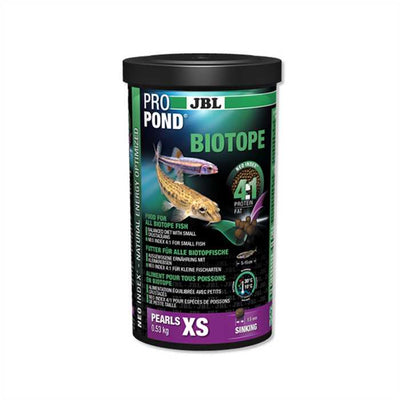
- Recommended food: Aquifood Biotope, small granules for native fish.
What is Notropis chrosomus?
Notropis chrosomus is a cyprinid, belonging to the same large family as the common minnow, goldfish, and koi carp. It comes from the small, clear, cool rivers of the southeastern United States, where it lives in schools above gravel beds. This is precisely what makes it an excellent pond fish: it tolerates cool water, enjoys the gentle current from a pump or waterfall, and spends its days swimming in a group mid-water, clearly visible from the bank.
Its common name, rainbow goby, sums up what captivates everyone who discovers it in the shop: in the sunlight, its flanks shimmer from metallic blue to pink, with a silver stripe and fins that take on red reflections. The males are the most colorful; the females remain more discreet, in shades of golden brown and silver. In spring, when the water warms up, the males take on their spawning colors: bright red, neon pink, and intense blue. This is when the school becomes truly spectacular.
Can Notropis be kept in a garden pond all year round?
Yes. This is even what sets it apart from many small colorful fish sold for aquariums: Notropis chrosomus is a cool-water fish. In its native habitat, the water temperature drops significantly in winter, and it is accustomed to slowing down its activity when the temperature falls. In our Belgian gardens, it spends the winter outdoors without any problem, provided the pond is large and deep enough.
We recommend a pond of at least 5 m³ for overwintering. This volume ensures a deep water zone that does not freeze to the bottom and where the temperature remains stable. In winter, the Notropis gather near the bottom, move little, and eat almost nothing. You simply need to guarantee them two things: oxygen and an opening in the ice so that gases from decomposition can escape. A small air pump with the diffuser placed halfway down, or a floating de-icer like the Oase IceFree Thermo 330, is enough to keep this opening.
In a smaller volume, such as a patio tub or mini-pond, the water freezes too quickly and too deeply: it is therefore better to overwinter them indoors, in a large aquarium of at least 100 liters, kept cool.
How many Notropis should be kept in a pond?
Notropis is a true schooling fish. Alone or in a group of three, it remains hidden and stressed; it loses its color and is barely seen. From ten onwards, it begins to swim in a group and show its natural behavior. The "cloud of color" effect that gives it all its charm really appears from 20 to 30 individuals. In a 5 to 10 m³ pond, a group of 20 is an excellent starting point; in a large natural pond, you can increase this to several dozen.
| Pond volume | Recommended group | Winter |
|---|---|---|
| 100 to 200 L aquarium | 10 to 12 | Indoors, kept cool |
| 5 to 10 m³ pond | 15 to 25 | Outdoors, with an opening in the ice |
| 10 to 30 m³ pond | 25 to 50 | Outdoors |
| Large natural pond | 50 or more | Outdoors |
Aquiflor team guidelines, to be adapted according to the filtration and other fish present.

Notropis chrosomus
4 to 5 cm

JBL ProPond Biotope XS
Native small fish

IceFree Thermo 330
Opening in the ice
What is the ideal pond for rainbow goby?
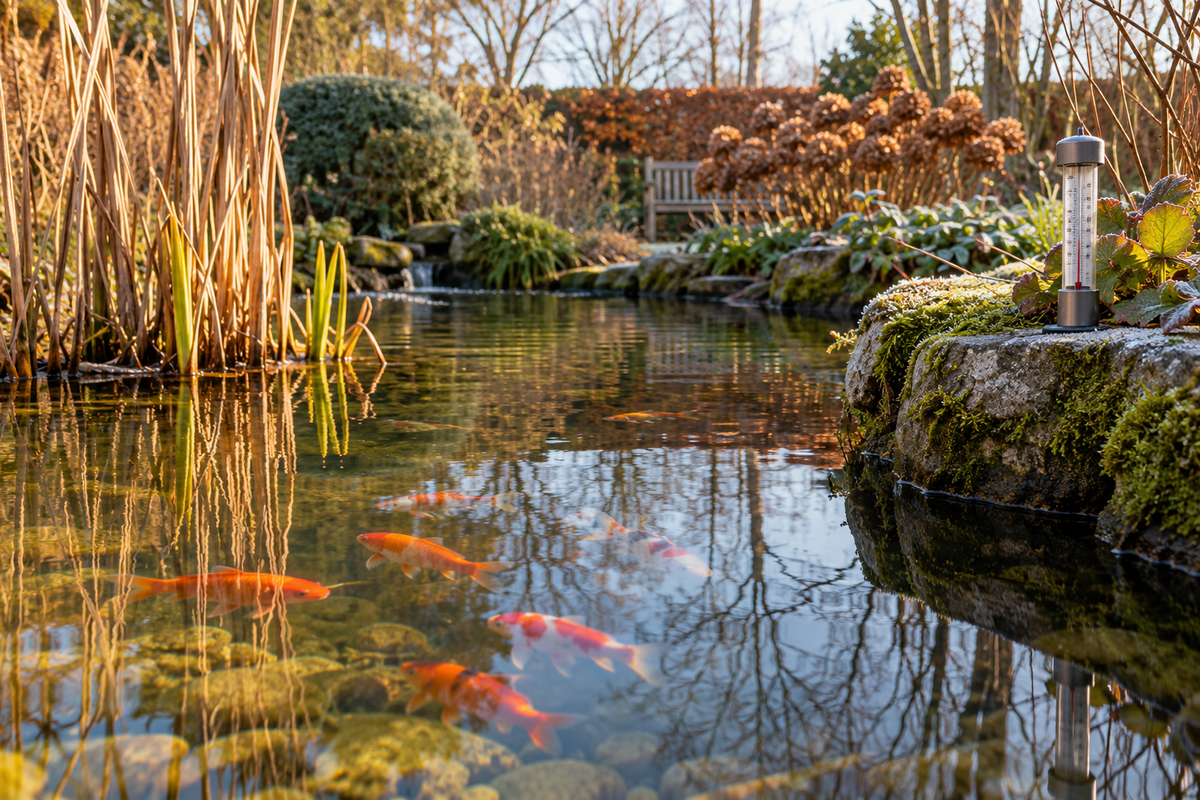
Notropis loves what you find in a well-designed pond: clear, well-oxygenated water, a little current, and lots of plants. A waterfall, stream, or filter outlet creates these gentle current zones where the school likes to stay. Submerged plants and bank plants offer them shelter and spawning areas. A gravel bottom recalls their native rivers.
It is at its best in a planted pond, natural pool, or natural swimming pool, where the goal is biological balance rather than a large population of big fish. Because of their small size, they do not damage plants, stir up the bottom, or put almost any load on the filtration.
Water quality
Aim for clear, well-oxygenated water without excessive nitrites. When starting a new pond, let the filtration and bacteria establish themselves for several weeks before introducing the fish. A simple water test will tell you if the pond is ready.
The workshop's tip: Notropis shows its most beautiful colors in the sun and against a dark background. Black EPDM liner or dark gravel bottom, with a few plants, highlights it much better than a light bottom. Also place your school where you spend the most time, near the patio: it is the fish that brings the pond to life.
What fish can Notropis live with?
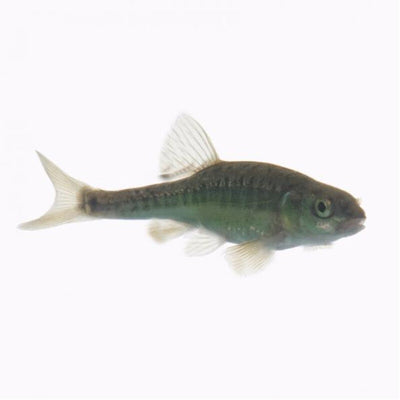
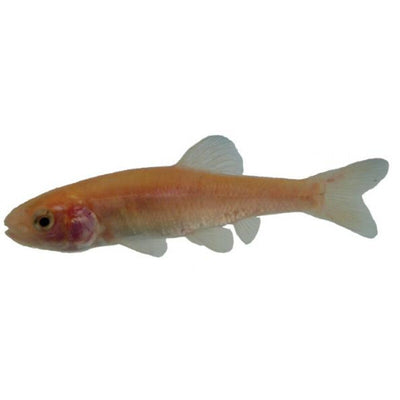
The rainbow goby is peaceful. It gets along well with other small schooling fish and calm fish: common minnows, golden minnows, gobies, small ides, as well as filter-feeding snails like the livebearer ramshorn or the planorbis. It can also live with goldfish and sarasa koi.
However, avoid predators such as perch or black bass, as well as very large koi which, in a densely stocked pond, will readily swallow the smaller Notropis. With koi, choose a large, well-planted pond with refuge zones.
What does Notropis chrosomus eat?
In nature, it feeds on small insects, larvae, and plankton. In the pond, it accepts small floating or slowly sinking granules very well. We recommend Aquifood Biotope, designed for native fish and small fish such as minnows, gobies, and Notropis, or the JBL ProPond Biotope XS. In the warmer season, the larger ones also accept small sizes of Aquifood. Feed sparingly, two to three times a day in summer, what they eat in a few minutes.
When the water drops below ten degrees, their appetite decreases sharply. In the middle of winter, stop feeding: their digestion is almost at a standstill, and uneaten food pollutes the water. Gradually resume in spring.
How does the rainbow goby reproduce?
In spring, when the water warms up, the males take on their spawning colors. In nature, Notropis often spawns above gravel nests dug by other fish. In the pond, reproduction is possible in a planted environment, with a gravel bottom and well-oxygenated water, but the eggs and fry are quickly eaten by the adults. If you want to see young grow up, a pond rich in submerged plants offers them the best hiding places.
Notropis, minnow, or ide: which one to choose?
- Notropis chrosomus: the most colorful, small, ideal for a planted pond or a natural pool.
- Common minnow: native, very hardy, likes current and highly oxygenated water.
- Melanotae ide: larger, swims on the surface, requires more volume.
Combining a school of Notropis and a school of minnows works very well: the two species swim at slightly different heights and animate the entire volume of the pond. See our schooling fish comparison.
How to buy Notropis from Aquiflor?
Our Notropis are sold at 4 to 5 cm. The live fish are delivered by our own delivery person, during a weekly tour within a radius of about 160 km around Aquiflor, in Nodebais. We do not deliver beyond that: check your address and prepare the pond before ordering. In winter, availability and tours depend on the water temperature: call us to reserve your school and receive it in good conditions, or come pick it up at the store.
What not to do: release the fish directly into the pond. Let the closed bag float for about twenty minutes to equalize the temperatures, then gradually add the pond water into the bag before releasing the school.
Frequently asked questions
Can Notropis chrosomus overwinter outdoors?
Yes, in a pond of at least 5 m³, with a deep zone and an opening in the ice. In a small tub, overwinter it indoors.
What is the adult size of Notropis?
About 6 to 8 cm. It is sold at 4 to 5 cm.
How many Notropis should be bought?
At least 10, because it is a schooling fish. The effect is much more beautiful from 20.
Can Notropis be kept with koi?
Yes in a large, well-planted pond with refuge zones. Very large koi can swallow the smaller fish.
Can Notropis be kept in an aquarium?
Yes, in an aquarium of at least 100 liters, in cool water, with a group of at least 10 individuals.
Written by the Aquiflor team, a store specializing in ponds and ponds in Nodebais (Belgium), official Oase repair workshop. Updated in November 2026. Data: Notropis chrosomus product sheet.
Do you want a school of Notropis for your pond? Send us the size of your pond and the fish already present to support@aquiflor.com or call 010 86 03 54: we will advise you on the right number and reserve your school. See also our guide Notropis in an aquarium and all our live pond fish.