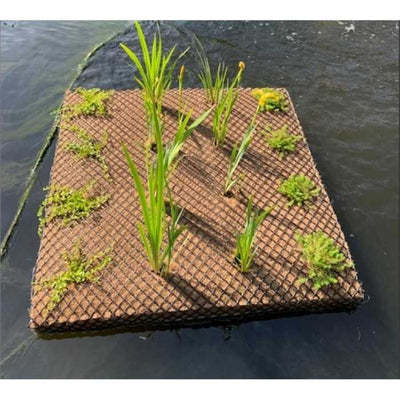
The short answer: a floating island or basket allows you to grow marginal plants anywhere in the pond, even over deep areas, in a pond without a planting shelf, or in a koi pond where plants are eaten. The roots hang in the water, drawing nutrients that feed algae and providing shelter for fry, while the foliage provides shade. It is lined with burlap, filled with aquatic potting soil and gravel, and then planted with suitable marginal plants.
Key points
- Plant in a pond without a planting shelf, even over deep water.
- Keep the roots and root ball out of reach of koi.
- The roots consume nutrients: fewer algae.
- Shade over the water and shelter for wildlife.
- Substrate: burlap, aquatic potting soil, and pre-washed gravel on top.
Why install floating plants?
Many ponds do not have a plantable edge: koi ponds with vertical walls, preformed shells without a planting shelf, deck ponds, or older ponds whose shelves have been removed. Without plants, the water lacks a valuable ally: plants consume the nitrates and phosphates that feed algae, and they provide shade. In a koi pond, there is another problem: the fish dig up and nibble everything that grows within their reach.
The floating island solves all these problems. It sits on the water, wherever you choose, and can be moved by hand according to the season. The plants grow above the water, their roots pass through the basket and descend into the pond. They form a true suspended plant filter that the fish can brush against without destroying the root ball. Fry and small wildlife take shelter there, and dragonflies perch on it.

Which model to choose?
| Model | Size | Ideal for |
|---|---|---|
| Superfish round floating basket | Ø 30 cm | One or two plants, small pond |
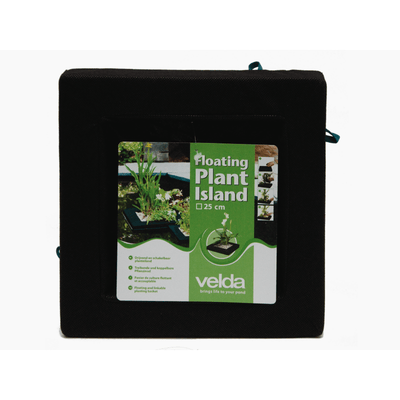
| Velda Floating Plant Island | 25 cm square, reliable | Creating an island of the desired size |
| Velda Floating Plant Oasis | 6 square baskets | Floating bed in deep water |
| Floating mat | 1 × 1 m, 25 9 cm pots | Large pond, plant-based filtration |
The 30 cm round floating basket from Superfish is the simplest solution: one root ball, one plant, and shade wherever you place it. The 25 cm square Floating Plant Island from Velda, equipped with a polystyrene floating ring, connects to other baskets to form a large island. The Floating Plant Oasis holds six square planting baskets and creates a true bed, perfect for deep water where you cannot plant on the bottom. Finally, the 1 × 1 m floating mat holds 25 9 cm pots: it is the format for large ponds and lakes where you want true plant-based filtration. Plants are not supplied with the supports.

1 × 1 m floating mat
25 plants

Velda floating basket
Reliable in an island

20 L aquatic potting soil
Velda and Moerings
How to plant a floating island?
- Line the basket with burlap: it holds the soil and allows roots to pass through. One 1 × 2 m piece is enough for several baskets.
- Add a few centimeters of aquatic potting soil, such as the Velda potting soil developed with the Moerings nursery, whose aerated structure allows water to circulate. Never use garden soil: it is too rich and feeds algae.
- Insert the potted plant and tamp down lightly.
- Cover with gravel or pre-washed clay pebbles up to the edge, so that the substrate does not disperse and the fish do not dig it up.
- Place the island on the water and check that it floats flat; distribute the plants to keep the arrangement balanced.
- Secure it if necessary with a cord and weight, so that it does not drift toward the skimmer or waterfall.
The workshop's advice: place the island where the sun shines brightest in the afternoon. Its shade limits the heating of the water and the growth of algae exactly where they start first, while giving the fish a cool place to rest.
What plants to put on a floating island?
Choose marginal plants, which like to have their feet in the water and their heads in the sun. Water irises, aquatic mint, rushes, marsh forget-me-nots, loosestrife, flowering bulrush, or marsh marigold do the job very well. Favor native, hardy species and moderate heights to keep the island stable in the wind. Avoid plants that are too tall or too heavy on a small basket: they will tip it over. Vary the species to spread the blooms from spring to autumn.
Invasive plants: some exotic floating plants are banned from sale and planting in Europe, as they invade waterways. Stick to authorized and, preferably, native species. Ask the store for advice if in doubt.
An example: a 15 m³ koi pond without plants
Imagine a 15 m³ koi pond with vertical walls and no planting shelf. The koi have dug up all the plants placed on the bottom, and the water turns green every summer despite the UV-C. The solution: two connected Velda floating baskets and one round Superfish basket, filled with burlap, aquatic potting soil, and gravel. Plant water irises, aquatic mint, and a few rushes in them, then place the whole thing in the sunniest corner, tied with a cord so that it does not drift toward the skimmer. After a few weeks, the roots descend into the water and form a curtain where young fish can hide. The koi come to rest in the shade of the island, and generally, the water remains more stable throughout the season, provided you maintain a reasonable feeding routine and well-maintained filtration.

How to maintain a floating island?
- In spring, cut off dry stems, divide plants that are too vigorous, and top up the gravel if necessary.
- In summer, remove yellowed leaves and monitor the balance: a plant that grows too much on one side can make the island tilt.
- In autumn, cut back the foliage so that it does not fall into the water.
- In winter, most native marginal plants remain on the island. In a small pond very exposed to frost, move the island closer to a sheltered edge.
- The roots can be trimmed if they become very long; they grow back quickly.
Errors to avoid
- Using garden soil: it is too rich and releases nutrients into the water.
- Forgetting the gravel: the fish dig up the substrate and disperse it.
- Overloading a small basket with large plants.
- Letting the island drift against the skimmer or into the waterfall.
- Planting invasive or prohibited species.
Frequently asked questions
Do koi eat the plants on a floating island?
They can nibble on the hanging roots, but the root ball and foliage remain out of reach. The roots grow back quickly, and the island also provides shade for the fish.
What substrate to put in a floating basket?
Burlap, a few centimeters of aquatic potting soil, then a layer of pre-washed gravel or clay pebbles.
Does a floating island help against algae?
Yes: the roots consume the nutrients that feed algae, and the foliage provides shade over the water.
How many plants on the 1 × 1 m floating mat?
It holds 25 plants in 9 cm pots. The plants are not supplied.
Written by the Aquiflor team, a pond and lake specialty store in Nodebais (Belgium), official Oase repair workshop. Updated in November 2026. Features: Superfish, Velda, and Aquipond product sheets.
Are you looking for the right plants for your island? Our nursery in Nodebais offers aquatic and marginal plants adapted to our climate. Call us at 010 86 03 54 or write to support@aquiflor.com.