

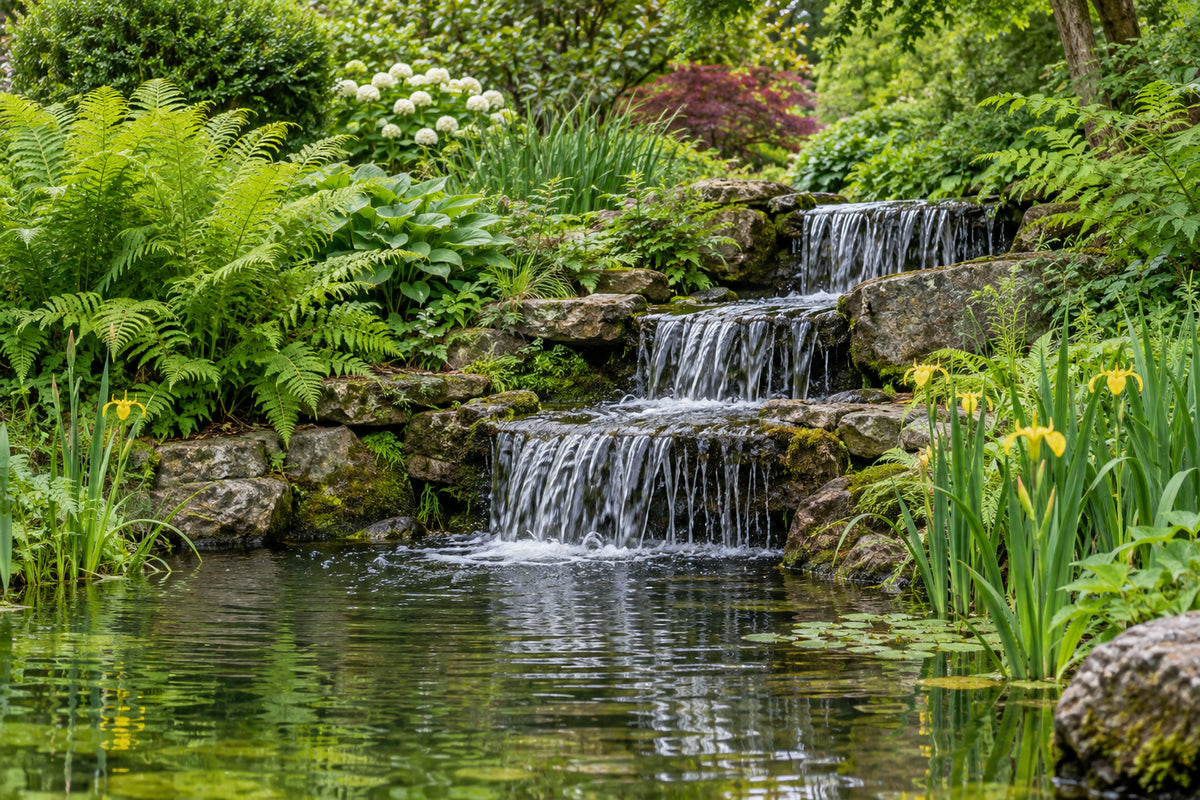
A successful waterfall gives the impression of having naturally found its place in the garden. It can be a series of discreet stones, a contemporary sheet of water, or a small stream that joins the pond. The choice depends as much on the desired relief and sound as on the style of the materials.
To help you decide, here are six examples of designs and the equipment to plan for. The scenes described are design ideas, to be adapted to your terrain. Their installation requires checking the available flow rate, waterproofing, and maintenance access before permanently fixing the décor.

1. A stone waterfall to extend a natural pond
A few irregular slabs, a water inlet hidden by plants, and a fairly wide collection area: this composition works well in a garden where the pond already has soft banks. The water follows several small passages and quickly returns to the body of water.
Read also:
- Choosing a pond pump: understanding flow rate, height, and volume
- Which pump to choose for a closed-circuit waterfall?
- Flow too strong in a waterfall: how to reduce it properly?
Choose stable stones and arrange them on a prepared support. Decorative elements must not rest directly on a membrane without suitable protection. Above all, the liner must collect the water across the entire actual width of the flow, including when a leaf diverts the current.
To plan for: pond liner, protection, stones, pump suitable for head loss, pipe, and accessible fittings. Keep a stone easily removable in front of the inlet connection. This discreet access will be valuable during the first cleaning.
2. A stainless steel sheet of water for a contemporary garden
A sheet of water forms a more regular ribbon. It pairs well with a rectangular pond, a mineral terrace, or a simple retaining wall. The effect depends heavily on the installation level: a slightly tilted weir can concentrate the water on one side, even with a good pump.
The width of the weir should remain consistent with the collection surface. A large sheet in front of a small basin increases the risk of splashing, especially when the wind intervenes. Plan a test at the chosen flow rate before closing the wall cladding.

The OASE Waterfall XL 60 is an option to consider for this type of project. The choice of the pump still needs to be made according to the height, the circuit, and the expected effect. A sheet of water purchased alone does not constitute a complete installation: check the exact contents and add the necessary elements.
3. A short stream to utilize a slope
On a slightly sloping terrain, a stream can connect a high area to the pond. It offers a gentler path than a vertical drop and allows plants to be installed along the banks. A few narrowings create variations in movement without multiplying obstacles.
However, it requires more waterproofed length. Each bank must remain high enough to contain the water when the flow varies or when debris accumulates. Do not end the liner flush with the visible flow during a clean test: the margin must account for actual operation.
To plan for: a continuous membrane or joints made according to the waterproofing system, stable banks, a pump sized for the elevation difference, and a pond capable of receiving the water that flows back when stopped.
4. A two-basin waterfall
Two containers designed for this use can form a compact composition: the upper basin overflows into the lower one, which joins the pond or serves as a reservoir. The whole is suitable for a terrace corner when the supports and water collection have been properly studied.
The difficulty is less decorative than hydraulic. The lower reservoir must contain the volume necessary for the pump in operation and the water that returns when it stops. Ordinary containers simply stacked can tip over, crack, or leak water on the sides.
On a raised terrace or balcony, have the total load validated before any installation. The weight of the water is added to that of the basins, stones, and supports. The visible exterior surface is not enough to determine the distribution of this load.
5. A small drop integrated into the filtration return
The return of a filter can sometimes be integrated into a waterfall. This allows a useful piece of equipment to participate in the staging of the pond. But this idea must respect the operation of the filter: a gravity-outlet model needs a free return and a suitable installation.
Do not throttle an outlet to artificially obtain a thinner sheet. Ask if the filter accepts the planned installation and what flow rate must pass through it. The décor must not create a risk of overflow or prevent the removal of a cover or a valve.
With fish, filtration first meets the needs of the pond. If you wish to turn off the waterfall at night for the noise, an independent decorative circuit can be more practical than stopping all biological filtration.
6. A discreet flow near a relaxation area
A short drop, close to the surface, often allows for a more moderate sound. It is an interesting option next to a bench or a table. The water can slide over a stone rather than falling from a height onto a dry slab.
Temporarily install the elements and listen from several places: the terrace, the house, the edge of the garden. The walls can reflect the sound. An installation that is pleasant when standing right in front of it can become overwhelming from an open window.
The adjustment is done by geometry and by a control method compatible with the pump. Not all motors are electronically adjustable. An ordinary variable frequency drive should not be added to a pump that is not designed for it.
The equipment common to the six projects
| Element | Question to resolve before purchase |
|---|---|
| Pump | What flow rate remains available at the actual height and with this circuit? |
| Pipe | What diameter limits losses without complicating connections? |
| Waterproofing | Where can the water pass if the current is diverted? |
| Reservoir | Can it receive the returning water when stopped? |
| Access | Can the pump be removed and the weir cleaned easily? |
The AquaMax Eco Classic 8500 is an example of a pump for a filter or stream to compare with your needs. Its stated maximum flow rate is 8,300 l/h and its maximum height is 3.20 m; these two values are not obtained simultaneously. The operating curve is used to check your operating point.
For the piping, consult the flexible pipes for pumps and check the inner diameter as well as the compatibility of the fittings. An outlet that is too narrow can limit the entire circuit, even if the rest of the pipe is generously sized.
Plan for cleaning from the design stage
Leaves readily get stuck between two stones, and a thin layer of biofilm naturally appears on wet surfaces. Keep accessible areas to intervene without dismantling the entire décor. Cut the power supply before handling the pump, in accordance with its manual.
When deposits accumulate in the collection pond, a PondoVac vacuum cleaner can facilitate their removal if the configuration is suitable. For the organic fraction of the sludge, Aquipond Bactovase can complete the maintenance according to its manual. It does not replace the removal of leaves or the cleaning of a clogged passage.
Is your favorite idea chosen? Send a sketch with the height, the drop width, the pipe length, and a photo to support@aquiflor.com. These four pieces of information allow for the preparation of a coherent selection of equipment before starting the work.















