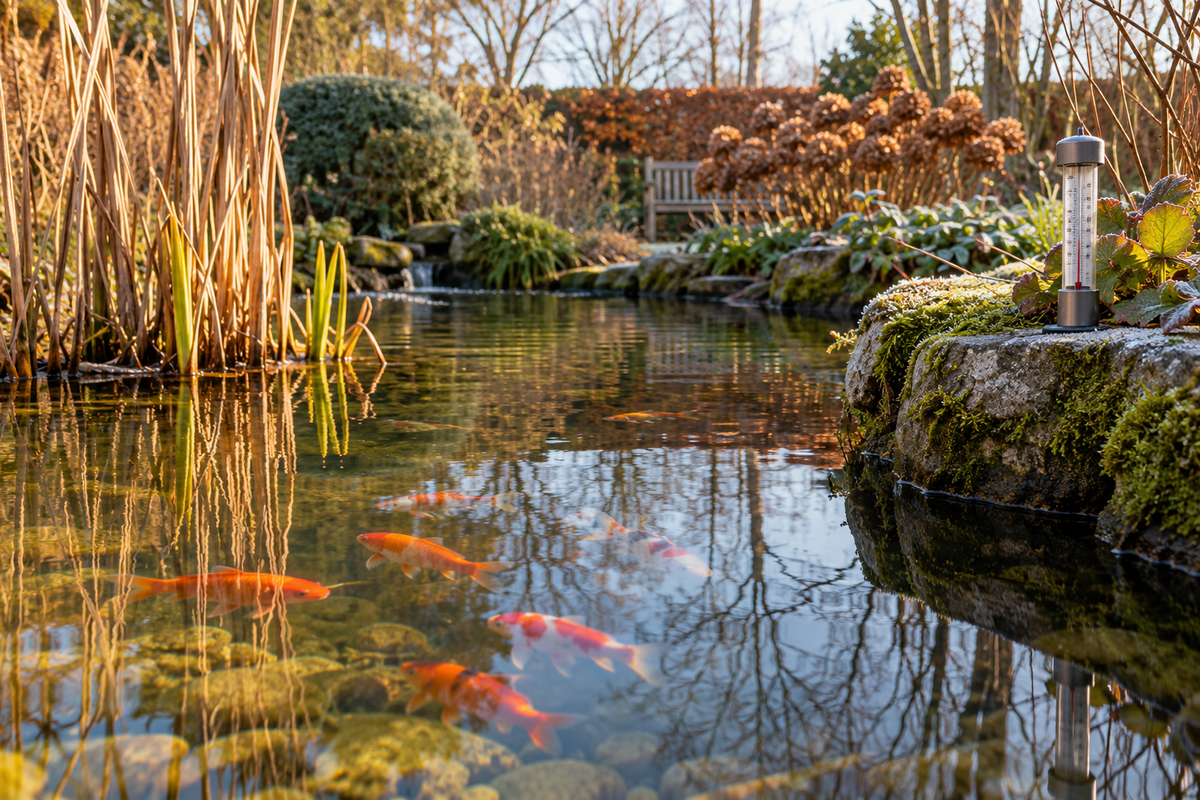
In January, a koi remains near the bottom and no longer comes to claim its pellets. This behavior may correspond to the cooling of the water. But if it loses its balance, breathes with difficulty, or shows a lesion, winter is no longer enough to explain it.
To spot a problem with fish in winter, compare their usual behavior, the progression of signs, and the conditions of the pond. The goal is to quickly identify a worrying situation and gather useful information, without unnecessarily capturing the fish or choosing a treatment at random.

What may be normal when the water cools
Koi and goldfish generally reduce their activity and food intake as the temperature drops. The RSPCA describes the search for sheltered areas and a more marked presence near the bottom among pond fish in winter.
The slowdown must remain consistent with other observations: fish capable of maintaining their position, breathing without apparent effort, and absence of a worrying change in appearance. It is not a sleep that would make any sign abnormal without importance.
Behavior also varies according to the species. Sturgeons do not follow the same rules of winter feeding. Delicate varieties of goldfish may require a prepared indoor accommodation. Therefore, identify the fish before interpreting their activity.
The signs that justify reacting quickly
Labored breathing or fish gathered at the surface
Marked gill movements, a persistent search for air at the surface, or several fish gathered near a water inlet require a quick check. An oxygen problem is possible, but it is not the only explanation.
The Merck Veterinary Manual describes several environmental causes capable of producing respiratory difficulties, notably nitrites and certain contaminants. The presence of bubbles in the pond does not prove that dissolved oxygen is sufficient everywhere.
Loss of balance or disorganized swimming
A fish lying on its side, unable to straighten up or swimming in a disorganized way should not be considered simply "asleep from the cold". Ask for an urgent veterinary opinion, especially if the sign appears suddenly or concerns several individuals.
Mortality or rapid worsening
An unexplained death, then a second fish in difficulty, is important information. Note the times and the number of animals affected. Quickly contact a competent professional in fish health instead of waiting for the return of warmer weather.
In case of marked distress, observations and samples should not delay the urgent measures recommended by this professional.
The more discreet changes to note
The RSPCA and OATA invite you to monitor deviations in behavior, appearance, and feeding. Look in particular if a fish isolates itself permanently, presses its fins, rubs itself repeatedly, or shows an unusual change in silhouette.
Red spots, wounds, new spots, or a cottony appearance require an evaluation. Their appearance alone does not allow to name with certainty an infection or a parasite. Several causes can produce similar signs.
For white spots, for example, the University of Florida indicates that a visual suspicion must be confirmed by the identification of the parasite in the examined tissues. A photograph helps describe the problem; it does not always replace the necessary examination.
Photograph if possible the same fish from a comparable angle, without chasing it. A dated image allows to see if an area is expanding or if a modification was already present before.
An observation method in a few minutes
Sit down in the same place, on a stable bank, and wait for the fish to resume their usual behavior. Avoid tapping on the edge, waving a net, or systematically distributing food to make them come up.
- Look at the group. Where is it located and how many fish are visible?
- Compare the individuals. Is one of them distinguished by its position or its movements?
- Observe the breathing. Do you see an unusual effort or a repeated search for the surface?
- Check the equipment. Level, circulation planned for winter, opening in the ice, and electrical power.
- Note the changes. Date, temperature, recent event, and eventual progression.
A short video can better show swimming and breathing than a photo. It will be particularly useful when the behavior does not recur during an exchange with the veterinarian.
Test the water, even when it appears clear
Clear water can contain ammonia or nitrites. During a problem, the basic tests concern notably temperature, pH, ammonium/ammonia, nitrites, and dissolved oxygen. Hardness and other analyses can complete the investigation according to the context.
The JBL ProAquaTest CombiSet Pond kit contains pH, KH, GH, ammonium, nitrite, and phosphate tests. It allows to obtain several useful data to communicate.

This kit does not measure dissolved oxygen or nitrates. The first is ideally checked on site with an appropriate device. A transported bottle does not necessarily reproduce the conditions present in the pond at the time of the signs.
Respect the volumes, reaction times, and reading conditions of the tests. A photograph taken long after the planned deadline can give a misleading interpretation. Also check the date and storage of the reagents.
Reconstruct what happened before the problem
The University of Florida's diagnostic recommendations insist on the history. Prepare the list of species and numbers, the pond volume, the water values, the meals, and the dates of appearance of the signs.
Add recent events: new fish or plants, filter cleaning, power outage, water change, heavy rain, frost, or added product. Keep the exact name of the products and the quantity actually used.
If a sample is requested, contact the veterinarian or the laboratory first to know the procedure. The water sample must be distinct from the water used to transport a fish, because the latter evolves during the journey. Do not transport a sick animal without appropriate instructions.
The errors that complicate the situation
- Attribute all immobility to the cold. Balance, breathing, and other signs remain essential.
- Suddenly warm up a fish. An indoor transfer requires preparation and an adapted protocol.
- Multiply the products. Successive additions can disturb the environment and complicate the diagnosis.
- Clean the filter entirely by reflex. Excessive maintenance can reduce its biological capacity.
- Feed more to "give back strength". Leftovers increase the pond load without helping a fish that does not eat.
An isolation tank must also have an appropriate volume, water, and filtration. The simple fact of separating a fish does not make a container suitable for its maintenance.
Prevent by preparing the pond and the tracking
Prevention rests on water quality, a suitable population, consistent feeding, and regular maintenance. Plan the removal of leaves and deposits before difficult winter conditions, then limit unnecessary disturbances.
Read also:
- Preparing your pond for winter: the 7 steps, in order
- Antifreeze or pond heating: what to choose in winter?
- Should you stop pond filtration in winter? The complete guide
When the installation justifies it, a correctly dimensioned aeration can be part of the equipment. The OASE AquaOxy 1000 has two outlets and diffusers; its choice and installation depend on the pond. The announced air flow does not replace a measurement of oxygen in the water.
If a biological correction is planned at a compatible period, the Aquipond NitriBoost is intended for seeding with nitrifying bacteria. It does not treat a fish and does not instantly remove a nitrite problem. Respect its conditions of use, notably the indicated temperature.
Keep the right information at hand
A notebook, a thermometer, and usable tests facilitate the tracking of the pond. In case of difficulty, provide dated values and a short video rather than a description limited to "it does not move anymore".
Sources
- RSPCA — Caring for Your Pet Fish in Winter : seasonal slowdown.
- RSPCA — Fish Health : health signs and changes to monitor.
- OATA — How to Look After Pond Fish : observation and maintenance.
- Merck Veterinary Manual — Environmental Diseases of Aquatic Animals : environmental causes.
- UF/IFAS — Submission of Fish for Diagnostic Evaluation : history and samples.
- UF/IFAS — Introduction to Fish Health Management : water assessment and tracking.
- UF/IFAS — White Spot Infections in Fish : necessity of diagnostic confirmation.
- Aquishop sheets of the products cited: content of the tests and functions of the equipment.