
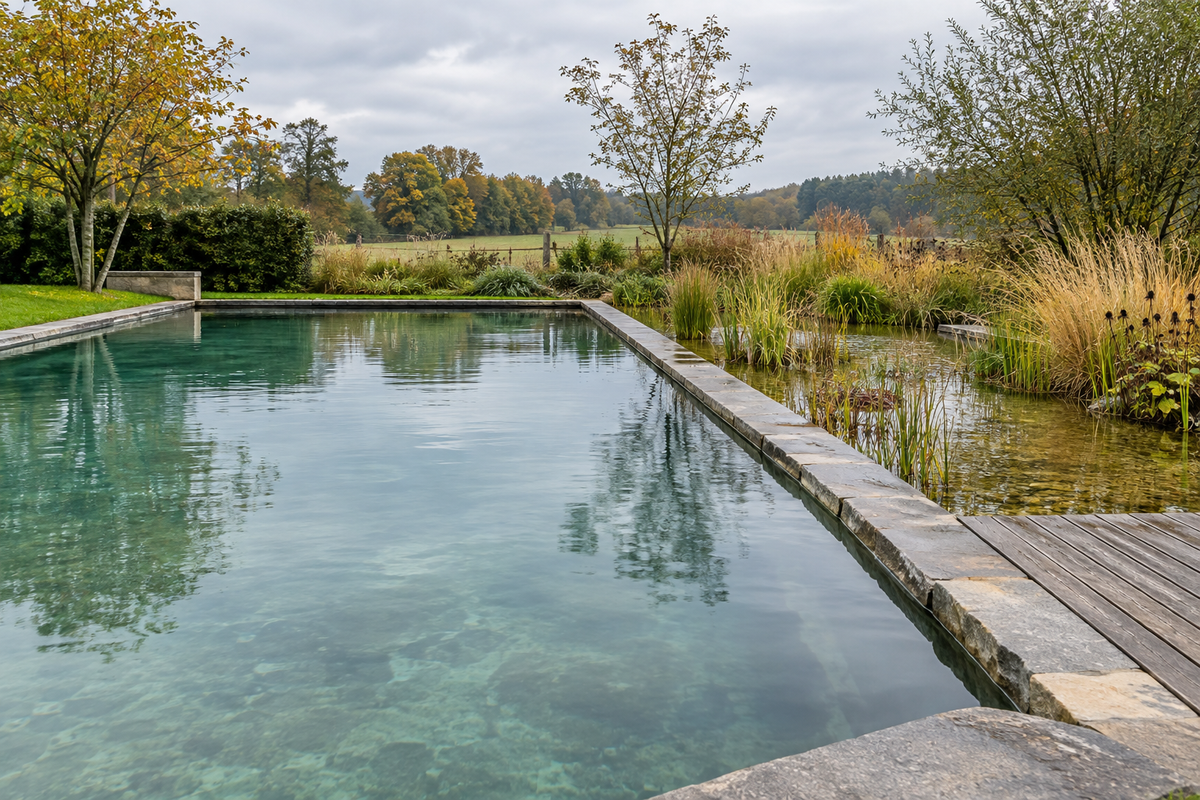
Plants in a lagoon system do not share a single temperature limit. A hardy species may spend the winter in dormancy, while a tropical plant will need to be protected. And surviving the cold does not mean purifying the water with the same level of activity all year round. For a swimming pond, the choice must therefore combine climate, planting depth, and the operation of the filtration system.
Before buying a collection of plants, you must answer one question: what function do you expect from this planted area? Decorating the banks, supplementing a biological filter, or creating a large regeneration zone requires different choices. Here is how to prepare a coherent planting scheme and its maintenance throughout the seasons.
Three temperatures not to be confused
Air temperature indicates the risk of frost, but it does not exactly describe what the roots are experiencing. Water changes temperature more slowly. A pot placed in a few centimeters of water near an exposed bank does not experience the same conditions as a rootstock installed deeper. The thermometer placed on the terrace is therefore not enough to decide the fate of all the plants.
You must also distinguish between winter hardiness and the temperature favorable for growth. A plant may remain alive in the form of a rootstock and produce almost no new leaves for several months. The presence of living roots does not guarantee significant nutrient absorption in the middle of winter.
Finally, a commercial label such as "hardy down to −15 °C" generally describes cold resistance under certain growing conditions. It does not mean that the water must reach this value, nor that a basket entirely encased in ice will be without risk. Check the exact species, its installation, and the conditions to which the indication applies.
The lagoon complements a system designed for swimming
Clear water is pleasant, but its appearance is not enough to assess its quality for swimmers. The planting must be part of a project that provides for water circulation, waste elimination, and water quality monitoring. A basket added near some stairs does not replace this design.
The 2013 French professional guidelines for biological swimming ponds with intensive filtration distinguish between physical filtration, biological filtration, and an optional planted zone. This distinction remains useful for understanding the role of each piece of equipment. This document describes a specific type of implementation: its recommendations should not be automatically transposed to all natural pools.

Which plants should be examined first?
For an outdoor installation in Belgium, start with species whose hardiness is documented and compatible with your situation. Then ask the lagoon designer to validate the list. The Latin name is essential: two plants sold under the same common name may have different needs.
| Situation | Selection guidance | Point to check |
|---|---|---|
| Wet soil bank | Marsh marigold, water forget-me-not, purple loosestrife | Location outside the swimming zone, humidity, and available volume |
| Planted zone with water flow | Range validated for the selected filtration process | Substrate, depth, nutrition, and circulation between roots |
| Exotic seasonal decoration | Cold-sensitive plants, precisely identified | Real possibility of overwintering them in shelter |
| Small accessible compartment | Species whose development remains controllable | Division possible without dismantling the filtration |
Natagora lists Caltha palustris, Myosotis scorpioides, and Lythrum salicaria among the wet soil plants of a pond. This reference helps avoid treating them like deep-water plants. However, it does not constitute validation of their use in just any swimming pond filter.
Beware of universal lists of "best filtering plants." The 2013 professional annex specifically advises against rushes and yellow iris in the particular context of an intensive, nutrient-poor swimming pond. This is not a general ban on these plants in the garden: it is proof that their compatibility depends on the system. Beautiful growth in a fish pond does not predict their behavior in a lightly loaded swimming pond.
Preparing for winter without moving all the plants
In the autumn, identify the hardy plants and those that require protection. Virginia Cooperative Extension reminds us that many aquatic plants go dormant and that cold-sensitive species must be properly overwintered. Sorting is done species by species, rather than by applying the same method to all pots.
In a fixed lagoon, systematically moving plants to the deep part is generally not a trivial operation. You could disturb the substrate, hinder circulation, or make the plants difficult to retrieve. Have it specified during the design phase which plants remain in place and which are removable.
Remove leaves that detach and risk accumulating in the water. Inspect the passages, inlets, and outlets of the compartment. Avoid compacting the roots by walking directly in the planted area. Stems that are still healthy and damaged parts do not necessarily require the same intervention: adapt the pruning to the species.
What to do when the pond warms up?
In the spring, a slow recovery does not immediately mean that the planting has failed. Photograph the same areas a few weeks apart and look for new shoots. Check the water level and the actual depth above the crown, especially after adjusting the general level.
A plant that is yellowing deserves an examination before any nutrient addition: is it too submerged, too shaded, poorly rooted, or placed in an unsuitable medium? Adding fertilizer to a swimming pond to make a few leaves turn green again can run counter to the goal of nutrient control. Ask for a diagnosis based on the plant and the water.
During hot periods, note the water temperature at a comparable time and observe the shallow areas. Penn State highlights that these can warm up quickly. Exposure, depth, and the shading provided for in the project therefore deserve as much attention as the choice of vegetation. Avoid promising a maximum temperature common to all species.

The form to prepare before your purchase
A relevant choice begins with a few simple pieces of information. For each zone, note its length, width, planting depth, and exposure. Add a general photo, the type of medium, and the name of the filtration system. Specify whether the pond is already in operation or still in the design phase.
- Ask for the full botanical name and adult size of the proposed plants.
- Have the recommended water depth above the medium specified.
- Check the planting method compatible with the chosen process.
- Provide access to remove waste and divide clumps.
- Keep a list of the plants with their locations to track their development.
You can browse the Aquishop aquatic plants to prepare your selection. For a swimming pond, the final choice must remain consistent with the technical project. The analysis solutions for natural pools and swimming ponds also allow for comparing the parameters measured by each kit; a standard test does not necessarily cover all the checks necessary for swimming.
Frequently asked questions
Do I need to heat the lagoon in winter?
Not just to keep leaves green. An outdoor project must provide for its seasonal operation and adapted plants. If certain species require shelter, removable planting may be more logical than heating the entire zone. Any change to winter operation should be decided based on the instructions for the installed system.
Are plants that are dead on the surface lost?
Not necessarily. A perennial can lose its aerial parts and start growing again from its rootstock. Identify the species and its normal recovery period before replacing the plant. A degraded rootstock and simple dormancy cannot be diagnosed by leaf color alone.
How many plants are needed per square meter?
There is no figure that applies to all species and all media. Ask for a planting plan indicating initial density and future maintenance. Filling every space from the first day sometimes leaves too little room for the clumps to develop.
The right approach: choose the plants, their location, and their seasonal maintenance together. Cold resistance is a starting criterion; the success of the lagoon depends on the entire project.
Sources and references
- UNEP, AITF, FFP and Hortis — Biological swimming ponds with intensive filtration, July 2013: distinction of functions and specific context for plant selection. Historical technical reference, not presented as current regulation.
- Virginia Cooperative Extension — Winterizing the Water Garden: dormancy and distinction between hardy and cold-sensitive plants.
- Natagora — Pond plants: examples of plants classified according to their planting zone.
- Penn State Extension — Water for Wildlife: influence of shallow depth and exposure on the warming of a small body of water.






