The best filter plants are those that grow well where you plant them. A properly placed water mint plant does more for your pond than a large clump of iris that is slowly dying at the bottom. Before filling your basket, measure the depths, assess the sunlight, and distinguish the damp bank, the lagoon zone, and the open water.
The selection below is based on the plants offered in the Aquishop catalogue and their uses in water gardens. It helps you create a cohesive planting for an ornamental pond or the planted zone of a natural swimming pool. For swimming, the planting plan must remain integrated into the chosen treatment system.

What do filter plants really do?
Plants use nutrients to build their tissues. Their roots and the materials surrounding them also provide a home for organisms that help maintain the environment. In practice, the planting supports water circulation, waste management, and the pond's biological activity.
Read also:
This system has its limits. Plants do not instantly remove all sludge, cannot replace filtration suitable for a large fish population, and do not disinfect a swimming pool. Their growth varies with the seasons. A planted zone that seems effective in June does not work in exactly the same way in the depths of winter.
Removing some of the cut plants helps export organic matter from the pond. If all the leaves die and decompose in the water, some of the elements they contain return to the environment. Maintenance is therefore part of the planting's filtering role.
Start with the depth at the crown
Planting depth is not always measured from the bottom of the basket. The useful reference point is generally the crown, at the junction between the roots and the above-ground parts, or the point specified for the species. A shelf located 30 cm underwater may leave the crown barely submerged if the basket is tall.
Take a quick survey before buying: shelf depth, container height, and usual water level. Also allow for fluctuations in water level. A damp-soil plant does not become a submerged plant just because it is sold among aquatic plants. If in doubt, confirm the exact position using its botanical name.
A selection to create your planting
| Plant | Suggested location | Point to consider |
|---|---|---|
| Water iris, Iris pseudacorus | Marsh or lagoon zone with room for a vigorous clump | Allow for its growth and access for dividing the clumps |
| Water mint, Mentha aquatica | Damp to shallowly submerged border | Contain its spread in small arrangements |
| Small bulrush, Typha minima | Shallow zone depending on the planting medium | Check the species: not all bulrushes take up the same amount of space |
| Flowering rush, Butomus umbellatus | Shallow aquatic zone suited to its needs | Leave room for underground parts and future stems |
| Water clover, Menyanthes trifoliata | Aquatic border and transition zone | Allow for its spread rather than crowding it between dominant plants |
| Pickerelweed, Pontederia cordata | Shallow submerged zone with emergent foliage | Respect the depth indicated for the supplied plant |
| Marsh marigold, Caltha palustris | Damp soil and very shallow border | Interesting for its spring flowers, to be combined with other plants |
| Acorus gramineus 'Ogon' | Damp border for a low silhouette | Do not plant it at the bottom like a submerged plant |
This list offers complementary roles; it does not rank the species by a number of litres "filtered". This type of performance cannot be attributed to a single plant without knowing the system, inputs, and growing conditions.
Three choices easy to integrate into the plan
Water mint for a living border
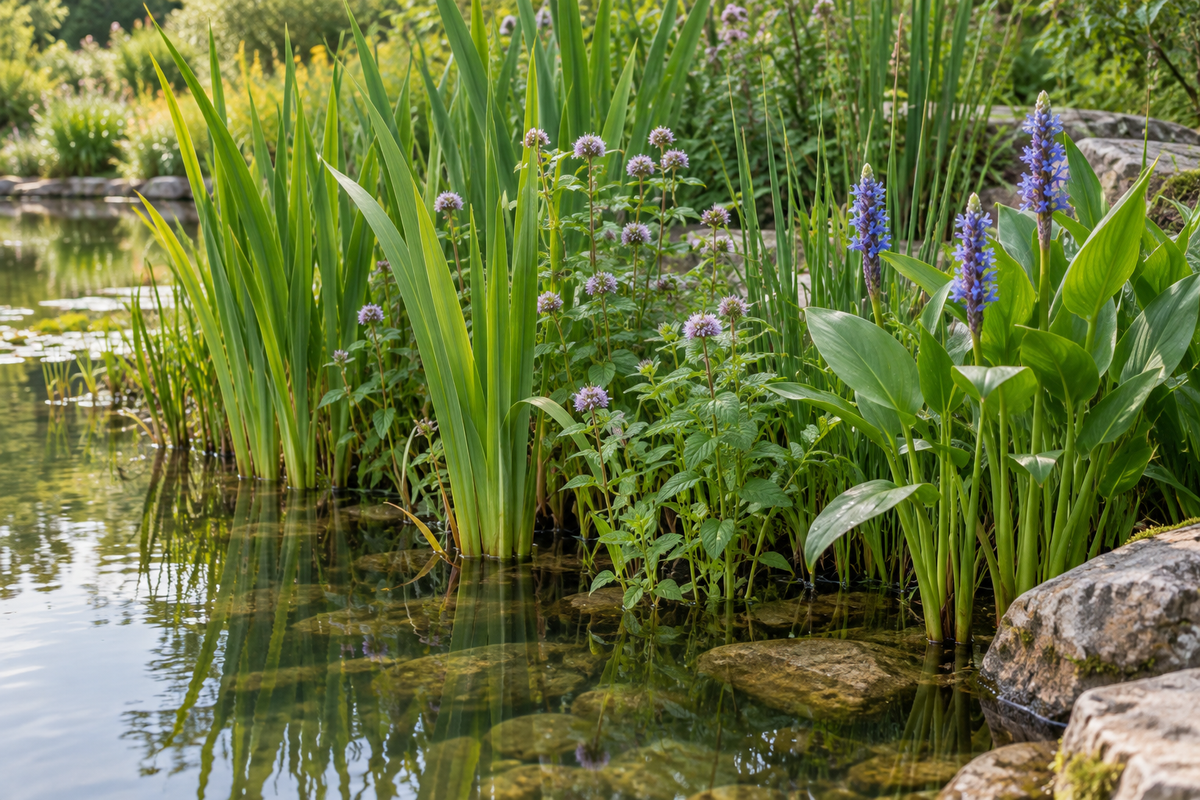
The water mint provides aromatic foliage and flowers that are appreciated in the garden. The Aquishop information sheet indicates planting in the damp zone up to about 10 cm of water at the crown. In a small pond, an accessible container makes it easier to control its spread and divide it.
Pickerelweed for adding height
The heart-leaf pickerelweed is suitable for an arrangement where emergent foliage and vertical flowers are desired. Despite the word "submerged" appearing in some commercial designations, its foliage grows above the water. The information sheet places it in shallow water, to be adapted to the plant and its installation.
Marsh marigold to start the season
The marsh marigold adds interest to the bank in spring. It complements plants whose visual effect appears later. Place it at a depth compatible with its needs, without trying to have it occupy the same level as a water lily or pickerelweed.
A pack to plant a lagoon zone

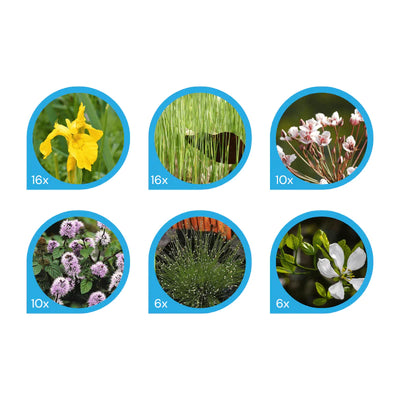
The Aquipond pack of 64 filter plants includes, according to its catalogue composition, 16 yellow irises, 16 small bulrushes, 10 flowering rushes, 10 water mints, 6 bent grasses, and 6 water clovers. Check the composition and availability at the time of ordering.
The mention "approximately 4 m²" describes the planting area offered for the pack. It does not mean that these plants are sufficient to filter any swimming pool or a specific volume of pond. The lagoon must be sized with its substrate, hydraulics, the load to be treated, and its cleaning possibilities.
Before planting, distribute the pots on the plan or dry on the prepared area. Group the species in a clear way, keep the tallest ones out of main view, and preserve access to the water inlets. Avoid covering a hatch or manifold with a vigorous species.
What space for oxygenating plants and water lilies?
Submerged plants complement the border vegetation. The submerged hornwort, for example, has no true roots and can grow freely in the water. It is not planted like an iris in a soil basket.
So-called oxygenating plants produce oxygen in the light, but they also breathe. Their presence therefore does not guarantee sufficient oxygenation for fish, especially at night or in high heat. Population management and, if necessary, aeration remain important.
Water lilies provide shade and surface cover. Choose a variety suited to the size of the pond and the available depth. In a natural swimming pool, their location must leave the swimming area and suction inlets clear.
Planting without unnecessarily loading the water
Use the support provided by the lagoon designer or a substrate suitable for aquatic plants in the appropriate containers. Enriched and loose garden soil can release matter and nutrients into the water. Do not add fertiliser to the entire zone out of habit: needs are assessed according to the system.
Read also:
In an ornamental pond, planting baskets allow you to move and divide clumps. In a planted filter designed for direct planting, on the contrary, respect the intended setup. Mixing these two methods without checking water circulation can complicate operation.
Maintaining the plants and managing deposits
Monitor water passages, remove accessible waste, and divide plants that are choking their neighbours. Work by zones to preserve refuges in ponds favourable to wildlife. Trimming residues must not be abandoned in a stream or natural environment.
If sediments accumulate, first look for their origin and the condition of the pre-filtration. In an ornamental pond, a PondoVac helps remove accessible deposits. Aquipond Bactovase can support organic matter management according to its instructions; it does not remove gravel or sand. For a natural swimming pool, confirm the compatibility of any treatment before use.
Need a suitable selection? Send your depths, dimensions, and photos to support@aquiflor.com. A well-placed planting will be easier to maintain and more durable than a list of species chosen without considering the pond.
Zone 1: the damp bank, close to the water
The first zone is outside the open water, in soil that remains damp. Note: the ground outside a liner is not automatically damp because it visually touches the pond. The waterproofing can precisely prevent water from reaching it.
To create a damp border, you must plan its actual water supply conditions. A marsh plant installed in a dry flowerbed does not become drought-resistant just because it is near a pond.
The soft rush, Juncus effusus, is an option for a damp zone. Its vertical foliage structures the border. The Aquishop information sheet presents it for sun or partial shade; the exact depth of the supplied plant remains to be confirmed before submerging it.
In this zone, plants contribute to the landscape and terrestrial refuges. Their presence next to the pond does not necessarily mean that the pond water passes through their roots: it depends on the design.
The right zone is not enough: light, vigour, and maintenance
A correctly submerged plant may still lack sunlight or be choked by its neighbours. Leave room for its growth and distribute the heights so that large foliage does not mask all the small species.
Throughout the season, remove accessible faded parts and control excess growth. Exporting some of the plants also removes the nutrients contained in these tissues. Work by sectors to preserve refuges and identify species that could multiply from fragments.
A well-managed planted zone complements the balance of the pond. It does not automatically compensate for overpopulation of fish or excess food. If the main goal is to correct cloudy water, you must also examine the filtration and waste inputs.
Define what you expect from the plant
Do you want to plant a bank, shade the water, complete a lagoon, or diversify a natural pond? These objectives can come together, but they do not always lead to the same species.
To shade a part of the surface, you can consider a water lily suited to the pond. For a damp border, you will rather look for a marsh plant. In a filtering zone crossed by water, the choice must respect the intended technical operation and leave maintenance access points available.
If the problem is a sudden green water, also start by checking the fish, feeding, filtration, and nutrient inputs. A planting is an investment in the operation of the pond; it is not an immediate correction of all causes of cloudy water.
Read the characteristics without confusing vigour and guaranteed efficiency
A growing plant uses nutrients. This does not mean that a taller species will always remove more nitrates from your pond. Its growth depends on its growing conditions, the season, and the available resources.
Beware of an overly literal interpretation of "purification" notes. A commercial value of 15 or 25 out of 100 does not mean that the plant removes 15 or 25% of a pollutant. Without a measurement protocol, these figures do not allow you to calculate the number of plants needed for a fish population.
Instead, ask for the botanical name, the recommended depth, spread, hardiness, and the way to contain the plant. This is information directly useful for your choice.
To go further: Natural swimming pool in Belgium: prepare your project.
Sources and selection
- Royal Horticultural Society: choose plants according to zones and depths.
- Biotop: integrate the planted zone into the design of a natural swimming pool.
- Aquishop: composition of the Aquipond filter plant pack.
- Aquishop botanical sheets of the plants linked in this article, for planting guidelines.
- RHS — planting aquatic plants and using baskets.
- Penn State Extension — plant maintenance and nutrient removal.
- Penn State Extension — dissolved oxygen and nocturnal respiration.
- RHS — Mentha aquatica, growth and rhizome control.
- Aquascape — the role of design and maintenance in a planted filter.
- Aquiflor — functions of filter materials.