The best incense for the home depends first on your taste, the room, and the place you want to give the fragrance. A subtle woody note may be suitable for a moment of reading; a very present scent can quickly become overwhelming in a small living room. There is no universally best incense, nor any incense to burn that improves air quality.
To choose, look at the fragrance family, the format, the duration of use, and the manufacturer's information. The object should remain an occasional pleasure, compatible with the people who live in the house. Here is a simple method to compare without being guided solely by the packaging.

Start with the fragrance you actually like
First choose a fragrance direction, rather than a long list of promises. The words used on the boxes give clues, but the accords vary from one manufacturer to another. Two incenses advertised as sandalwood can have very different intensities and nuances.
| Advertised family | Impression often sought | Question to ask yourself |
|---|---|---|
| Woody | A warm or dry presence | Do you like wood fragrances in a room? |
| Floral | A more floral fragrance, sometimes soft or powdery | Do you prefer an identifiable flower or a subtle accord? |
| Herbal | A plant-based or aromatic evocation | Do you like the scent without it becoming medicinal to your taste? |
| Resinous or spicy | A denser impression | Do you want a marked or very light presence? |
These descriptions are olfactory tasting guidelines, without guaranteed therapeutic effect. A so-called relaxing scent may please you and displease someone else. If you share the home, the choice is also made with the other occupants.
Stick, cone or spiral: look at the intended use
The stick is easy to associate with a suitable holder and allows you to choose short or long formats. Some have a central stem, others do not. The burning time depends on the product: compare the actual indications rather than inferring them from the size of the box.
A cone requires a burner that supports heat on its base. A spiral can burn for a long time and requires supervision throughout. Decorative presentations with very visible smoke do not constitute an air quality criterion.
Resins on charcoal require specific equipment and precautions. For a first purchase, the simplicity of a format and its instructions counts more than the search for a complicated ritual. Never use a holder that is not designed for the chosen combustion method.
Japanese incense: what this indication brings
Japanese origin can refer to a manufacturing tradition and particular compositions. It does not guarantee by itself a low intensity or safety. Japanese collections include different fragrance families and several formats.
The manufacturer Nippon Kodo notably presents sandalwood incense, aloe wood, and floral or herbal accords. These examples show the diversity of the offer; they do not constitute a ranking of brands nor a list of references necessarily available at Aquishop.
When comparing, ask for the origin of the specific product, its composition when communicated, and its duration of use. A clear description is more useful than a simple qualifier like "premium" or "authentic".
An option from the Aquishop catalog to set up a dedicated space
The Japanese Buddhist altar in light wood offered in the catalog brings together a decorative set and accessories. Its sheet describes a beech wood craftsmanship, glass elements, a frame, an incense holder, and a box of Japanese incense "Forest Fragrance".

The sheet mentions notes from essential oils of chamomile, sage, and lavender. It presents a low-smoking incense. This mention describes the announced visible smoke, without demonstrating an absence of emissions in the air.
The set may interest a person who also wants a decorative object and a space for contemplation. If you are only looking for a few sticks, compare this need with the complete content of the box. Do not buy a larger set solely to discover a scent.
"Natural" and "low smoke": keep the right guidelines
The combustion of an incense emits substances into the air, even when the ingredients are of plant origin. The studies of ADEME and Ineris describe gaseous and particulate emissions that vary according to the products and conditions of use.
A discreet smoke can improve visual comfort, but it does not measure all pollutants. The absence of a strong burning smell also does not prove the absence of exposure. To preserve indoor air, the reduction of sources and proper ventilation remain the useful guidelines.
Avoid using incense to sanitize a room, disinfect the air, or treat a respiratory problem. It perfumes a moment; it does not replace the cleaning of an odor source nor a medical opinion.
Adapt the choice to the occupants and the room
In a small volume, a scent can quickly become dominant. The reaction also depends on individual sensitivity. In the presence of children, asthmatic people, pregnant women, or people sensitive to fragrances, the most prudent solution consists in avoiding combustion in their living space.
A meditation or reading session can perfectly take place without incense. A soft light, a chosen object, and an aired room are enough to create a pleasant setting. Fragrance is not a condition to enjoy a calm moment.
Do not place an incense near your face, an open aquarium, or a space where ash deposits could fall. Keep the products, accessories, and residues out of reach of children and animals.
Choose the holder before lighting
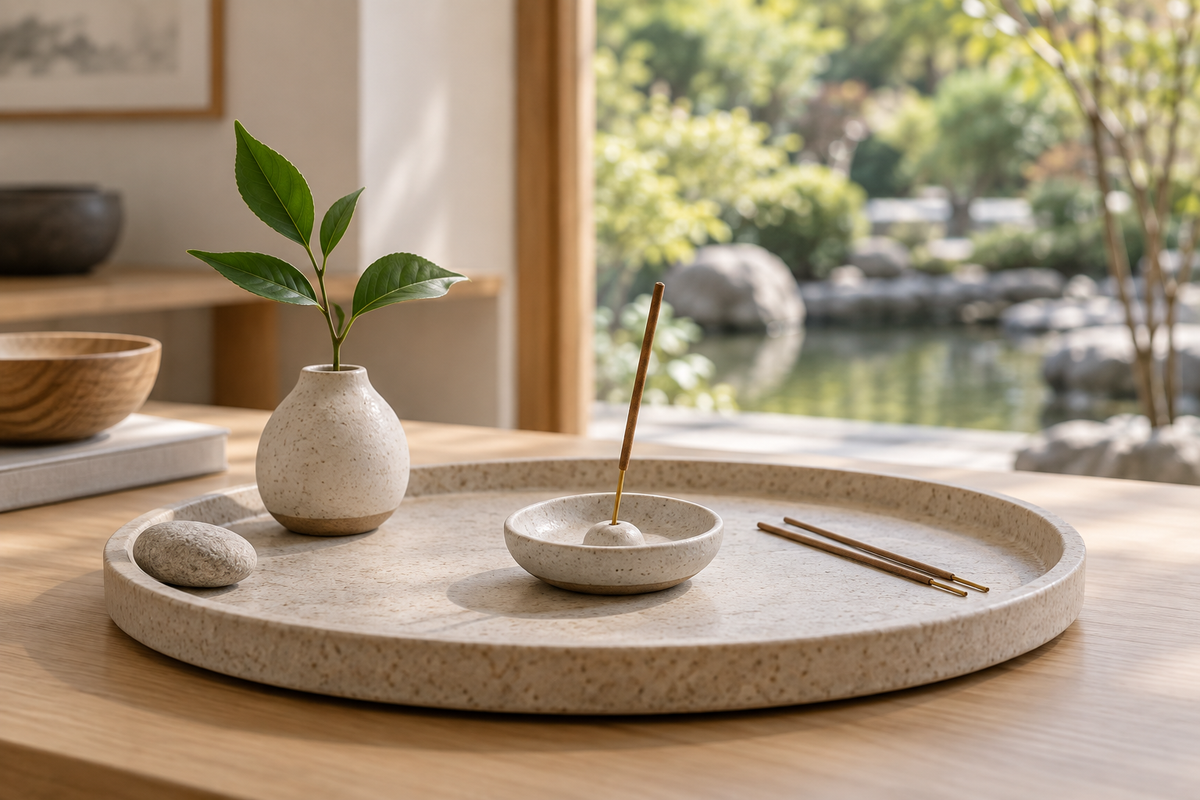
The incense holder must hold the product and collect the ashes. Place it on a stable surface, adapted to heat, away from curtains, paper, and flammable objects. Respect the instructions of the holder and those of the incense.
Stay present during use and check the complete extinction before leaving or going to bed. A material advertised as treated against fire does not transform a piece of furniture into a universal burner. Do not move a hot holder and wait for it to cool before maintenance.
Air out after use, making sure not to create a draft that disperses embers during combustion. The completely cooled incense and ashes are stored or disposed of according to their instructions.
How to compare two references without multiplying purchases?
Establish a short sheet: advertised fragrance, format, number of pieces, indicative duration, necessary holder, and packaging price. Start with a small quantity when possible. A large box is economical only if the fragrance and the format suit you.
Evaluate separately the scent during use and the smell that remains afterwards. Do not burn several references together to compare them: you lose the guidelines and increase emissions. Your preference can also change according to the season and the ventilation of the home.
A persistent smell in the house requires another approach
If you are looking for an incense to mask a sewer, humidity, or burning smell, first identify its origin. Perfuming the room can delay the detection of the problem. A siphon, a leak, or a damp material requires an appropriate intervention.
Also read:
- How to eliminate a sewer smell in the house, step by step?
- Septic tank and bad smells: the maintenance points to check
To know the content of a box and check its availability, contact the Aquiflor team. The right choice remains that whose fragrance, accessories, and conditions of use truly correspond to your home.