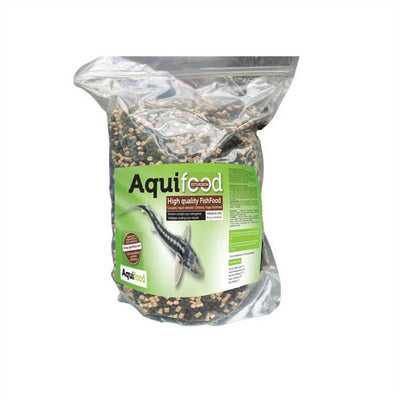
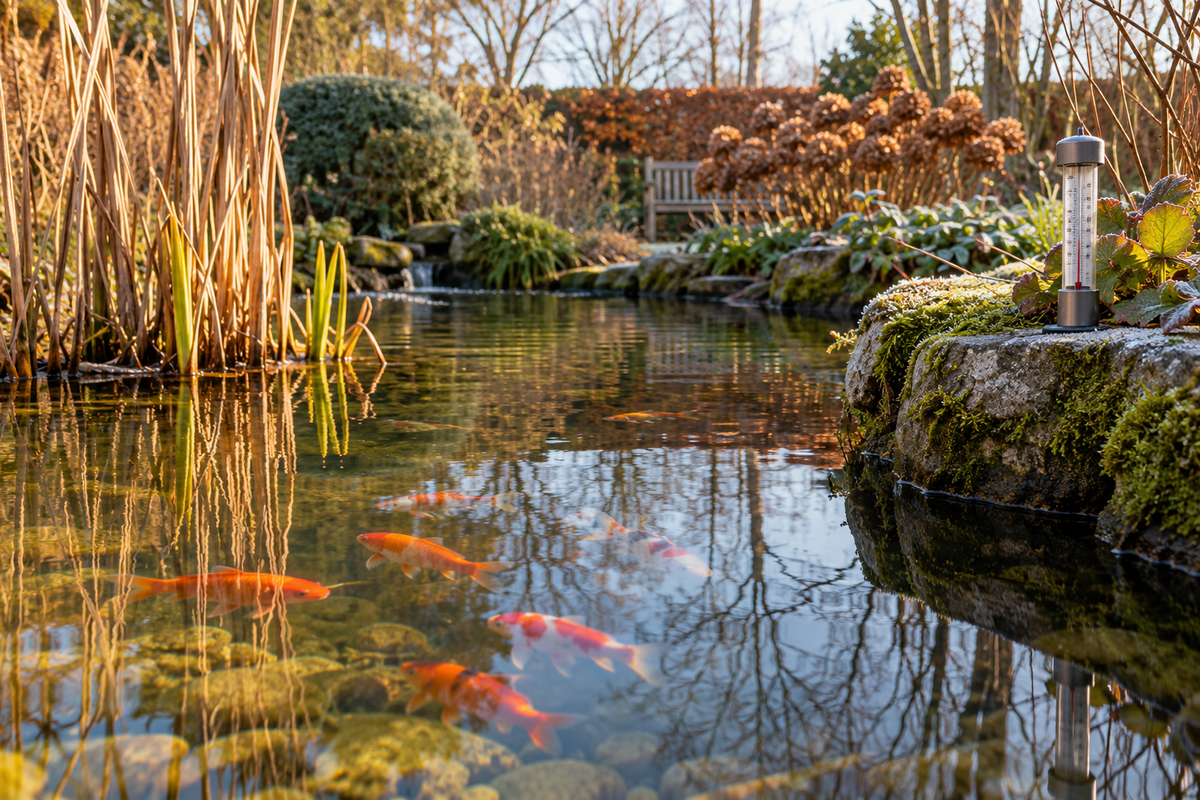
Food suitable for a pond sturgeon should be sinking, formulated for sturgeons, and easy to grab with its mouth located under the head. Pellet size and actual access to the ration count as much as the composition.
Quality food is useless if koi eat it before the sturgeon. The choice of food must therefore be accompanied by a distribution method and water monitoring, in summer as in winter.

Why specific food?
Not all pond fish foods meet the same needs. The OATA lists the sturgeon among the fish requiring sinking food with an appropriate protein and fat content.
Read also:
Floating food for koi is therefore not the default choice to offer it. Even if a sturgeon seems to be trying to reach pellets on the surface, this observation does not prove that it is receiving an appropriate ration.
Look for food that clearly states its use for sturgeons. Compare its composition, pellet size, and the manufacturer's recommendations rather than solely selecting the highest protein level.
The size and species of your fish remain important. The needs of a small growing fish and those of a large individual that has been established for several years are not reduced to the same daily handful.
Choosing the pellet size
The pellet must be able to be grabbed and swallowed without difficulty. A size that is too large may be ignored; particles that are too small become harder to track and can disperse on the bottom.
In the Aquifood range offered on Aquishop, the indications allow for an initial selection:
| Food | Pellet size | Product sheet indication |
|---|---|---|
| Aquifood Sturgeon 1 550 g | 3 mm | Sturgeons up to 25 cm. |
| Aquifood Sturgeon 5 kg | 6 mm | Sturgeons over 25 cm. |
These range guidelines do not preclude observing the feeding. When changing sizes, check that the fish actually grabs the new pellets and that they are not left abandoned.
If you do not know the size or species of your sturgeon, prepare a photo and a length estimate before asking for advice. Avoid capturing it solely to get a measurement to the nearest centimeter.
What Aquifood Sturgeon foods offer
The two references mentioned are sinking foods. Their product sheets indicate 38% crude protein and 12% fat. Aquiflor presents this range as food intended for pond sturgeons throughout the year.

The packaging must match your consumption. A large bucket is only interesting if you can use its contents under good conditions of freshness and storage.
Keep the label: it allows you to find the composition, instructions, and batch information. The recommendations of the received packaging take precedence for its use.
How to check that the sturgeon is really eating?
Choose an open area where you can observe the bottom. Distribute a small amount, then watch the fish search for and take the pellets.
The disappearance of the food is not enough if other fish are nearby. Take the time to identify who is consuming it. A sturgeon can remain underfed in a pond where all the food seems to disappear quickly.
A routine at a regular place makes monitoring easier. Note the changes: time before the fish arrives, interest in the food, remaining quantity, or visible change in its silhouette.
When the bottom is difficult to see, first improve the observation conditions and the distribution method. Adding more food "just in case" can mostly increase waste.
Limiting competition from koi
Aquiflor advises distributing the koi food on the other side of the pond to give the sturgeon time. The goal is to separate the feeding areas and monitor everyone's consumption.
A clean tube can also guide the sinking pellets to a specific area of the bottom, as described by Aquiflor. Use a suitable accessory, without sharp edges, handled without hitting the fish or the liner.
This method facilitates delivery; it does not guarantee that the koi will leave the ration intact once at the bottom. Stay present during feeding and adjust the organization if necessary.
Do not compensate for competition by systematically doubling the ration. A more targeted distribution is often more useful than an overall increase.
What quantity to distribute?
There is no single identical dose for all sturgeons. Size, species, activity, temperature, the condition of the fish, and the pond's capacity to process waste come into play.
Start with the manufacturer's indications and the advice adapted to your fish. Measuring the ration with a small scale allows you to track adjustments more precisely than a variable handful.
Distribute so you can observe the consumption. If pellets remain on the bottom, remove the accessible leftovers and look for why they were not eaten: excessive quantity, competition, unsuitable food, or water problem.
Very young fish require special monitoring. Ask the seller for a feeding program corresponding to the species and size, rather than applying without adaptation a routine intended for a large sturgeon.
Should the sturgeon be fed in winter?
Yes, its feeding must continue to be monitored during the winter. The OATA explicitly distinguishes sturgeons from the fish for which feeding can be stopped when the water gets cold.
Read also: When to stop feeding pond fish in autumn?
Adapt the quantities to the feeding and the conditions of the pond. "Feeding all year round" does not mean automatically maintaining the summer ration.
Monitor the water quality when the filtration activity changes. An unconsumed ration continues to produce waste, even if the water is cold and seems clear.
If the pond freezes, maintain a gas exchange area with a suitable and monitored device. Do not strike the ice to create an opening. Access to food and oxygenation must remain thought together.
In summer, oxygen remains a priority
Warm water contains less oxygen at saturation than cold water. Feeding must take into account the activity of the fish and the oxygenation conditions.
Control the operation of the aeration and circulation. An air pump must be sized according to the pond and its depth; an example of a kit like the AquaOxy 1000 does not constitute a valid recommendation for all sturgeon ponds.
If the fish breathes abnormally, shows unusual swimming, or suddenly refuses food, check the water and look for the cause. Do not insist with repeated distributions in a situation of distress.
A refusal of food deserves a complete observation
Record the temperature, the available analysis results, and recent changes: new food, arrival of fish, maintenance, treatment, or equipment failure.
Check especially ammonia and nitrites with suitable tests. Clear water can present a problem that is not visible to the naked eye.
Weight loss, lesions, or persistent refusal require professional, even veterinary, advice. Enriched food does not replace the identification of a health or environmental problem.
Storing food to keep a healthy ration
Store the closed packaging in a dry, cool place protected from light. Use a clean and dry measure; avoid putting back into the bucket pellets that have touched the water.
Respect the date and the manufacturer's instructions. If the food becomes damp, moldy, or presents an abnormal odor, do not distribute it.
Keep a small quantity accessible for meals and preserve the rest of the openings unnecessarily, if the packaging and its instructions allow it. A simple monitoring of the opening date helps to organize the next purchases.
Choosing the suitable Aquifood format
First compare the size of the fish and the pellets, then choose a packaging consistent with your consumption.
See Aquifood Sturgeon in 3 mm →
See Aquifood Sturgeon in 6 mm →
Sources
- OATA — Pond fish care: specific food, sinking pellets, and winter feeding of the sturgeon.
- Aquiflor — Advice before introducing a sturgeon: distribution and competition with koi.
- Aquiflor — Presentation of Aquifood Sturgeon: use of the range.
- USGS — Dissolved oxygen and water temperature.
- Hikari — Frequently asked questions about food: principles of food preservation.
- Aquishop product sheets for Aquifood Sturgeon 3 mm and 6 mm linked in the article.