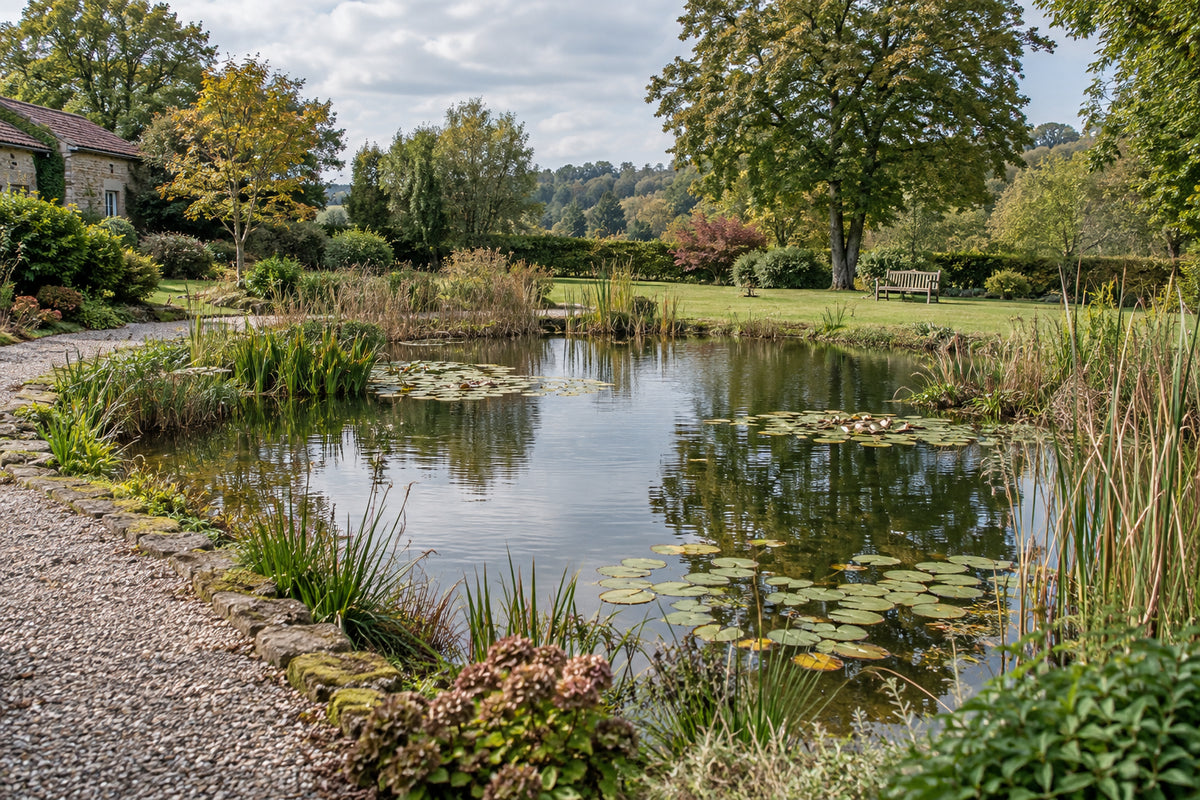
Nautex is a natural coccolithic chalk, composed mainly of calcium carbonate (CaCO₃). When spread in a pond, it strengthens the water's buffering capacity, which helps stabilize the pH, and supports the breakdown of organic matter at the bottom. It is mainly used in natural ponds and bodies of water, at the beginning of the season, after a water analysis.
What is Nautex?
Nautex, also known as coccolithic chalk or Champagne chalk, is a sedimentary mineral formed from the microscopic skeletons of fossilized marine algae. It is mainly composed of natural calcium carbonate. It has long been used in fish farming and in fishing ponds.
What does it do in a pond?
- It strengthens the buffering capacity. Calcium carbonate provides alkalinity (KH). Better-buffered water experiences fewer pH fluctuations between day and night.
- It supports the breakdown of organic sludge. Buffered water promotes the activity of aerobic microorganisms that decompose deposits. The result depends on oxygenation, temperature, and the amount of matter present.
- It supports the overall balance. In an acidic or mineral-poor pond, it helps restore conditions that are more favorable for plants and fish.
Read also:
- Copper sulfate in a pond: what risks before any treatment?
- Algae in a natural pond without a filter: what to do?
It is not a miracle treatment: it does not replace the removal of leaves, sufficient aeration, or appropriate filtration in a fish pond.
When and how to use it?
- Analyze the water first. Measure at least the pH and KH. If the water is already hard and alkaline, adding more is not useful.
- Spread at the beginning of the season, before the water exceeds 20°C, when biological activity restarts.
- Distribute over the entire surface, focusing on areas where sludge accumulates. A spreading shovel makes the job easier.
- Follow the manufacturer's dosage according to the surface area and depth, then check the pH and KH again a few weeks later.
The water may become slightly cloudy just after spreading: the chalk then gradually settles.
Which packaging should you choose?
Nautex is available in several sizes depending on the surface area to be treated: 5 kg bucket, 10 kg bucket, 25 kg bag, or Aquipond Nautex.
For more information: Green water in the pond: what to do, and in what order?
Frequently Asked Questions
Is Nautex harmful to fish?
It is a natural mineral used in fish farming. Follow the manufacturer's dosage and check the pH and KH before and after adding it.
When should Nautex be added to a pond?
At the beginning of the season, before the water exceeds 20°C, after an analysis shows a need for more buffering capacity.
Does Nautex remove sludge?
It supports the breakdown of the organic part of the sludge, but does not remove sand or soil. Removing leaves and maintaining good oxygenation remain necessary.
Is it suitable for a small ornamental pond?
It is mainly intended for natural ponds and bodies of water. For a filtered koi pond, a KH corrector dosed after analysis is often easier to manage.